
Catalogue Search | MBRL


Are you sure you want to remove the book from the shelf?

{{itemTitle}}
3
result(s) for
"National characteristics, Mexican, in art-History-20th century"
Sort by:

Mexico, nation in transit : contemporary representations of Mexican migration to the United States
\"This book argues for a deterritorialized notion of Mexican national, regional, and local identities by analyzing the representations of migration within Mexican and Mexican American literature, film, and music from the last twenty years\"--Provided by publisher.
Book

Resurrecting Tenochtitlan
How Mexican artists and intellectuals created a new
identity for modern Mexico City through its ties to Aztec
Tenochtitlan. After archaeologists rediscovered a corner
of the Templo Mayor in 1914, artists, intellectuals, and government
officials attempted to revive Tenochtitlan as an instrument for
reassessing Mexican national identity in the wake of the Revolution
of 1910. What followed was a conceptual excavation of the original
Mexica capital in relation to the transforming urban landscape of
modern Mexico City.
Revolutionary-era scholars took a renewed interest in sixteenth
century maps as they recognized an intersection between
Tenochtitlan and the foundation of a Spanish colonial settlement
directly over it. Meanwhile, Mexico City developed with modern
roads and expanded civic areas as agents of nationalism promoted
concepts like indigenismo, the embrace of Indigenous
cultural expressions. The promotion of artworks and new
architectural projects such as Diego Rivera's Anahuacalli Museum
helped to make real the notion of a modern Tenochtitlan. Employing
archival materials, newspaper reports, and art criticism from 1914
to 1964, Resurrecting Tenochtitlan connects art history
with urban studies to reveal the construction of a complex physical
and cultural layout for Mexico's modern capital.
eBook
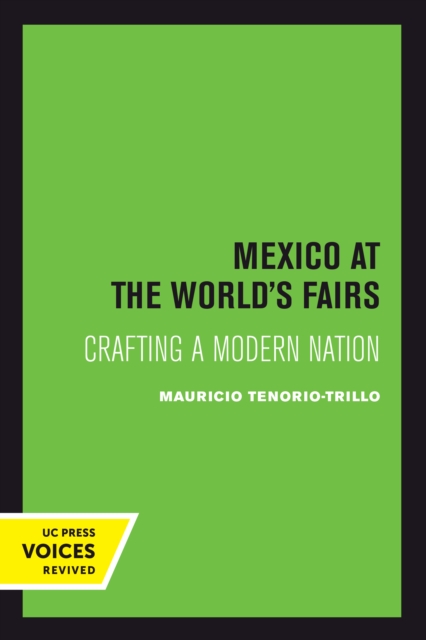
Mexico at the World's Fairs
This intriguing study of Mexico's participation in world's fairs
from 1889 to 1929 explores Mexico's self-presentation at these
fairs as a reflection of the country's drive toward nationalization
and a modernized image. Mauricio Tenorio-Trillo contrasts Mexico's
presence at the 1889 Paris fair-where its display was the largest
and most expensive Mexico has ever mounted-with Mexico's presence
after the 1910 Mexican Revolution at fairs in Rio de Janeiro in
1922 and Seville in 1929. Rather than seeing the revolution as a
sharp break, Tenorio-Trillo points to important continuities
between the pre- and post-revolution periods. He also discusses
how, internationally, the character of world's fairs was radically
transformed during this time, from the Eiffel Tower prototype,
encapsulating a wondrous symbolic universe, to the Disneyland model
of commodified entertainment. Drawing on cultural, intellectual,
urban, literary, social, and art histories, Tenorio-Trillo's
thorough and imaginative study presents a broad cultural history of
Mexico from 1880 to 1930, set within the context of the origins of
Western nationalism, cosmopolitanism, and modernism. This title is
part of UC Press's Voices Revived program, which
commemorates University of California Press's mission to seek out
and cultivate the brightest minds and give them voice, reach, and
impact. Drawing on a backlist dating to 1893, Voices
Revived makes high-quality, peer-reviewed scholarship
accessible once again using print-on-demand technology. This title
was originally published in 1997.
eBook