
Catalogue Search | MBRL


Are you sure you want to remove the book from the shelf?

{{itemTitle}}
15
result(s) for
"National health insurance-Law and legislation-United States"
Sort by:

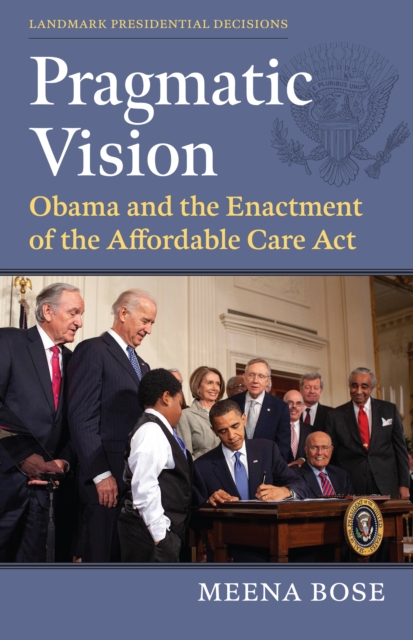
Pragmatic Vision
On March 23, 2010, President Barack Obama signed the Patient
Protection and Affordable Care Act into law, providing every
American with the opportunity to have guaranteed health care
coverage. The Affordable Care Act-frequently referred to as
Obamacare-is almost synonymous with Obama's presidential legacy and
reflects a series of key decisions that he made beginning before he
took office. As Meena Bose shows, it was Obama's particular brand
of pragmatic politics that ultimately shaped the passage of the
Affordable Care Act and made a lasting mark on health care reform
in the United States.
Pragmatic Vision examines eight of Obama's decisions
that resulted in the landmark enactment of health care reform,
starting with his commitment to health care reform in the 2008
presidential campaign and concluding with his decision to allow for
flexibility with its implementation, following technical hurdles
and Supreme Court rulings. Bose shows that Obama's steadfast
commitment to the issue was crucial to its passing, especially
after the Democrats lost their filibuster-proof majority in the
Senate. Obama's direct engagement built key political support for
the legislation and was aided by the senior White House staff and
Democratic leaders in Congress who skillfully navigated the bill to
passage just fourteen months after Obama took office.
The story of Obama's leadership in enacting the Affordable Care
Act is a tale of today's partisan divide and the polarization of
Congress. The legislation passed on a party-line vote and continued
to divide politicians long after its passage. Nevertheless, despite
repeated efforts by Republicans to repeal the law, it is more
popular today than ever and seems destined to remain in force until
the next stage of reform. Pragmatic Vision is an
authoritative guide to this singular achievement of the Obama
administration.
eBook


The tough luck constitution and the assault on health care reform
Chief Justice John Roberts stunned the nation by upholding the Affordable Care Act--more commonly known as Obamacare. In The Tough Luck Constitution and the Assault on Health Care Reform, Andrew Koppelman explains how the Court's conservatives embraced the arguments of a fringe libertarian legal movement bent on eviscerating the modern social welfare state. They instead advocate what Koppelman calls a \"tough luck\" philosophy: if you fall on hard times, too bad for you. He argues that the rule they proposed--that the government can't make citizens buy things--has nothing to do with the Constitution, and that it is in fact useless to stop real abuses of power. He goes on to dismantle the high court's construction of the commerce clause, arguing that it almost crippled America's ability to reverse rising health-care costs and shrinking access. Ranging from early constitutional history to potential consequences, this is the definitive postmortem of the landmark Obamacare case.
eBook

Life Is Filled with Swift Transitions
Finally, a book that an attorney may pick-up and thumb through the table of contents to find direction to help her figure out how to navigate the unchartered waters associated with long-term care No matter what practice area an attorney may be in, because they are a trusted member of a person's network they will be asked for advice on how to.
eBook

The health care case : the Supreme Court's decision and its implications
The Supreme Court’s decision in the Health Care Case, NFIB v. Sebelius, gripped the nation’s attention during the spring of 2012. Like the legislative battle leading to adoption of the Affordable Care Act (ACA or “Obamacare”), the litigation took many unexpected twists and turns. No one could have predicted the strange coalition of justices and arguments that would eventually lead the Court to uphold the Act’s principal provisions. The constitutional case against the ACA was originally written off as frivolous, but after oral argument at the Court, many predicted that the unthinkable had now become likely. When the Supreme Court delivered its complicated and fractured decision, it offered new interpretations to four different clauses in the Constitution. Early commentary viewed the decision as a victory for President Obama’s signature legislative achievement, even if five members of the Court agreed with several of the arguments advanced by the law’s detractors. Others focused on what the decision meant for the Roberts Court as an institution and for long-run debates over constitutional interpretation. This volume gathers together reactions to the decision from an ideologically diverse selection of the nation’s leading scholars of constitutional, administrative, and health law.
eBook

Fighting for our health : the epic battle to make health care a right in the United States
This first-person account brings readers inside the biggest and most consequential issue campaign in American history. Fighting for Our Health recounts how a reform campaign led by grassroots organizers played a crucial role in President Obama's signing historic health reform legislation in March of 2010—defeating the tea partiers, Republican Party, health insurance industry, and the US Chamber of Commerce. The action takes place inside the Beltway—the White House, Congressional anterooms, and the streets of DC—and at hundreds of town meetings, demonstrations, and confrontations in places like Danville, Virginia and Lincoln, Nebraska. The book describes the tense relationship between progressives and the Obama administration, as the President and his team both pushed for reform and made repeated concessions to the health care industry, while trying to squelch any pressure from the left. Most powerfully, it is the story of the triumph of thousands of people who had seen loved ones die, families go bankrupt, small businesses ruined, and futures destroyed by the health insurance system in the United States. The book is accessible to undergraduate and graduate students as well as the general reader. Detailed enough to interest people primarily concerned about health care policy and politics, it will also capture readers generally interested in US political dynamics and the health of American democracy.
eBook

HIV and the blood supply : an analysis of crisis decisionmaking
During the early years of the AIDS epidemic, thousands of Americans became infected with HIV through the nation's blood supply.Because little reliable information existed at the time AIDS first began showing up in hemophiliacs and in others who had received transfusions, experts disagreed about whether blood and blood products could transmit.
eBook

Differential Diagnoses
Although the United States spends 16 percent of its gross domestic product on health care, more than 46 million people have no insurance coverage, while one in four Americans report difficulty paying for medical care. Indeed, the U.S. health care system, despite being the most expensive health care system in the world, ranked thirty-seventh in a comprehensive World Health Organization report. With health care spending only expected to increase, Americans are again debating new ideas for expanding coverage and cutting costs. According to the historian Paul V. Dutton, Americans should look to France, whose health care system captured the World Health Organization's number-one spot.
InDifferential Diagnoses, Dutton debunks a common misconception among Americans that European health care systems are essentially similar to each other and vastly different from U.S. health care. In fact, the Americans and the French both distrust \"socialized medicine.\" Both peoples cherish patient choice, independent physicians, medical practice freedoms, and private insurers in a qualitatively different way than the Canadians, the British, and many others. The United States and France have struggled with the same ideals of liberty and equality, but one country followed a path that led to universal health insurance; the other embraced private insurers and has only guaranteed coverage for the elderly and the very poor.
How has France reconciled the competing ideals of individual liberty and social equality to assure universal coverage while protecting patient and practitioner freedoms? What can Americans learn from the French experience, and what can the French learn from the U.S. example?Differential Diagnosesanswers these questions by comparing how employers, labor unions, insurers, political groups, the state, and medical professionals have shaped their nations' health care systems from the early years of the twentieth century to the present day.
eBook

Dead on arrival
Why, alone among industrial democracies, does the United States not have national health insurance? While many books have addressed this question, Dead on Arrival is the first to do so based on original archival research for the full sweep of the twentieth century. Drawing on a wide range of political, reform, business, and labor records, Colin Gordon traces a complex and interwoven story of political failure and private response. He examines, in turn, the emergence of private, work-based benefits; the uniquely American pursuit of social insurance; the influence of race and gender on the health care debate; and the ongoing confrontation between reformers and powerful economic and health interests.Dead on Arrival stands alone in accounting for the failure of national or universal health policy from the early twentieth century to the present. As importantly, it also suggests how various interests (doctors, hospitals, patients, workers, employers, labor unions, medical reformers, and political parties) confronted the question of health care - as a private responsibility, as a job-based benefit, as a political obligation, and as a fundamental right.Using health care as a window onto the logic of American politics and American social provision, Gordon both deepens and informs the contemporary debate. Fluidly written and deftly argued, Dead on Arrival is thus not only a compelling history of the health care quandary but a fascinating exploration of the country's political economy and political culture through the American century, of the role of private interests and private benefits in the shaping of social policy, and, ultimately, of the ways the American welfare state empowers but also imprisons its citizens.
eBook