
Catalogue Search | MBRL


Are you sure you want to remove the book from the shelf?

{{itemTitle}}
1,232
result(s) for
"National parks and reserves -- History"
Sort by:


Crimes against nature
Crimes against Nature reveals the hidden history behind three of the nation's first parklands: the Adirondacks, Yellowstone, and the Grand Canyon. Focusing on conservation's impact on local inhabitants, Karl Jacoby traces the effect of criminalizing such traditional practices as hunting, fishing, foraging, and timber cutting in the newly created parks. Jacoby reassesses the nature of these \"crimes\" and provides a rich portrait of rural people and their relationship with the natural world in the late nineteenth and early twentieth centuries.
eBook


Pilgrimage to the National Parks
National Parks - 'America's Best Idea' - were from the first seen as sacred sites embodying the God-given specialness of American people and American land, and from the first they were also marked as tourist attractions. The inherent tensions between these two realities ensured the parks would be stages where the country's conflicting values would be performed and contested. As pilgrimage sites embody the values and beliefs of those who are drawn to them, so Americans could travel to these sacred places to honor, experience, and be restored by the powers that had created the American land and the American enterprise.
This book explores the importance of the discourse of nature in American culture, arguing that the attributes and symbolic power that had first been associated with the 'new world' and then the 'frontier' were embodied in the National Parks. Author Ross-Bryant focuses on National Parks as pilgrimage sites around which a discourse of nature developed and argues the centrality of religion in understanding the dynamics of both the language and the ritual manifestations related to National Parks. Beyond the specific contribution to a richer analysis of the National Parks and their role in understanding nature and religion in the U.S., this volume contributes to the emerging field of 'religion and the environment,' larger issues in the study of religion (e.g. cultural events and the spatial element in meaning-making), and the study of non-institutional religion.
eBook


Civilizing Nature
National parks are one of the most important and successful institutions in global environmentalism. Since their first designation in the United States in the 1860s and 1870s they have become a global phenomenon. The development of these ecological and political systems cannot be understood as a simple reaction to mounting environmental problems, nor can it be explained by the spread of environmental sensibilities. Shifting the focus from the usual emphasis on national parks in the United States, this volume adopts an historical and transnational perspective on the global geography of protected areas and its changes over time. It focuses especially on the actors, networks, mechanisms, arenas, and institutions responsible for the global spread of the national park and the associated utilization and mobilization of asymmetrical relationships of power and knowledge, contributing to scholarly discussions of globalization and the emergence of global environmental institutions and governance.
eBook

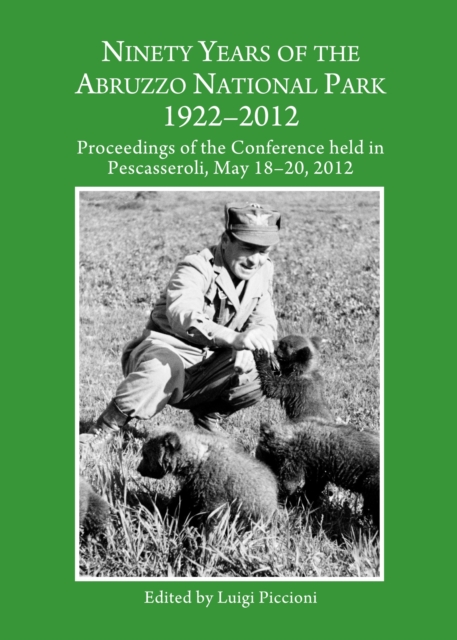
Ninety Years of the Abruzzo National Park 1922-2012
On September 9th, 2012, the Abruzzo National Park - now Abruzzo, Latium and Molise National Park - celebrated its ninetieth birthday. It is - along with the Gran Paradiso National Park - the oldest protected area in Italy and one of the oldest in Europe. The colloquium held in Pescasseroli in May 2012, on which this volume is based, reconstructed the highlights of the Parks troubled but always influential history and took stock of its connections with the other protected areas, with Italian.
eBook

A place called Yellowstone : the epic history of the world's first national park
\"It has been called Wonderland, America's Serengeti, the crown jewel of the National Park System, and America's best idea. But how did this faraway landscape evolve into one of the most recognizable places in the world? As the birthplace of the national park system, Yellowstone witnessed the first-ever attempt to protect wildlife, to restore endangered species, and to develop a new industry centered on nature tourism. Yellowstone remains a national icon, one of the few entities capable of bridging ideological divides in the United States. Yet the park's history is also filled with episodes of conflict and exclusion, setting precedents for Native American land dispossession, land rights disputes, and prolonged tensions between commercialism and environmental conservation. Yellowstone's legacies are both celebratory and problematic. A Place Called Yellowstone tells the comprehensive story of Yellowstone as the story of the nation itself\"-- Provided by publisher.
BOOK

Museums, Monuments, and National Parks
The rapid expansion of the field of public history since the 1970s has led many to believe that it is a relatively new profession. In this book, Denise D. Meringolo shows that the roots of public history actually reach back to the nineteenth century, when the federal government entered into the work of collecting and preserving the nation’s natural and cultural resources. Scientists conducting research and gathering specimens became key figures in a broader effort to protect and interpret the nation’s landscape. Their collaboration with entrepreneurs, academics, curators, and bureaucrats alike helped pave the way for other governmental initiatives, from the Smithsonian Institution to the parks and monuments today managed by the National Park Service. All of these developments included interpretive activities that shaped public understanding of the past. Yet it was not until the emergence of the educationoriented National Park Service history program in the 1920s and 1930s that public history found an institutional home that grounded professional practice simultaneously in the values of the emerging discipline and in government service. Even thereafter, tensions between administrators in Washington and practitioners on the ground at National Parks, monuments, and museums continued to define and redefine the scope and substance of the field. The process of definition persists to this day, according to Meringolo, as public historians establish a growing presence in major universities throughout the United States and abroad.
eBook