
Catalogue Search | MBRL


Are you sure you want to remove the book from the shelf?

{{itemTitle}}
572
result(s) for
"National parks and reserves -- United States -- History"
Sort by:


Crimes against nature
Crimes against Nature reveals the hidden history behind three of the nation's first parklands: the Adirondacks, Yellowstone, and the Grand Canyon. Focusing on conservation's impact on local inhabitants, Karl Jacoby traces the effect of criminalizing such traditional practices as hunting, fishing, foraging, and timber cutting in the newly created parks. Jacoby reassesses the nature of these \"crimes\" and provides a rich portrait of rural people and their relationship with the natural world in the late nineteenth and early twentieth centuries.
eBook


Reshaping our national parks and their guardians : the legacy of George B. Hartzog Jr
This biography of the seventh director of the National Park Service brings to life one of the most colorful, powerful, and politically astute people to hold this position. George B. Hartzog Jr. served during an exciting and volatile era in American history. Appointed in 1964 by Secretary of the Interior Stewart Udall, he benefited from a rare combination of circumstances that favored his vision, which was congenial with both President Lyndon Johnson's \"Great Society\" and Udall's robust environmentalism.
Hartzog led the largest expansion of the National Park System in history and developed social programs that gave the Service new complexion. During his nine-year tenure, the system grew by seventy-two units totaling 2.7 million acres including not just national parks, but historical and archaeological monuments and sites, recreation areas, seashores, riverways, memorials, and cultural units celebrating minority experiences in America. In addition, Hartzog sought to make national parks relevant and responsive to the nation's changing needs.
eBook

A place called Yellowstone : the epic history of the world's first national park
\"It has been called Wonderland, America's Serengeti, the crown jewel of the National Park System, and America's best idea. But how did this faraway landscape evolve into one of the most recognizable places in the world? As the birthplace of the national park system, Yellowstone witnessed the first-ever attempt to protect wildlife, to restore endangered species, and to develop a new industry centered on nature tourism. Yellowstone remains a national icon, one of the few entities capable of bridging ideological divides in the United States. Yet the park's history is also filled with episodes of conflict and exclusion, setting precedents for Native American land dispossession, land rights disputes, and prolonged tensions between commercialism and environmental conservation. Yellowstone's legacies are both celebratory and problematic. A Place Called Yellowstone tells the comprehensive story of Yellowstone as the story of the nation itself\"-- Provided by publisher.
BOOK

Museums, Monuments, and National Parks
The rapid expansion of the field of public history since the 1970s has led many to believe that it is a relatively new profession. In this book, Denise D. Meringolo shows that the roots of public history actually reach back to the nineteenth century, when the federal government entered into the work of collecting and preserving the nation’s natural and cultural resources. Scientists conducting research and gathering specimens became key figures in a broader effort to protect and interpret the nation’s landscape. Their collaboration with entrepreneurs, academics, curators, and bureaucrats alike helped pave the way for other governmental initiatives, from the Smithsonian Institution to the parks and monuments today managed by the National Park Service. All of these developments included interpretive activities that shaped public understanding of the past. Yet it was not until the emergence of the educationoriented National Park Service history program in the 1920s and 1930s that public history found an institutional home that grounded professional practice simultaneously in the values of the emerging discipline and in government service. Even thereafter, tensions between administrators in Washington and practitioners on the ground at National Parks, monuments, and museums continued to define and redefine the scope and substance of the field. The process of definition persists to this day, according to Meringolo, as public historians establish a growing presence in major universities throughout the United States and abroad.
eBook


Natural Museums
In 1872, the world's first national park was founded at Yellowstone.Although ideas of nature conservation were not embraced generally by the American public, five more parks were created before the turn of the century.
eBook

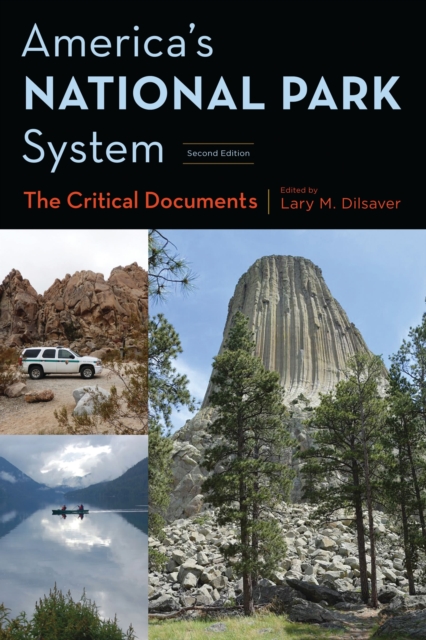
America's National Park System
Now in a fully updated edition, this invaluable reference work is a fundamental resource for scholars, students, conservationists, and citizens interested in America's national park system. The extensive collection of documents illustrates the system's creation, development, and management. The documents include laws that established and shaped the system; policy statements on park management; Park Service self-evaluations; and outside studies by a range of scientists, conservation organizations, private groups, and businesses. A new appendix includes summaries of pivotal court cases that have further interpreted the Park Service mission.
eBook