
Catalogue Search | MBRL


Are you sure you want to remove the book from the shelf?

{{itemTitle}}
8,093
result(s) for
"National security -- China"
Sort by:

Routledge handbook of Chinese security
Located in the center of Asia with one of the largest land frontiers in the world and 14 neighbors whose dispositions could not easily be predicted, China has long been obsessed with security. In this handbook, an internationally renowned team of contributors provide a comprehensive and systematic analysis of contemporary thinking about Chinese national security. Chapters cover the PRC's historical, ideological and doctrinal heritage related to security, its security arrangements and policies targeting key regions and nations of the world, the security aspects of the PRC's ground, air, sea, space and cyber forces, as well as the changing and expanding definition and scope of China's security theory and practice.
Book

PLA influence on China's national security policymaking
No detailed description available for \"PLA Influence on China's National Security Policymaking\".
eBook


Major Law and Policy Issues in the South China Sea
Major law and policy issues in the South China Sea are discussed mainly from the perspectives of leading American and European scholars in the study of the complex South China Sea disputes. The issues include regional maritime cooperation and regime building, Southeast Asian countries' responses to the Chinese assertiveness, China's historic claims, maritime boundary delimitation and excessive maritime claims, military activities and the law of the sea, freedom of navigation and its impact on the problem, the dispute between Vietnam and China, confidence-building measures and U.S.-Taiwan-China relations in the South China Sea, and Taiwan's role in the resolution to the South China Sea issues. Over the past three years, there have been several incidents in the South China Sea between the claimants, and also between the claimants and non-claimants over fisheries, collection of seismic data, exploration for oil and gas resources, and exercise of freedom of navigation. Third party concerns and involvement in the South China Sea disputes have been increasing as manifested in actions taken by the United States, India, and Japan. It is therefore important to examine South China Sea disputes from the legal and political perspective and from the view point of American and European experts who have been studying South China Sea issues for many years.
eBook


Chinese Nuclear Proliferation
While the world's attention is focused on the nuclearization of
North Korea and Iran and the nuclear brinkmanship between India and
Pakistan, China is believed to have doubled the size of its nuclear
arsenal, making it \"the forgotten nuclear power,\" as described in
Foreign Affairs . Susan Turner Haynes analyzes China's
buildup and its diversification of increasingly mobile, precise,
and sophisticated nuclear weapons. Haynes provides context and
clarity on this complex global issue through an analysis of
extensive primary source research and lends insight into questions
about why China is the only nuclear weapon state recognized under
the Nuclear Nonproliferation Treaty that continues to pursue
qualitative and quantitative advancements to its nuclear force. As
the gap between China's nuclear force and the forces of the nuclear
superpowers narrows against the expressed interest of many nuclear
and nonnuclear states, Chinese Nuclear Proliferation
offers policy prescriptions to curtail China's nuclear growth and
to assuage fears that the \"American world order\" presents a direct
threat to China's national security. Presenting technical concepts
with minimal jargon in a straightforward style, this book will be
of use to casual China watchers and military experts alike.
eBook

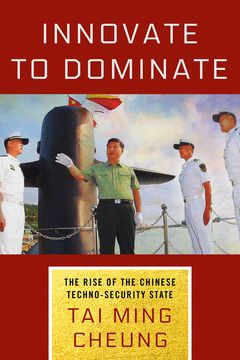
Innovate to Dominate
In Innovate to
Dominate , Tai Ming Cheung offers insight
into why, how, and whether China will overtake the United States to
become the world's preeminent technological and security
power . This examination of the means and ends of China's
quest for techno-security supremacy is required reading for anyone
looking for clues as to the long-term direction of the global
order. The techno-security domain, Cheung argues, is where national
security, innovation, and economic development converge, and it has
become the center of power and prosperity in the twenty-first
century. China's paramount leader Xi Jinping recognizes that
effectively harnessing the complex interactions among security,
innovation, and development is essential in enabling China to
compete for global dominance. Cheung offers a richly detailed
account of how China is building a potent techno-security state. In
Innovate to Dominate he takes readers from the strategic
vision guiding this transformation to the nuts-and-bolts of policy
implementation. The state-led top-down mobilizational model that
China is pursuing has been a winning formula so far, but the
sternest test is ahead as China begins to compete head-to-head with
the United States and aims to surpass its archrival by mid-century
if not sooner. Innovate to Dominate is a timely and
analytically rigorous examination of the key strategies guiding
China's transformation of its capabilities in the national,
technological, military, and security spheres and how this is
taking place. Cheung authoritatively addresses the burning
questions being asked in capitals around the world: Can China
become the dominant global techno-security power? And if so,
when?
eBook


The dragon extends its reach : Chinese military power goes global
China has evolved from a nation with local and regional security interests to a major economic and political power with global interests, investments, and political commitments. It now requires a military that can project itself around the globe, albeit on a limited scale, to secure its interests. Therefore, as Larry M. Wortzel explains, the Chinese Communist Party leadership has charged the Peoples Liberation Army (PLA) with new and challenging missions that require global capabilities. Advances in technology and the development of indigenous weapons platforms in China, combined with reactions to modern conflicts, have produced a military force very different from that which China has fielded in the past. Wortzel presents a clear and sobering picture of the PLAs modernization effort as it expands into space and cyberspace, and as it integrates operations in the traditional domains of war. This book will appeal to the specialist in security and foreign policy issues in Asia as well as to the person interested in arms control, future warfare, and global military strategies. The book puts Chinas military growth into historical context for readers of recent military and diplomatic history.
eBook