
Catalogue Search | MBRL


Are you sure you want to remove the book from the shelf?

{{itemTitle}}
2,119
result(s) for
"National security India"
Sort by:


Border walls
Two decades after the fall of the Berlin Wall, why are the notable democracies of the United States, India, and Israel building massive walls and fences on their borders? Despite predictions of a borderless world through globalization, these three countries alone have built security barriers totaling an astonishing 5,700 kilometers in length. In this groundbreaking work, Reece Jones analyzes how these controversial walls were justified, their impact on those living behind them, and the long-term effects of the hardening of political boundaries. Border Walls is a bold, important intervention that demonstrates that the exclusion and violence necessary to secure the borders of the modern state often undermine the very ideals of freedom and democracy the barriers are meant to protect.
eBook


Shaping the Emerging World: India and the Multilateral Order
India faces a defining period. Its status as a global power is not only recognized but increasingly institutionalized, even as geopolitical shifts create both opportunities and challenges. With critical interests in almost every multilateral regime and vital stakes in emerging ones, India has no choice but to influence the evolving multilateral order. If India seeks to affect the multilateral order, how will it do so? In the past, it had little choice but to be content with rule taking-adhering to existing international norms and institutions. Will it now focus on rule breaking-challenging the present order primarily for effect and seeking greater accommodation in existing institutions? Or will it focus on rule shaping-contributing in partnership with others to shape emerging norms and regimes, particularly on energy, food, climate, oceans, and cyber security? And how do India's troubled neighborhood, complex domestic politics, and limited capacity inhibit its rule-shaping ability?
Despite limitations, India increasingly has the ideas, people, and tools to shape the global order-in the words of Jawaharlal Nehru, \"not wholly or in full measure, but very substantially.\" Will India emerge as one of the shapers of the emerging international order? This volume seeks to answer that question.
eBook

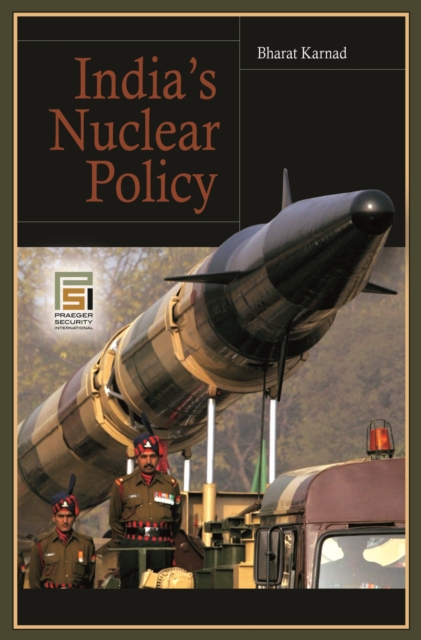
India's Nuclear Policy
This book by a leading Indian strategic thinker contains a detailed analysis of, and insights into, India's growing strategic nuclear capabilities, its flexible strategic concept of credible minimum deterrence and its thinking about limited war. This book examines the Indian nuclear policy, doctrine, strategy and posture, clarifying the elastic concept of credible minimum deterrence at the center of the country's approach to nuclear security. This concept, Karnad demonstrates, permits the Indian nuclear forces to be beefed up, size and quality-wise, and to acquire strategic reach and clout, even as the qualifier minimum suggests an overarching concern for moderation and economical use of resources, and strengthens India's claims to be a responsible nuclear weapon state. Based on interviews with Indian political leaders, nuclear scientists, and military and civilian nuclear policy planners, it provides unique insights into the workings of India's nuclear decision-making and deterrence system. Moreover, by juxtaposing the Indian nuclear policy and thinking against the theories of nuclear war and strategic deterrence, nuclear escalation, and nuclear coercion, offers a strong theoretical grounding for the Indian approach to nuclear war and peace, nuclear deterrence and escalation, nonproliferation and disarmament, and to limited war in a nuclearized environment. It refutes the alarmist notions about a nuclear flashpoint in South Asia, etc. which derive from stereotyped analysis of India-Pakistan wars, and examines India's likely conflict scenarios involving China and, minorly, Pakistan. Testimonials Bharat Karnad has produced a very thoughtful and comprehensive book on the nuclear weapons issues of the next century, as seen from a definitely Indian perspective. While thus reflecting the national interests and national outlook of a citizen of India, Karnad at the same time draws in a wealth of the past fifty years-foreign literature and foreign perspectives on nuclear deterrence, far beyond what all but the very most involved Indian analysts will have ever read or contemplated, and indeed far beyond what almost all foreigners will have thought through. For someone trying to master the issues of nuclear deterrence, the footnote citations in this book by themselves would amount to a goldmine of the relevant literature. -George H. Quester, Professor of Government and Politics, University of Maryland
eBook

Constructing National Security
Jarrod Hayes explores why democracies tend not to use military force against each other. He argues that democratic identity - the shared understanding within democracies of who 'we' are and what 'we' expect from each other - makes it difficult for political leaders to construct external democracies as threats. At the same time, he finds that democratic identity enables political actors to construct external non-democracies as threats. To explore his argument, he looks at US relations with two rising powers: India and China. Through his argument and case studies, Professor Hayes addresses not just the democratic peace but also the larger processes of threat construction in international security, the role of domestic institutions in international relations, and the possibility for conflict between the United States and the world's two most populous countries.
eBook

Ascending India and its state capacity : extraction, violence, and legitimacy
India's ascent as a formidable power on the world stage and its geopolitical ramifications have received much attention in recent years. This comprehensive study by Sumit Ganguly and William Thompson, two highly distinguished scholars of political science and international relations, delves into the intricate inner workings of this great Asian nation to reveal an Indian state struggling to maintain national security, domestic order, and steady fiscal growth despite weaknesses in its economic and political institutions. The authors' sobering account questions India's perceived strengths and domestic and foreign policy initiatives, while focusing on the South Asian giant's infrastructural and economic growth problems, opposition to reform, and other important hurdles the nation has faced and will continue to face over the coming decade and beyond.-- Provided by Publisher.
Book
India's National Security
This fourteenth volume of India's National Security Annual Review intensively analyses India's national security with respect to the changing internal and external dynamics.
In the global environment, the situation is characterised by rising tensions between United States and Russia, intensified rivalry between United States (US) and China, and increasing cooperation between China and Russia. For India which seeks peaceful growth to emerge as a major power, this poses severe diplomatic challenges. This volume discusses the complexity of these challenges and the deftness with which India gets the best out of its strategic partnerships with the US and Russia while warding off the transgressions of a mighty adversary like China. It also studies the impact of internal convulsions and external intrusions on India's security from South Asian nations such as Afghanistan, Bangladesh, Nepal and Sri Lanka.
Examining the field of internal security, the essays carry rare insights into the causes of expansion of Naxalite violence in tribal areas and the dynamics of conflict resolution in the Northeast, as well as India's deep concern as a growing power with its economic slowdown in the recent past, and energy and cyber security.
Bringing together contributions from eminent scholars and diplomats, the volume will be indispensable for policymakers, government think tanks, defence and strategic studies experts, as well as students and researchers of international relations, foreign policy and political science.
eBook