
Catalogue Search | MBRL


Are you sure you want to remove the book from the shelf?

{{itemTitle}}
554
result(s) for
"Nationalism Iran."
Sort by:

Psycho-nationalism : global thought, Iranian imaginations
\"States routinely and readily exploit the grey area between sentiments of national affinity and hegemonic emotions geared to nationalist aggression. In this book, Arshin Adib-Moghaddam focuses on the use of Iranian identity to offer a timely exploration into the psychological and political roots of national identity and how these are often utilised by governments from East to West. Examining this trend, both under the Shah as well as by the governments since the 1979 Iranian revolution, Adib-Moghaddam's analysis is driven by what he terms 'psycho-nationalism', a new concept derived from psychological dynamics in the making of nations. Through this, he demonstrates how nationalist ideas evolved in global history and their impact on questions of identity, statecraft and culture. Psycho-nationalism describes how a nation is made, sustained and 'sold' to its citizenry and will interest students and scholars of Iranian culture and politics, world political history, nationalism studies and political philosophy.\" -- Back cover.
Book
Imagining Iran
Thematically, this book problematizes Iranian official nationalism. It reviews how every modern Iranian regime since the constitutional revolution of the 1905-06 has failed to legitimize its official identity, resulting in the fall of five different regimes. The book details how the collapse of each regime resulted in the interruption of the official meaning of being Iranian, as well as the meanings of its enemies. What remained the same was how every Iranian regime represented itself as the agent of a particular national desire defined in terms of making Iran to become sovereign, developed, democratic, and constitutional. Nonetheless, no regime was able to convince a great majority of the people that it achieved what it represented. This book makes three specific contributions. The first contribution is pedagogical. By focusing on the dynamics of regime changes, it provides a heuristic model for identifying challenges that all Iranian regimes have faced. Moreover, the book is a comprehensive review of the disruptive, oppressive, and bloody nature of the rise and fall of different regimes. The second contribution is theoretical. Rather than examining the behavior of various Iranian regimes in isolation from their international context, the book examines how each regime got to understand itself in relations to its imperial others. By examining the governmental rationality of each regime, the book offers a better theoretical framework for understanding political development not only in Iran, but also in all other Middle Eastern and South Asian states. Finally, the third contribution of this book is its critical approach to the main body of the literature on Iran, modernity, development, democracy, and constitutionalism.
eBook

Nationalizing Iran
When Naser al-Din Shah, who ruled Iran from 1848 to 1896, claimed the title Shadow of God on Earth, his authority rested on premodern conceptions of sacred kingship. By 1941, when Mohammad Reza Shah Pahlavi came to power, his claim to authority as the Shah of Iran was infused with the language of modern nationalism. In short, between roughly 1870 and 1940, Iran's traditional monarchy was forged into a modern nation-state.
InNationalizing Iran, Afshin Marashi explores the changes that made possible this transformation of Iran into a social abstraction in which notions of state, society, and culture converged. He follows Naser al-Din Shah on a tour of Europe in 1873 that led to his importing a new public image of monarchy-an image based on the European late imperial model-relying heavily on the use of public ceremonies, rituals, and festivals to promote loyalty to the monarch. Meanwhile, Iranian intellectuals were reimagining ethnic history to reconcile \"authentic\" Iranian culture with the demands of modernity. From the reform of public education to the symbolism surrounding grand public ceremonies in honor of long-dead poets, Marashi shows how the state invented and promoted key features of the common culture binding state and society. The ideological thrust of that century would become the source of dramatic contestation in the late twentieth century.
Marashi's study of the formative era of Iranian nationalism will be valuable to scholars and students of history, sociology, political science, and anthropology, as well as journalists, policy makers, and other close observers of contemporary Iran.
eBook

Defining Iran
Defining Iran presents a new and revealing analysis of the way in which Iranian political discourses compete with each other by examining them within the framework of national identity construction. By deconstructing the intellectual roots and development of Iranian national identity, Shabnam Holliday advocates the need to study Iran's heritage and historical experience to understand key shifts and processes in contemporary Iranian politics. Holliday convincingly argues that competing discourses of national identity advocated by political figures from Musaddiq to the current administration demonstrate a politics of resistance to both internal and external forces. With a particular emphasis on Khatami’s presidency, this study compares the meanings attached by significant members of the Iranian political elite to concepts including Iran’s pre-Islamic heritage, Islamic heritage, civilization, 'democracy' and the 'West'. Furthermore, discourses of Iranian national identity exist not in isolation but rather as part of a continuous process construction and reconstruction in Iran's journey of political development; a process manifested so vividly in the revolution of 1979 and the fallout from the 2009 presidential election. Defining Iran simultaneously furthers our understanding of the conceptualization of national identity both generally and specifically in the case of Iran and political dynamics which shape contemporary Iran.
eBook

Persian kingship and architecture : strategies of power in Iran from the Achaemenids to the Pahlavis
\"Through analyses of palaces, mausolea, art, architectural decoration and urban design the authors show how architecture was appropriated by different rulers as an integral part of their strategies of legitimising power. They refer to a variety of examples, from the monuments of Persepolis under the Achamenids, the Sassanian palaces at Kish, the Safavid public squares of Isfahan, the Qajar palaces at Shiraz and to the modernisation and urban agendas of the Pahlavis.\"--Publisher's website.
Book

Frontier Fictions
InFrontier Fictions, Firoozeh Kashani-Sabet looks at the efforts of Iranians to defend, if not expand, their borders in the nineteenth and early twentieth centuries, and explores how their conceptions of national geography influenced cultural and political change. The \"frontier fictions,\" or the ways in which the Iranians viewed their often fluctuating borders and the conflicts surrounding them, played a dominant role in defining the nation. On these borderlands, new ideas of citizenship and nationality were unleashed, refining older ideas of ethnicity.
Kashani-Sabet maintains that land-based conceptions of countries existed before the advent of the modern nation-state. Her focus on geography enables her to explore and document fully a wide range of aspects of modern citizenship in Iran, including love of homeland, the hegemony of the Persian language, and widespread interest in archaeology, travel, and map-making. While many historians have focused on the concept of the \"imagined community\" in their explanations of the rise of nationalism, Kashani-Sabet is able to complement this perspective with a very tangible explanation of what connects people to a specific place. Her approach is intended to enrich our understanding not only of Iranian nationalism, but also of nationalism everywhere.
eBook
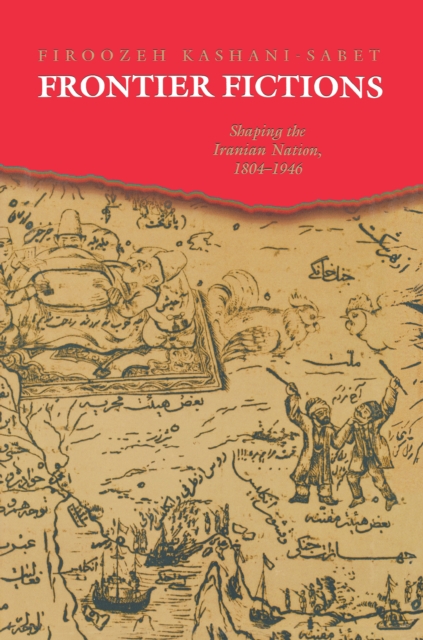
Frontier fictions : shaping the Iranian nation, 1804-1946
In Frontier Fictions, Firoozeh Kashani-Sabet looks at the efforts of Iranians to defend, if not expand, their borders in the nineteenth and early twentieth centuries, and explores how their conceptions of national geography influenced cultural and political change. The \"frontier fictions,\" or the ways in which the Iranians viewed their often fluctuating borders and the conflicts surrounding them, played a dominant role in defining the nation. On these borderlands, new ideas of citizenship and nationality were unleashed, refining older ideas of ethnicity. Kashani-Sabet maintains that land-based conceptions of countries existed before the advent of the modern nation-state. Her focus on geography enables her to explore and document fully a wide range of aspects of modern citizenship in Iran, including love of homeland, the hegemony of the Persian language, and widespread interest in archaeology, travel, and map-making. While many historians have focused on the concept of the \"imagined community\" in their explanations of the rise of nationalism, Kashani-Sabet is able to complement this perspective with a very tangible explanation of what connects people to a specific place. Her approach is intended to enrich our understanding not only of Iranian nationalism, but also of nationalism everywhere.
eBook

Electronic Iran
Electronic Iranintroduces the concept of the Iranian Internet, a framework that captures interlinked, transnational networks of virtual and offline spaces.
Taking her cues from early Internet ethnographies that stress the importance of treating the Internet as both a site and product of cultural production, accounts in media studies that highlight the continuities between old and new media, and a range of works that have made critical interventions in the field of Iranian studies, Niki Akhavan traces key developments and confronts conventional wisdom about digital media in general, and contemporary Iranian culture and politics in particular.
Akhavan focuses largely on the years between 1998 and 2012 to reveal a diverse and combative virtual landscape where both geographically and ideologically dispersed individuals and groups deployed Internet technologies to variously construct, defend, and challenge narratives of Iranian national identity, society, and politics. While it tempers celebratory claims that have dominated assessments of the Iranian Internet,Electronic Iranis ultimately optimistic in its outlook. As it exposes and assesses overlooked aspects of the Iranian Internet, the book sketches a more complete map of its dynamic landscape, and suggests that the transformative powers of digital media can only be developed and understood if attention is paid to both the specificities of new technologies as well as the local and transnational contexts in which they appear.
eBook