
Catalogue Search | MBRL


Are you sure you want to remove the book from the shelf?

{{itemTitle}}
90
result(s) for
"Nationalism Ireland History 20th century."
Sort by:

Protestant nationalists in Ireland, 1900-1923
\"This book analyses those Irish Protestants who, between 1900 and 1923, eschewed the unionist views typically held by their co-religionists, and played an active role in the advanced nationalist movement. This book has three overarching themes. The first is motivation. This book assesses the formative influences that caused a minority to reject unionism for nationalism. It charts the tendency for Protestant nationalists to form self-perpetuating networks of activists, where individuals forged alliances that allowed them to repudiate the views of Protestant unionists. Secondly, this book details the extent of Protestant involvement in, and influence on, Irish nationalism. It seeks to uncover the extent of 'grassroots' Protestant nationalist activism, largely by means of a prosopographical methodology. Thirdly, it examines the relationship between religious identity and Irish nationalism. It describes how Protestant nationalists sought to find a place within the nationalist movement, often by means of explicitly denominational-based organisations, and also describes how Catholic nationalists viewed these figures. After 1916, the nationalist movement grew steadily more Catholic in nature. This book discusses evidence that Protestants suffered discrimination from Catholic nationalists, and will highlight the hostility that Protestants faced from their unionist co-religionists, especially in Ulster\"-- Provided by publisher.
Book

Militant Nationalism
Why do some militant nationalists turn to electoral politics while others resist-and even seek to destroy-that arena? Cynthia L. Irvin examines two cases of electoral interventions by nationalist organizations engaged in violent political competition: in Northern Ireland and in the Basque provinces of Spain. Through her research, she offers important insights into these insurgent organizations’ adoption of different strategies--from armed struggle to parliamentary politics.
eBook


Masculinity and Power in Irish Nationalism, 1884-1938
This book is a comparative study of masculinity and white racial identity in Irish nationalism and Zionism. It analyses how both national movements sought to refute widespread anti-Irish or anti-Jewish stereotypes and create more prideful (and highly gendered) images of their respective nations. Drawing on English-, Irish-, and Hebrew-language archival sources, Aidan Beatty traces how male Irish nationalists sought to remake themselves as a proudly Gaelic-speaking race, rooted both in their national past as well as in the spaces and agricultural soil of Ireland. On the one hand, this was an attempt to refute contemporary British colonial notions that they were somehow a racially inferior or uncomfortably hybridised people. But this is also presented in the light of the general history of European nationalism; nationalist movements across Europe often crafted romanticised images of the nation's past and Irish nationalism was thus simultaneously European and postcolonial. It is this that makes Irish nationalism similar to Zionism, a movement that sought to create a more idealized image of the Jewish past that would disprove contemporary anti-Semitic stereotypes.
eBook

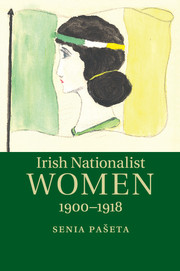
Irish Nationalist Women, 1900–1918
This is a major new history of the experiences and activities of Irish nationalist women in the early twentieth century, from learning and buying Irish to participating in armed revolt. Using memoirs, reminiscences, letters and diaries, Senia Pašeta explores the question of what it meant to be a female nationalist in this volatile period, revealing how Irish women formed nationalist, cultural and feminist groups of their own as well as how they influenced broader political developments. She shows that women's involvement with Irish nationalism was intimately bound up with the suffrage movement as feminism offered an important framework for women's political activity. She covers the full range of women's nationalist activism from constitutional nationalism to republicanism, beginning in 1900 with the foundation of Inghinidhe na hÉireann (Daughters of Ireland) and ending in 1918 with the enfranchisement of women, the collapse of the Irish Party and the ascendancy of Sinn Fein.
eBook

The Rising of the Moon
The Rising of the Moon puts the radical changes in current political dialogue in Ireland into the context of the whole of the 20th century. Exploring the dynamics of power and language, Ella O'Dwyer compares the literature of Beckett, Conrad and Chinua Achebe, amongst others, to accounts of real events in Ireland's political history. She also examines accounts of particular events in Irish history that include Rex Taylor's biography of Michael Collins, Gerry Adams's biography and even messages from hunger-striker Bobby Sands that were smuggled out of prison.
In a country where people have been subjected to incarceration and victimisation, and where the political discourse is characterised by slogans, repetition, agreement and treaty, the implications for the national language and identity are immense. Ella O'Dwyer shows how oppression has obstructed and fractured the nature of Irish national discourse, and that this fragmented voice is a feature of all postcolonial narrative.
eBook


Dividing Ireland
This book provides an original assessment of the First World War in Ireland and its consequences, the key to understanding the complexities of the Irish nation today. Thomas Hennessey explores how the War transformed the nature of the Irish and Ulster questions from devolved self-government within the UK to a free Irish republic outside the British Empire, considering such influential figures as de Valera and Michael Collins, and issues such as conscription. He examines both this process of re-evaluation, and the vital question of the consequences for Northern Ireland today.
eBook