
Catalogue Search | MBRL


Are you sure you want to remove the book from the shelf?

{{itemTitle}}
14
result(s) for
"Native Americans Old Northwest."
Sort by:

Tecumseh : Speech at Vincennes
\"A Shawnee warrior and chief, Tecumseh was widely admired as a skilled orator who wanted to unite Indigenous groups in the United States and Canada to prevent the loss of their territory and way of life. This thought-provoking book features his memorable speech in 1810 at Vincennes, to Indiana Governor Harrison to revoke a treaty that took Indigenous lands, and to Indigenous peoples to resist the takeover of their territories. Readers are introduced to the social and political circumstances of the time and an anlysis of text highlights Tecumseh's skill in persuasive writing\"-- Provided by publisher.
Book

Seeing Red
Against long odds, the Anishinaabeg resisted removal, retaining
thousands of acres of their homeland in what is now Michigan,
Wisconsin, and Minnesota. Their success rested partly on their
roles as sellers of natural resources and buyers of trade goods,
which made them key players in the political economy of plunder
that drove white settlement and U.S. development in the Old
Northwest. But, as Michael Witgen demonstrates, the credit for
Native persistence rested with the Anishinaabeg themselves.
Outnumbering white settlers well into the nineteenth century, they
leveraged their political savvy to advance a dual citizenship that
enabled mixed-race tribal members to lay claim to a place in U.S.
civil society. Telling the stories of mixed-race traders and
missionaries, tribal leaders and territorial governors, Witgen
challenges our assumptions about the inevitability of U.S.
expansion. Deeply researched and passionately written, Seeing
Red will command attention from readers who are invested in
the enduring issues of equality, equity, and national belonging at
its core.
eBook

The American National State and the Early West
This book challenges the widely held myth that the American national state was weak in the early days of the republic. William H. Bergmann reveals how the federal government used its fiscal and military powers, as well as bureaucratic authority, to enhance land acquisitions, promote infrastructure development and facilitate commerce and communication in the early trans-Appalachian West. Energetic federal state-building efforts prior to 1815 grew from national state security interests as Native Americans and British imperial designs threatened to unravel the republic. White Westerners and Western state governments partnered with the federal government to encourage commercial growth and emigration, to transform the borderland into a bordered land. Taking a regional approach, this work synthesizes the literatures of social history, political science and economic history to provide a new narrative of American expansionism, one that takes into account the unique historical circumstances in the Ohio Valley and the southern Great Lakes.
eBook

The victory with no name : the Native American defeat of the first American army
In 1791, General Arthur St. Clair led the United States army in a campaign to destroy a complex of Indian villages at the Miami River in northwestern Ohio. Almost within reach of their objective, St. Clair's 1,400 men were attacked by about one thousand Indians. The U.S. force was decimated, suffering nearly one thousand casualties in killed and wounded, while Indian casualties numbered only a few dozen. But despite the lopsided result, it wouldn't appear to carry much significance; it involved only a few thousand people, lasted less than three hours, and the outcome, which was never in doubt, was permanently reversed a mere three years later. Neither an epic struggle nor a clash that changed the course of history, the battle doesn't even have a name. Yet, as renowned Native American historian Colin Calloway demonstrates here, St. Clair's Defeat--as it came to be known-- was hugely important for its time. It was both the biggest victory the Native Americans ever won, and, proportionately, the biggest military disaster the United States had suffered. With the British in Canada waiting in the wings for the American experiment in republicanism to fail, and some regions of the West gravitating toward alliance with Spain, the defeat threatened the very existence of the infant United States. Generating a deluge of reports, correspondence, opinions, and debates in the press, it produced the first congressional investigation in American history, while ultimately changing not only the manner in which Americans viewed, raised, organized, and paid for their armies, but the very ways in which they fought their wars. Emphasizing the extent to which the battle has been overlooked in history, Calloway illustrates how this moment of great victory by American Indians became an aberration in the national story and a blank spot in the national memory. Calloway shows that St. Clair's army proved no match for the highly motivated and well-led Native American force that shattered not only the American army but the ill-founded assumption that Indians stood no chance against European methods and models of warfare. An engaging and enlightening read for American history enthusiasts and scholars alike, The Victory with No Name brings this significant moment in American history back to light.
eBook

French and Indians in the Heart of North America, 1630-1815
In the past thirty years, the study of French-Indian relations in the center of North America has emerged as an important field for examining the complex relationships that defined a vast geographical area, including the Great Lakes region, the Illinois Country, the Missouri River Valley, and Upper and Lower Louisiana. For years, no one better represented this emerging area of study than Jacqueline Peterson and Richard White, scholars who identified a world defined by miscegenation between French colonists and the native population, or métissage, and the unique process of cultural accommodation that led to a \"middle ground\" between French and Algonquians. Building on the research of Peterson, White, and Jay Gitlin, this collection of essays brings together new and established scholars from the United States, Canada, and France, to move beyond the paradigms of the middle ground and métissage. At the same time it seeks to demonstrate the rich variety of encounters that defined French and Indians in the heart of North America from 1630 to 1815. Capturing the complexity and nuance of these relations, the authors examine a number of thematic areas that provide a broader assessment of the historical bridge-building process, including ritual interactions, transatlantic connections, diplomatic relations, and post-New France French-Indian relations.
eBook

Visualizing the sacred : cosmic visions, regionalism, and the art of the Mississippian world
The prehistoric native peoples of the Mississippi River Valley and other areas of the Eastern Woodlands of the United States shared a complex set of symbols and motifs that constituted one of the greatest artistic traditions of the pre-Columbian Americas. Traditionally known as the Southeastern Ceremonial Complex, these artifacts of copper, shell, stone, clay, and wood were the subject of the groundbreaking 2007 book Ancient Objects and Sacred Realms: Interpretations of Mississippian Iconography, which presented a major reconstruction of the rituals, cosmology, ideology, and political structures of the Mississippian peoples. Visualizing the Sacred advances the study of Mississippian iconography by delving into the regional variations within what is now known as the Mississippian Iconographic Interaction Sphere (MIIS). Bringing archaeological, ethnographic, ethnohistoric, and iconographic perspectives to the analysis of Mississippian art, contributors from several disciplines discuss variations in symbols and motifs among major sites and regions across a wide span of time and also consider what visual symbols reveal about elite status in diverse political environments. These findings represent the first formal identification of style regions within the Mississippian Iconographic Interaction Sphere and call for a new understanding of the MIIS as a network of localized, yet interrelated religious systems that experienced both continuity and change over time.
eBook

Mississippian Mortuary Practices
The residents of Mississippian towns principally located in the southeastern and midwestern United States from 900 to1500 A.D. made many beautiful objects, which included elaborate and well-crafted copper and shell ornaments, pottery vessels, and stonework. Some of these objects were socially valued goods and often were placed in ritual context, such as graves.
The funerary context of these artifacts has sparked considerable study and debate among archaeologists, raising questions about the place in society of the individuals interred with such items, as well as the nature of the societies in which these people lived.
By focusing on how mortuary practices serve as symbols of beliefs and values for the living, the contributors to Mississippian Mortuary Practices explore how burial of the dead reflects and reinforces the cosmology of specific cultures, the status of living participants in the burial ceremony, ongoing kin relationships, and other aspects of social organization.
eBook
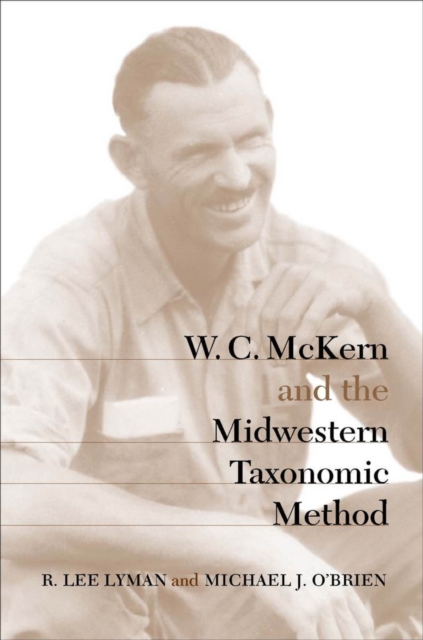
W.C. McKern and the Midwestern Taxonomic Method
This volume explains the deep influence of biological methods and theories on the practice of Americanist archaeology by exploring W.C. McKern's use of Linnaean taxonomy as the model for development of a pottery classification system.
eBook

Archaic Hunters and Gatherers in the American Midwest
This volume brings together articles that reveal the Archaic period of the American Midwest to be one of innovation and technological achievement.
eBook

The People Named the Chippewa
Ranging in time and space from Madeline Island and the reservations of northern Minnesota to the urban reservation of Minneapolis-St. Paul, Vizenor recounts the experiences of the Chippewa and their encounters with the white people who “named” them.
eBook