
Catalogue Search | MBRL


Are you sure you want to remove the book from the shelf?

{{itemTitle}}
13
result(s) for
"Native peoples Canada Government relations Case studies."
Sort by:


Navigating neoliberalism : self-determination and the Mikisew Cree First Nation
This remarkable book argues that neoliberalism, which drives government policy concerning First Nations in Canada, can also drive self-determination -- including the Mikisew First Nation, which successfully exploited opportunities for greater autonomy and well-being that the current political and economic climate has presented.
eBook

Between Indigenous and Settler Governance
Between Indigenous and Settler Governance addresses the history, current development and future of Indigenous self-governance in four settler-colonial nations: Australia, Canada, New Zealand and the United States. Bringing together emerging scholars and leaders in the field of indigenous law and legal history, this collection offers a long-term view of the legal, political and administrative relationships between Indigenous collectivities and nation-states. Placing historical contingency and complexity at the center of analysis, the papers collected here examine in detail the process by which settler states both dissolved indigenous jurisdictions and left spaces - often unwittingly - for indigenous survival and corporate recovery. They emphasise the promise and the limits of modern opportunities for indigenous self-governance; whilst showing how all the players in modern settler colonialism build on a shared and multifaceted past. Indigenous tradition is not the only source of the principles and practices of indigenous self-determination; the essays in this book explore some ways that the legal, philosophical and economic structures of settler colonial liberalism have shaped opportunities for indigenous autonomy. Between Indigenous and Settler Governance will interest all those concerned with Indigenous peoples in settler-colonial nations.
eBook

“This Is Going to Affect Our Lives”: Exploring Huu-ay-aht First Nations, the Government of Canada and British Columbia’s New Relationship Through the Implementation of the Maa-nulth Treaty
Canada celebrated its 150th anniversary since Confederation in 2017. At the same time, Canada is also entering an era of reconciliation that emphasizes mutually respectful and just relationships between Indigenous Peoples and the Crown. British Columbia (BC) is uniquely situated socially, politically, and economically as compared to other Canadian provinces, with few historic treaties signed. As a result, provincial, federal, and Indigenous governments are attempting to define ‘new relationships’ through modern treaties. What new relationships look like under treaties remains unclear though. Drawing from a comprehensive case study, we explore Huu-ay-aht First Nations—a signatory of the Maa-nulth Treaty, implemented in 2011—BC and Canada’s new relationship by analysing 26 interviews with treaty negotiators and Indigenous leaders. A disconnect between obligations outlined in the treaty and how Indigenous signatories experience changing relations is revealed, pointing to an asymmetrical dynamic remaining in the first years of implementation despite new relationships of modern treaty. Le Canada a célébré le 150e anniversaire de la Confédération en 2017. Parallèlement, le Canada s’engage actuellement dans une ère de réconciliation promouvant la mise en place de relations justes et respectueuses entre les peuples autochtones et la Couronne. La Colombie-Britannique (CB) qui a une position unique, par rapport aux autres provinces canadiennes, sur le plan social, politique et économique n’a ratifié que peu de traités historiques. Conséquemment, les gouvernements provinciaux et fédéraux ainsi que les autochtones tentent de définir de « nouvelles relations » par le biais de traités modernes. Les nouvelles relations qui apparaissent sous ces traités demeurent toutefois imprécises. À partir d’une étude de cas, nous explorons la nouvelle relation entre la CB, le Canada et les Premières Nations Huu-ay-aht – signataires du Traité Maa-nulth mis en œuvre en 2011– en analysant 26 entrevues réalisées auprès des négociateurs du traité et des dirigeants autochtones. Une rupture entre les obligations énoncées dans le traité et la manière dont les signataires autochtones expérimentent les relations changeantes est mise en exergue; une rupture qui laisse entrevoir un maintien de la dynamique asymétrique au cours des premières années de la mise en œuvre du traité, et ce, malgré les nouvelles relations des traités modernes.
Journal Article

Decolonizing Employment
Indigenous North Americans continue to be overrepresented among those who are poor, unemployed, and with low levels of education. This has long been an issue of concern for Indigenous people and their allies and is now drawing the attention of government, business leaders, and others who know that this fast-growing population is a critical source of future labour. Shauna MacKinnon's Decolonizing Employment: Aboriginal Inclusion in Canada's Labour Market is a case study with lessons applicable to communities throughout North America. Her examination of Aboriginal labour market participation outlines the deeply damaging, intergenerational effects of colonial policies and describes how a neoliberal political economy serves to further exclude Indigenous North Americans. MacKinnon's work demonstrates that a fundamental shift in policy is required. Long-term financial support for comprehensive, holistic education and training programs that integrate cultural reclamation and small supportive learning environments is needed if we are to improve social and economic outcomes and support the spiritual and emotional healing that Aboriginal learners tell us is of primary importance.
eBook
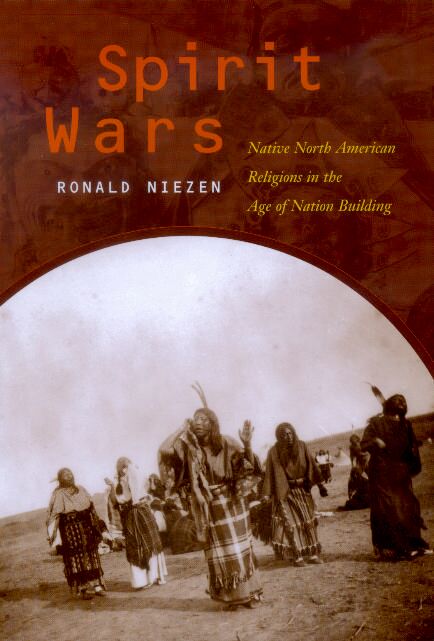
Spirit wars : Native North American religions in the age of nation building
Spirit Wars is an exploration of the ways in which the destruction of spiritual practices and beliefs of native peoples in North America has led to conditions of collective suffering--a process sometimes referred to as cultural genocide. Ronald Niezen approaches this topic through wide-ranging case studies involving different colonial powers and state governments: the seventeenth-century Spanish occupation of the Southwest, the colonization of the Northeast by the French and British, nineteenth-century westward expansion and nationalism in the swelling United States and Canada, and twentieth-century struggles for native people's spiritual integrity and freedom. Each chapter deals with a specific dimension of the relationship between native peoples and non-native institutions, and together these topics yield a new understanding of the forces directed against the underpinnings of native cultures. Many titles in the Voices Revived program are also newly available as ebooks, offered at a discounted price to support wider access to scholarly work.
eBook

Closing the Education Gap: A Case for Aboriginal Early Childhood Education in Canada, A Look at the Aboriginal Headstart Program
This paper raises awareness concerning the education gap between Aboriginal youth and the non-Aboriginal youth population in Canada. It argues that the historical consequences of colonialism that resulted in diminished sense of self-worth, self-determination, and culture have placed Aboriginals at the low-end of the socio-economic strata. This continuing phenomenon has meant that Aboriginal youth perform far worse than non- Aboriginals in terms of their ability to obtain higher education and employment. Given this, using welfare-state theory and Indigenous-based theory I argue that early-childhood education which is culturally sensitive to the needs of Aboriginal children and controlled by Aboriginal communities will help to remedy and close the education gap between Aboriginal and non-Aboriginal youth. The paper concludes with solutions to rectify the situation in Canada. Specifically, it discusses the current government initiative, Aboriginal Head Start (AHS), that has been making significant strides throughout the Aboriginal community.
Journal Article

Treaty Federalism in Northern Canada: Aboriginal-Government Land Claims Boards
Treaty federalism in North America encompasses not only governance implications of the historic treaties signed with Aboriginal peoples, but also the modern-day treaties known as “comprehensive land claim agreements.” This article explores how treaty federalism is realized in Northern Canada through claims-mandated joint government-Aboriginal boards dealing with wildlife management, land-use planning, and environmental protection. These boards, existing at the intersection of the three orders of government-national, federal/territorial, and Aboriginal—are found to be unique governance institutions, with substantial independence from government. They have significantly enhanced Aboriginal peoples' influence over land, wildlife, and resource decisions, but the extent to which they bring Aboriginal culture and worldviews to bear in decision-making remains an open question.
Journal Article