
Catalogue Search | MBRL


Are you sure you want to remove the book from the shelf?

{{itemTitle}}
9
result(s) for
"Native peoples Canada Prairie Provinces History."
Sort by:

No surrender : the land remains indigenous
\"Between 1869 and 1877 the government of Canada negotiated Treaties One through Seven with the Indigenous peoples of the Great Plains. Many historians argue that the negotiations suffered from cultural misunderstandings between the treaty commissioners and Indigenous chiefs, but newly uncovered eyewitness accounts show that the Canadian government had a strategic plan to deceive over the \"surrender clause\" and land sharing. According to Sheldon Krasowski's research, Canada understood that the Cree, Anishnabeg, Saulteaux, Assiniboine, Siksika, Piikani, Kainaa, Stoney and Tsuu T'ina nations wanted to share the land with newcomers--with conditions--but were misled over governance, reserved lands, and resource sharing. Exposing the government chicanery at the heart of the negotiations, No Surrender demonstrates that the land remains Indigenous.\"-- Provided by publisher.
Book

Legends of our times : native cowboy life
Throughout the world, the image of the cowboy is an instantly recognized symbol of the North American West. This lavishly illustrated book tells the story of some of the first cowboys - the Native peoples of the Plains and Plateau.
eBook
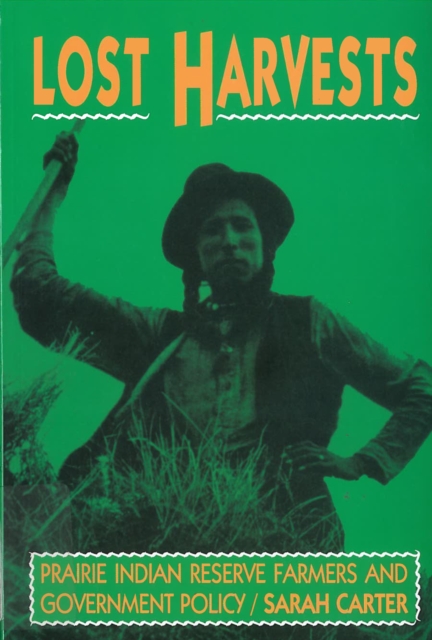
Lost harvests
Despite repeated requests for assistance from Plains Indians, the Canadian government provided very little help between 1874 and 1885, and what little they did give proved useless. Although drought, frost, and other natural phenomena contributed to the failure of early efforts, reserve farmers were determined to create an economy based on agriculture and to become independent of government regulations and the need for assistance. Officials in Ottawa, however, attributed setbacks not to economic or climatic conditions but to the Indians' character and traditions which, they claimed, made the Indians unsuited to agriculture. In the decade following 1885 government policies made farming virtually impossible for the Plains Indians. They were expected to subsist on one or two acres and were denied access to any improvements in technology: farmers had to sow seed by hand, harvest with scythes, and thresh with flails. After the turn of the century, the government encouraged land surrenders in order to make good agricultural land available to non-Indian settlers. This destroyed any chance the Plains Indians had of making agriculture a stable economic base.
eBook

Indigeneity, Immigrant Newcomers and Interculturalism in Winnipeg, Canada
This paper examines how modern urban Indigeneity is influencing the integration of immigrant newcomers in Western settler cities. Using a case study of Ka Ni Kanichihk Inc. (KNK), an Indigenous organisation in the city of Winnipeg, Canada, this research contributes to the emerging framework of intercultural urbanism. Indigenous peoples and newcomers are living side-by-side in many neighbourhoods, with common histories of colonialism, racism and socioeconomic challenges. Interviews with staff and focus groups with Indigenous and newcomer participants of KNK programmes indicated that they are beginning their co-existence, mostly in inner-city neighbourhoods, with low levels of interaction, mutual misunderstanding, misperceptions, segregation and tension among youth in high schools. Through the initiatives of KNK and partner organisations, cross-cultural understanding and relationships are being built, overcoming social distance. There is great potential for building intercultural relationships among Indigenous peoples and immigrant newcomers as a means of decolonising Western cities.
Journal Article

Taking Medicine
Taking Medicine challenges traditional understandings of colonial medicine by bringing to light the healing work of Aboriginal and settler women in southern Alberta.
eBook
BC-Cda-News-Digest
Three-quarters of nursing homes cited for not meeting some provincial standards TORONTO _ The majority of Ontario's nursing homes have failed to meet basic standards set out by the province to preserve the rights of elderly residents, with some failing to bathe residents even twice a week, others leaving seniors sitting for hours in soiled diapers and still others unnecessarily restraining those in their care, an investigation by The Canadian Press reveals. Would-be jihadis tricked into bomb plot, Khawaja lawyer suggests OTTAWA _ Would-be Islamic warriors who attended a supposed terrorist training camp in northern Pakistan thought they were going to fight in Afghanistan, not participate in a bomb plot in Britain, says Momin Khawaja's defence lawyer.
Newsletter
BC-Cda-News-Digest
\"We attempted to find other products that might have the same biological effect on people to help them when they can't smoke, or in our case, when they can't smoke and shouldn't smoke,\" said Joseph Knight, CEO of the California-based Nico Worldwide Inc., the makers of Nic Lite. \"We're hoping that in the next two to three months we would have our clearances in place,\" Knight said in a phone interview from Oxnard, Calif. \"We don't know really much about how these databases get made and who is programming them,\" said Simone Browne, a teacher and doctoral candidate at the Ontario Institute for Studies in Education at the University of Toronto.
Newsletter