
Catalogue Search | MBRL


Are you sure you want to remove the book from the shelf?

{{itemTitle}}
7
result(s) for
"Naturalists Great Britain Correspondence."
Sort by:


Sociable Knowledge
Working with the technologies of pen and paper, scissors and glue, naturalists in early modern England, Scotland, and Wales wrote, revised, and recombined their words, sometimes over a period of many years, before fixing them in printed form. They built up their stocks of papers by sharing these materials through postal and less formal carrier services. They exchanged letters, loose notes, drawings and plans, commonplace books, as well as lengthy treatises, ever-expanding repositories for new knowledge about nature and history as it accumulated through reading, observation, correspondence, and conversation. These textual collections grew alongside cabinets of natural specimens, antiquarian objects, and other curiosities-insects pinned in boxes, leaves and flowers pressed in books, rocks and fossils, ancient coins and amulets, and drafts of stone monuments and inscriptions. The goal of all this collecting and sharing, Elizabeth Yale claims, was to create channels through which naturalists and antiquaries could pool their fragmented knowledge of the hyperlocal and curious into an understanding and representation of Britain as a unified historical and geographical space.
Sociable Knowledgepays careful attention to the concrete and the particular: the manuscript almost lost off the back of the mail carrier's cart, the proper ways to package live plants for transport, the kin relationships through which research questionnaires were distributed. The book shows how naturalists used print instruments to garner financing and content from correspondents and how they relied upon research travel-going out into the field-to make and refresh social connections. By moving beyond an easy distinction between print and scribal cultures, Yale reconstructs not just the collaborations of seventeenth-century practitioners who were dispersed across city and country, but also the ways in which the totality of their exchange practices structured early modern scientific knowledge.
eBook


May We Be Spared to Meet on Earth
May We Be Spared to Meet on Earth is a privileged
glimpse into the private correspondence of the officers and sailors
who set out in May 1845 on the Erebus and Terror
for Sir John Franklin's fateful expedition to the Arctic. The
letters of the crew and their correspondents begin with the
journey's inception and early planning, going on to recount the
ships' departure from the river Thames, their progress up the
eastern coast of Great Britain to Stromness in Orkney, and the
crew's exploits as far as the Whalefish Islands off the western
coast of Greenland, from where the ships forever departed the
society that sent them forth. As the realization dawned that
something was amiss, heartfelt letters to the missing were sent
with search expeditions; those letters, returned unread, tell
poignant stories of hope. Assembled completely and conclusively
from extensive archival research, including in far-flung family and
private collections, the correspondence allows the reader to peer
over the shoulders of these men, to experience their excitement and
anticipation, their foolhardiness, and their fears. The Franklin
expedition continues to excite enthusiasts and scholars worldwide.
May We Be Spared to Meet on Earth provides new insights
into the personalities of those on board, the significance of the
voyage as they saw it, and the dawning awareness of the possibility
that they would never return to British shores or their
families.
eBook
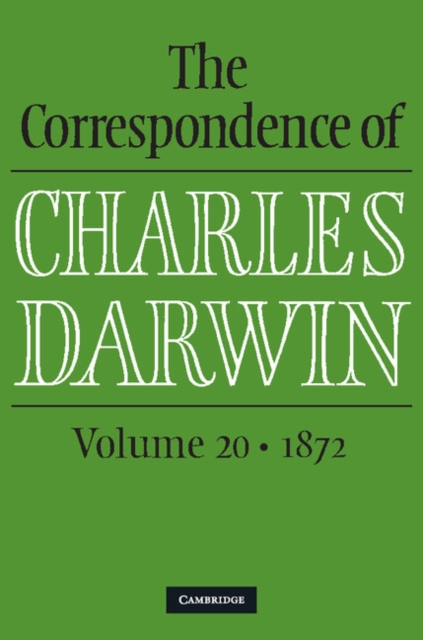
Correspondence of Charles Darwin: Volume 20, 1872
This volume is part of the definitive edition of letters written by and to Charles Darwin, the most celebrated naturalist of the nineteenth century. Notes and appendixes put these fascinating and wide-ranging letters in context, making the letters accessible to both scholars and general readers. Darwin depended on correspondence to collect data from all over the world and to discuss his emerging ideas with scientific colleagues, many of whom he never met in person. The letters are published chronologically: volume 20 includes letters from 1872, the year in which The Expression of the Emotions in Man and Animals was published, making ground-breaking use of photography. Also in this year, the sixth and final edition of On the Origin of Species was published and Darwin resumed his work on carnivorous plants and plant movement, finding unexpected similarities between the plant and animal kingdoms.
eBook

Henry Dresser and Victorian ornithology
This book explores the life of Henry Dresser (1838-1915), one of the most productive British ornithologists of the mid-late nineteenth and early twentieth centuries, and is largely based on previously unpublished archival material. Dresser travelled widely and spent time in Texas during the American Civil War. He built enormous collections of skins and eggs of birds from Europe, North America and Asia, which formed the basis of over 100 publications, including some of the finest bird books of the late nineteenth century. Dresser was a leading figure in scientific society and in the early bird conservation movement; his correspondence and diaries reveal the inner workings, motivations, personal relationships and rivalries that existed among the leading ornithologists.
eBook

Growing Wild
Mary Elizabeth Barber (1818-1899), born in Britain, arrived in the Cape Colony in 1820 where she spent the rest of her life as a rolling stone, as she lived in and near Grahamstown, the diamond and gold fields, Pietermaritzburg, Malvern near Durban and on various farms in the eastern part of the Cape Colony. She has been perceived as 'the most advanced woman of her time', yet her legacy has attracted relatively little attention. She was the first woman ornithologist in South Africa, one of the first who propagated Darwin's theory of evolution, an early archaeologist, keen botanist and interested lepidopterist. In her scientific writing, she propagated a new gender order; positioned herself as a feminist avant la lettre without relying on difference models and at the same time made use of genuinely racist argumentation. This is the first publication of her edited scientific correspondence. The letters - transcribed by Alan Cohen, who has written a number of biographical articles on Barber and her brothers - are primarily addressed to the entomologist Roland Trimen, the director of the Royal Botanic Gardens Kew, London. Today, the letters are housed at the Royal Entomological Society in St Albans. This book also includes a critical introduction by historian Tanja Hammel who has published a number of articles and is about to publish a monograph on Mary Elizabeth Barber.
eBook