
Catalogue Search | MBRL


Are you sure you want to remove the book from the shelf?

{{itemTitle}}
47
result(s) for
"Nature in art Catalogs."
Sort by:


The mechanical life of plants: Descartes on botany
In this article, I argue that the French philosopher René Descartes was far more involved in the study of plants than has been generally recognized. We know that he did not include a botanical section in his natural philosophy, and sometimes he differentiated between plants and living bodies. His position was, moreover, characterized by a methodological rejection of the catalogues of plants. However, this paper reveals a significant trend in Descartes's naturalistic pursuits, starting from the end of 1637, whereby he became increasingly interested in plants. I explore this shift by examining both Descartes's correspondence and several notes contained in the Excerpta anatomica. Grounded in direct observations, Descartes's work on vegetation provides a modest, though not unimportant, contribution to a natural-philosophical approach to the vegetal realm. This had a direct bearing on his lifelong ambition to explain the nature of living bodies and also fuelled the emergence of botany as a modern science.
Journal Article

Van Gogh and nature
\"The celebrated painter Vincent van Gogh (1853-1890) had a lifelong fascination with the natural world. He spent his youth in rural Holland, and the country's flat landscapes, trees, flowers, and birds would feature in his early art. After he moved to Paris, he encountered new radical thinking about art and humans' changing relationship with nature. Later, in Provence and Auvers, he discovered unfamiliar terrain, flora, and fauna that further influenced his artistic ideas and subject matter. Van Gogh's images of such diverse environments reflect not only his immediate surroundings but also the artist's evolving engagement with nature and art. Van Gogh and Nature is an eye-opening new catalogue that chronicles the artist's ongoing relationship with nature throughout his entire career. Among the featured works are Van Gogh's drawings and paintings, along with related materials that illuminate his reading, sources, and influences. Vivid color photography and explanatory texts based on new research by the authors clarify a central theme of Van Gogh's oeuvre. \"-- Provided by publisher.
Book
Henry Moore and the historiography of early Italian art
'We may say without exaggeration that the art of sculpture has been dead in England for four centuries; equally without exaggeration I think we may say that it is reborn in the work of Henry Moore'.1 With these words Herbert Read paid tribute to the young Henry Moore in his review of Moore's solo exhibition at the Leicester Galleries in London in 1931.In portraying Moore as a modern day Giotto who single-handedly had taken Britain out of the sculptural darkness, Read may have merely used an old arthistorical cliché to praise the work of his young compatriot. Still, Read's praise alludes to a deeper connection between the British sculptor and the Italian painter. Scholars have acknowledged this connection, as well as Moore's wider fascination with early Italian art, and they have identified moments where this interest can be detected in particular works by Moore. The objective of this article is not to catalogue more instances where the appeal of early Italian art manifests itself in Moore's work. Instead, the goal is to analyse the art-historical background of this attraction, paying special attention to Moore's writings. Although Moore did not write much on early Italian art, certainly not when compared with his longer accounts of African and Pre-Columbian art, his comments on Giotto, Masaccio and Giovanni Pisano are of special interest. Not only do they testify to Moore's admiration for these artists and for qualities in their work that fuelled his own ambitions, they also bear witness to art-historical debates about early Italian art at a moment when it was undergoing a particularly formalist construction. While links between Moore's fascination with the work of Giotto, Masaccio and Giovanni Pisano and early twentieth-century critical ideas on early Italian art have been suggested in the literature, surprisingly little attention has been paid to specific developments in art-historical research that may have informed Moore's observations on these artists
Journal Article

Of green leaf, bird, and flower : artists' books and the natural world
\"Highlighting an enduring interest in natural history from the 16th century to the present, this gorgeous book explores depictions of the natural world, from centuries-old manuscripts to contemporary artists' books. It examines the scientific pursuits in the 18th and 19th centuries that resulted in the collecting and cataloguing of the natural world. It also investigates the aesthetically oriented activities of self-taught naturalists in the 19th century, who gathered flowers, ferns, seaweed, feathers, and other naturalia into albums. Examples of 20th- and 21st-century artists' books, including those of Eileen Hogan, Mandy Bonnell, and Tracey Bush, broaden the vision of the natural world to incorporate its interaction with consumer culture and with modern technologies. Featuring dazzling illustrations, the book itself is designed to evoke a fieldwork notebook, and features a collection pocket and ribbon markers. \"-- Provided by publisher.
Book
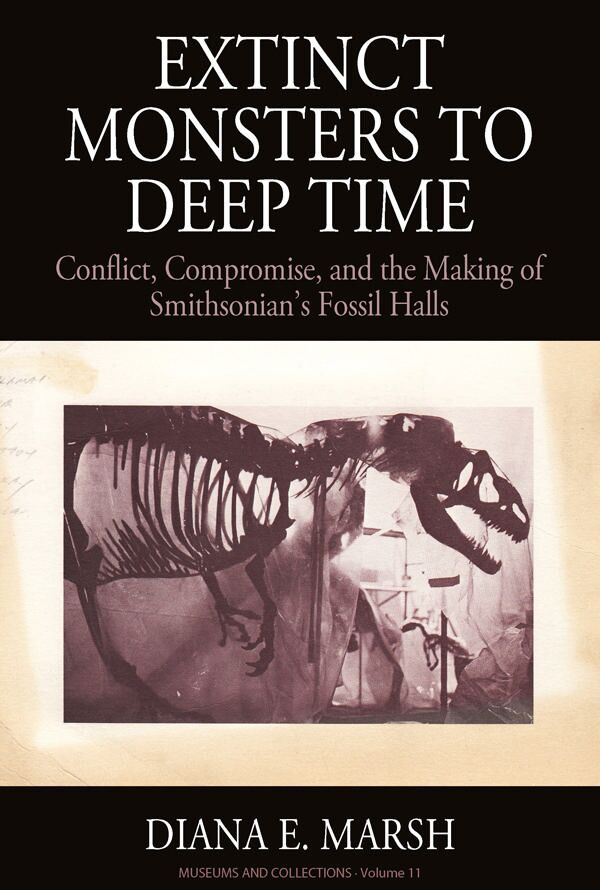
Extinct Monsters to Deep Time
Via the Smithsonian Institution, an exploration of the growing friction between the research and outreach functions of museums in the 21st century. Describing participant observation and historical research at the Smithsonian’s National Museum of Natural History as it prepared for its largest-ever exhibit renovation, Deep Time, the author provides a grounded perspective on the inner-workings of the world’s largest natural history museum and the social processes of communicating science to the public. From the introduction: In exhibit projects, the tension plays out between curatorial staff—academic, research, or scientific staff charged with content—and exhibitions, public engagement, or educational staff—which I broadly group together as “audience advocates” charged with translating content for a broader public. I have heard Kirk Johnson, Sant Director of the NMNH, say many times that if you look at dinosaur halls at different museums across the country, you can see whether the curators or the exhibits staff has “won.” At the American Museum of Natural History in New York, it was the curators. The hall is stark white and organized by phylogeny—or the evolutionary relationships of species—with simple, albeit long, text panels. At the Field Museum of Natural History in Chicago, Johnson will tell you, it was the “exhibits people.” The hall is story driven and chronologically organized, full of big graphic prints, bold fonts, immersive and interactive spaces, and touchscreens. At the Denver Museum of Nature and Science, where Johnson had previously been vice president and chief curator, “we actually fought to a draw.” That, he says, is the best outcome; a win on either side skews the final product too extremely in one direction or the other. This creative tension, when based on mutual respect, is often what makes good exhibitions.
eBook

Interpreting Arcimboldo: grotesque parodies or serious jokes?
Kaufmann focuses on several exhibitions of the works of Giuseppe Arcimboldo. The exhibition at the Museo de Bellas Artes de Bilbao was focused on Arcimboldo's pictures in Spanish aristocratic collections including Philip II and Emperor Maximilian II by Antonio Moro and Emperor Rudolf II and Archduke Ernest of Austria by Alonso Sanchez Coello. The exhibition at the National Museum of Western Art, Tokyo and seen in reduced form at Palazzo Barberini, Rome, took a different tack. The exhibition of portraits of Habsburg archduchesses in Tokyo and Rome, and the illustration in the catalogues of a group portrait with Maximilian II, all long attributed to Arcimboldo, should give pause. Technical examination by the Kunsthistorisches Museum of all their paintings attributed to Arcimboldo, carried out on the occasion of the 2007-08 exhibitions, might have put to rest these questionable attributions.
Journal Article

Henry Dresser and Victorian ornithology
This book explores the life of Henry Dresser (1838-1915), one of the most productive British ornithologists of the mid-late nineteenth and early twentieth centuries, and is largely based on previously unpublished archival material. Dresser travelled widely and spent time in Texas during the American Civil War. He built enormous collections of skins and eggs of birds from Europe, North America and Asia, which formed the basis of over 100 publications, including some of the finest bird books of the late nineteenth century. Dresser was a leading figure in scientific society and in the early bird conservation movement; his correspondence and diaries reveal the inner workings, motivations, personal relationships and rivalries that existed among the leading ornithologists.
eBook

Australasian nature photography
The bioregion of Australia, New Zealand, Antarctica and New Guinea possesses a unique natural heritage stretching back over 50 million years since the break-up of the great southern continent of Gondwanaland. The South Australian Museum focuses on enhancing a general knowledge of this extraordinary legacy by encouraging photography of the region's nature and wilderness, and promoting an annual competition to find the Nature Photographer of the Year. Australasian Nature Photography: ANZANG Eighth Collection presents the finest photographs submitted to the competition. Each photograph is accompanied by technical information as well as anecdotes about how the picture was taken, which will stimulate yet further interest in the flora and fauna and their conservation in the region.
eBook

Life on Matagorda Island
From most people’s point of view, a barrier beach is a paradox: appealing to visit but appalling to live on. An enjoyable day’s excursion requires shade, dark glasses, sunblock, drinking water, food, and, of course, a shower afterward. Take all those amenities away and consider existing alone on the island fulltime, even during hurricanes.
When Wayne and Martha McAlister moved to Matagorda Island, a wildlife refuge off the central Texas coast, they anticipated staying perhaps five years. But sent to take up duties with the U.S. Fish and Wildlife Service, Wayne McAlister fell under the island’s spell the moment he stepped out of his aging house trailer and met his first Matagorda rattlesnake. Seven years later, the McAlisters were still observing the flora and fauna of Matagorda. Except for the road and some occasional fence posts, the island appears untouched by humans. In Life on Matagorda Island, Wayne McAlister shows what life was like amid such isolation.
McAlister revels in the ghostly twinkles of nights on the beach, as luminescent comb jellies, sea walnuts, and glow worms light up every crest of wave. He watches hungry whooping cranes snatch striped mullet trapped in tidal pools; hunts for Hurter’s spadefoots, reclusive amphibians that surface during warm deluges; and sinks to his knees in the sand, flashlight in hand, to catch a glimpse of a whip eel’s sharp snout.
Not all observations are limited to the psammobionts—the creatures of the sand. McAlister recounts petting a fatbellied coyote pup and handing out kitchen scraps to wild turkeys. Badgers make their home on Matagorda Island, as do alligators, raccoons, and hundreds of varieties of insects, including the aggravating salt marsh mosquito.
But McAlister doesn’t merely observe: he tells why and how. Why oysters spit, why pistol shrimp snap, or how debris from offshore boats affects the beach environment. He also relates the more sinister aspects of living on a barrier island, such as finding himself ankledeep in quicksand. But it’s all in a day’s work—or play—to the McAlisters, as they balance their lifestyle with the will of the island and its nonhuman inhabitants.
“We try to stay in the background, enthralled observers,” McAlister writes. “We do not belong, can never truly belong, but we can coexist and commingle. Close enough.”
eBook