
Catalogue Search | MBRL


Are you sure you want to remove the book from the shelf?

{{itemTitle}}
15
result(s) for
"Nebraska-History, Local"
Sort by:

Nebraska during the New Deal
As a New Deal program, the Federal Writers' Project (FWP) aimed to put unemployed writers, teachers, and librarians to work. The contributors were to collect information, write essays, conduct interviews, and edit material with the goal of producing guidebooks in each of the then forty-eight states and U.S. territories. Project administrators hoped that these guides, known as the American Guide Series, would promote a national appreciation for America's history, culture, and diversity and preserve democracy at a time when militarism was on the rise and parts of the world were dominated by fascism. Marilyn Irvin Holt focuses on the Nebraska project, which was one of the most prolific branches of the national program. Best remembered for its state guide and series of folklore and pioneer pamphlets, the project also produced town guides, published a volume on African Americans in Nebraska, and created an ethnic study of Italians in Omaha. InNebraska during the New Deal Holt examines Nebraska's contribution to the project, both in terms of its place within the national FWP as well as its operation in comparison to other state projects.
eBook

Echo of Its Time
Throughout its existence the Federal District Court of Nebraska has echoed the dynamics of its time, reflecting the concerns, interests, and passions of the people who have made this state their home.Echo of Its Timeexplores the court's development, from its inception in 1867 through 1933, tracing the careers of its first four judges: Elmer Dundy, William Munger, Thomas Munger (no relation), and Joseph Woodrough, whose rulings addressed an array of issues and controversies echoing macro-level developments within the state, nation, and world.Echo of Its Timeboth informs and entertains while using the court's operations as a unique and accessible prism through which to explore broader themes in the history of the state and the nation. The book explores the inner workings of the court through Thomas Munger's personal correspondence, as well as the court's origins and growing influence under the direction of its legendary first judge, Elmer Dundy. Dundy handled many notable and controversial matters and made significant decisions in the field of Native American law, includingStanding Bear v. CrookandElk v. Wilkins. From the turn of the century through 1933 the court's docket reflected the dramatic and rapid changes in state, regional, and national dynamics, including labor disputes and violence, political corruption and Progressive Era reform efforts, conflicts between cattle ranchers and homesteaders, wartime sedition and \"slacker\" prosecutions, criminal enterprises, and the endless battles between government agents and bootleggers during Prohibition.
eBook

The Nebraska-Kansas Act of 1854
The Nebraska-Kansas Act of 1854turns upside down the traditional way of thinking about one of the most important laws ever passed in American history. The act that created Nebraska and Kansas also, in effect, abolished the Missouri Compromise, which had prohibited slavery in the region since 1820. This bow to local control outraged the nation and led to vicious confrontations, including Kansas's subsequent mini-civil war. The essays in this volume shift the focus from the violent and influential reaction of \"Bleeding Kansas\" to the role that Nebraska played in this decisive moment.
Essays from both established and new scholars examine the historical context and significance of this statute. They treat American political culture of the 1850s; American territorial history; the roles of Abraham Lincoln, Stephen Douglas, and Frederick Douglass in the creation and implementation of the law; the reactions of African Americans to the act; and the comparative impact on Nebraskans and Kansans. At the 150th anniversary of the Kansas-Nebraska Act, as it came to be known, these scholars reexamine the political, social, and personal contexts of this act and its effect on the course of American history.
eBook
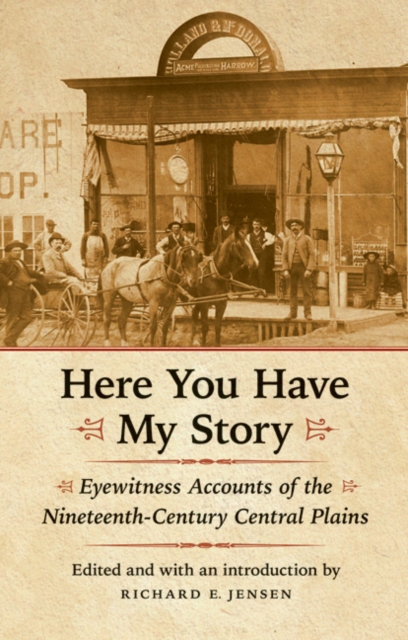
Here You Have My Story
Here You Have My Story vividly describes life on the early Plains in the words of those who came to settle in the rugged region. Originally published by the Nebraska State Historical Society between 1885 and 1919, these stories provide surprisingly accurate recollections of events and life on the Great Plains, with a focus on Nebraska. Many are filled with interactions with Native Americans, from Samuel Allis's experiences as a missionary to the Pawnees, to Henry Fontenelle's history of the Omaha Indians, to an account of the Powder River Expedition. Early freighters and cattle drovers share their personal experiences, including the dangers and difficulties of travel, and Nebraska's state-builders describe the early days of Omaha and the construction of the first state capitol building in Lincoln. Here You Have My Story, edited by Richard E. Jensen, brings to life the struggles and triumphs of early Plains settlement and a time when Nebraska was young.
eBook

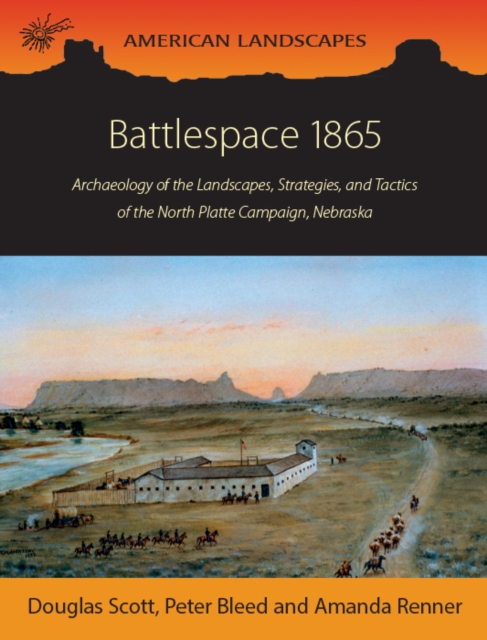
Battlespace 1865
For a period of about week in February 1865, as the Civil War was winding down and Plains Indian communities were reeling in the wake of the Sand Creek massacre, combat swept across the Nebraska panhandle, especially along the Platte River. The fighting that marked this event barely compares to the massive campaigns and terrible carnage that marked the conflict that was taking place in the eastern states but it was a significant event at the opening on the ensuing Indian Wars. Operating on terrain they knew well, Cheyenne warriors and other Native forces encountered the US Cavalry who operated within a modern network of long distance migration and pony express trails and military stations. The North Platte Campaign offers a good basis for the application of landscape approaches to conflict archaeology if only because of its scale. This fighting is both easily approached and fascinatingly encompassed. There were probably far fewer than 1000 fighters involved in those skirmishes, but before, after, and between them, they involved substantial movements of people and of equipment that was similar to the arms and gear in service to other Civil War era combatants. They also seem to have used approaches that were typical of America’s western warfare. Like many of the conflicts of interest to modern observers, the North Platte fights were between cultural different opponents. Archaeological consideration of battlefields such as Rush Creek and Mud Springs, bases, and landscapes associated with this fighting expose how the combat developed and how the opposing forces dealt with the challenges they encountered. This study draws on techniques of battlefield archaeology, focusing on the concept of ‘battlespace’ and the recovery, distribution and analysis of artifacts and weaponry, as well as historical accounts of the participants, LiDAR-informed terrain assessment, and theoretical consideration of the strategic thinking of the combatants. It applies a landscape approach to the archaeological study of war and reveals an overlooked phase of the American Civil War and the opening of the Indian Wars.
eBook

History of Nebraska
History of Nebraska was originally created to mark the territorial centennial of Nebraska and then revised to coincide with the statehood centennial. This one-volume history quickly became the standard text for the college student and reference for the general reader, unmatched for generations as the only comprehensive history of the state. This fourth edition, revised and updated, preserves the spirit and intelligence of the original. Incorporating the results of years of scholarship and research, this edition gives fuller attention to such topics as the Native American experience in Nebraska and the accomplishments and circumstances of the state's women and minorities. It also provides a historical analysis of the state's dramatic changes in the past two decades.
eBook

Prairie Forge
In the wake of Pearl Harbor, President Roosevelt called for the largest arms buildup in our nation's history. A shortage of steel, however, quickly slowed the program's momentum, and arms production fell dangerously behind schedule. The country needed scrap metal. Henry Doorly, publisher of theOmaha World-Herald, had the solution.Prairie Forgetells the story of the great Nebraska scrap drive of 1942-a campaign that swept the nation and yieldedfive million tonsof scrap metal, literally salvaging the war effort itself.
James J. Kimble chronicles Doorly's conception of a fierce competition pitting county against county, business against business, and, in schools across the state, class against class-inspiring Nebraskans to gather 67,000 tons of scrap metal in only three weeks. This astounding feat provided the template for a national drive. A tale of plowshares turned into arms,Prairie Forgegives the first full account of how home became home front for so many civilians.
eBook

Nebraska Moments
Nebraska author Mari Sandoz remarked that most people see Nebraska as \"that long flat state that sets between me and any place I want to go.\" If so, they're missing plenty, as this entertaining volume makes abundantly clear.Susan A.Wunder and John R.Wunder's new, expanded, and updated edition of Donald R.
eBook

Interior Places
\"We must include Knopp among those whom Barry Lopez calls our 'local geniuses of the American landscape,'\" Fran Shaw remarks in the journal Parabola. And, indeed, in this new book, Lisa Knopp's singular genius burrows deep into that landscape in showing us what it is to know, feel, and inhabit unique yet quintessentially American places. A collection of essays embracing nonfiction from memoir and biography to travel writing and natural history, Interior Places offers a curiously detailed group photograph of the Midwest's interior landscape. Here is an essay about the origin, history, and influence of corn. Here we find an exploration of a childhood meeting with Frederick Leopold, youngest brother of the great naturalist Aldo. Here also are a chronicle of the 146-year alliance between Burlington, Iowa, and the Burlington Route (later the CB&O, the BN, and finally, the BNSF) and a pilgrimage to Amelia Earhart's Kansas hometown. Whether writing about the lives of two of P. T. Barnum's giants or the \"secret\" nuclear weapons plant in southeastern Iowa, about hunger in Lincoln, Nebraska, or bird banding on the Platte River, Knopp captures the inner character of the Midwest as Nature dictates it, people live it, and history reveals it.
eBook