
Catalogue Search | MBRL


Are you sure you want to remove the book from the shelf?

{{itemTitle}}
141
result(s) for
"Necromancy"
Sort by:

‘Spirits of the Dead’ or ‘Necromancers’? The eṭemmū in an Old Assyrian Letter Reinterpreted in Light of Hebrew ’ōbôt, yidde‘ōnîm, and ’iṭṭîm
The Old Assyrian archive from Kanesh, dated to ca. 1950–1850 BCE, has yielded a letter that refers to the consultation of the spirits of the dead (eṭemmū), thus making it the world’s oldest actual attestation of necromancy. However, whereas the immediate context mentions the šā’ilātum, ‘the women dream interpreters’, and the bāriātum, ‘the women omen interpreters’, a necromantic professional is lacking in relation to the questioning of the eṭemmū. Earlier studies have explained this discrepancy by suggesting that necromancy was part of the skill set of the aforementioned female professionals, or that the communication with the spirits happened directly, without the immediate involvement of a skilled specialist. The present article rather argues that the term eṭemmu, ‘spirit of the dead’, had a wider semantic range than hitherto held. In rare cases, it could also designate a necromancer. This proposal is supported by an identical semantic phenomenon in another ancient Semitic language. The biblical Hebrew terms ʼōbôt and yidde‘ōnîm not only refer to the spirits of the dead but also to necromancers. The same might be argued for the apparent Hebrew cognate of Akkadian eṭemmū, the hapax legomenon ’iṭṭîm in Isaiah 19:3. On the strength of the findings presented in this study, it is concluded that the fleeting blending of the spirit with the necromancer lies at the heart of this semantic merger.
Journal Article

The Transformations of Magic
In this original, provocative, well-reasoned, and thoroughly documented book, Frank Klaassen proposes that two principal genres of illicit learned magic occur in late medieval manuscripts: image magic, which could be interpreted and justified in scholastic terms, and ritual magic (in its extreme form, overt necromancy), which could not. Image magic tended to be recopied faithfully; ritual magic tended to be adapted and reworked. These two forms of magic did not usually become intermingled in the manuscripts, but were presented separately. While image magic was often copied in the fourteenth and fifteenth centuries, The Transformations of Magic demonstrates that interest in it as an independent genre declined precipitously around 1500. Instead, what persisted was the other, more problematic form of magic: ritual magic. Klaassen shows that texts of medieval ritual magic were cherished in the sixteenth century, and writers of new magical treatises, such as Agrippa von Nettesheim and John Dee, were far more deeply indebted to medieval tradition—and specifically to the medieval tradition of ritual magic—than previous scholars have thought them to be.
eBook

ERICHTHO THE DOCTOR? MEDICAL OBSERVATIONS ON LUCAN'S NECROMANTIC EPISODE
This article aims to offer a fresh analysis of two passages in the extensive necromancy episode in Lucan's Bellum Ciuile: the ritual to reanimate the dead soldier's corpse (6.667–73), and the surgical procedure Erichtho then proceeds to undertake (6.750–7), resembling the practice of a vivisection. The study will focus mostly on the strong connection of magic to medical traditions in antiquity, with a commentary on, and analysis of, these verses through the lenses of medical vocabulary, themes and motifs. It ultimately concludes that Lucan was familiar with the language and characteristics of the medical tradition, enriched his report with them, and was playing with his audience's knowledge of the same.
Journal Article

Medieval Perceptions of Magic, Science, and the Natural World
This volume presents new research in medieval conceptions of magic, science, and the natural world, bringing not only medicine but also meteorology and navigation into the discussion. Ground-breaking theoretical chapters on theology, natural sciences, and the writing of history are presented by established experts in their fields. These are accompanied by case studies of interactions between magic, science, and natural philosophy. Each chapter offers new findings while contributing to a comprehensive survey of the shifting boundaries between natural and supernatural across both space and time. Emerging areas, such as the study of prognostics, are represented by challenging new work. This collection will prove fascinating to everyone engaging with this expanding field.
eBook
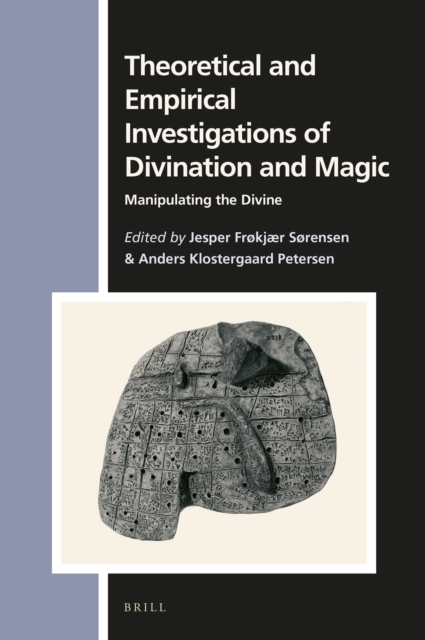
Theoretical and Empirical Investigations of Divination and Magic
In Theoretical and Empirical Investigations of Divination and Magic ten leading scholars of religion provide up-to-date investigations into these classic domains from historical, anthropological, cognitive, philosophical and theoretical perspectives.
eBook
Traces of Necromantic Divinatory Practices in the Picatrix
In the famous medieval magical manual called the Picatrix, the unknown author describes the phenomenon of magic with the term nigromantia. As is well known, the original meaning of the Greek term necromantia has a more concise meaning. It is used for a special kind of divination, i.e., divination through the parts of a cadaver and the conjured spirit of the dead. Seemingly, in the Picatrix, no necromantic ritual can be found; moreover, the author stresses that his main goal is pious, i.e., to find the path leading to the ultimate source of the universe, the one and only God. In my article, I show that on some pages of the Picatrix, there are traces of divinatory practices that may be connected to the original meaning of the term nigromantia. In the third book of the manual, descriptions of some interesting rituals attributed to the pagan Sabeans of Harran and their teacher, the god Hermes can be found. During the practices, the magician involved conjured spirits of the heavenly bodies and powers as well. Because of this, by looking closely at and analyzing the given text, it is possible to piece together a complex web of necromantic and demonic divinatory rituals.
Journal Article
Whose Soul Is It?—Destinative Magic in East-Central Europe (14th–18th Centuries)
This study explores destinative elements in late medieval and early modern learned magic in East-Central Europe, focusing on names, images, characters, invocations, and addresses facilitating communication with transcendental entities. It contends that a thematic shift occurred in the early modern era, witnessing a decline in destinative talisman texts, replaced by a surge in treasure-hunting manuals. Drawing from legal cases and treasure-hunting manuals, the research aims to categorize the “souls” frequently invoked in these practices. The term “souls” is interpreted as either spirits or the souls of the deceased, reflecting the significant role of the dead in treasure hunting, often conducted in cemeteries. This shift is linked to changes in the sociocultural background of practitioners, marking a transformation in magical practices from destinative talismans to treasure hunting, revealing a nuanced evolution in East-Central European magical traditions.
Journal Article
The Dead in Vernacular Magic Practices among Bosniaks
Based on fieldwork research among the Bosniak (Muslim) population in rural areas of Bosnia and Herzegovina, this article starts with the technique of summoning the dead, aimed at obtaining information about missing goods. It argues that the practice of summoning the dead, like practices aimed at magically harming others, is based on the same moral rules that govern everyday relations between the living and the dead. While these rules are generally followed and observed in everyday life, they can also be deliberately inverted to one’s own advantage or to the disadvantage of others. Ultimately, I argue that the dead prove to be moral agents who act when moral norms are violated.
Journal Article

Disenchanting Albert the Great
Albert the Great (1200-1280) was a prominent Dominican friar, a
leading philosopher, and the teacher of Thomas Aquinas. He also
endorsed the use of magic. Controversial though that stance would
have been, Albert was never punished or repudiated for what he
wrote. Albert's reception followed instead a markedly different
course, leading ultimately to his canonization by the Catholic
Church in 1931. But his thoughts about magic have been debated for
centuries. Disenchanting Albert the Great takes Albert's
contested reputation as a case study for the long and complex
history surrounding the concept of magic and magic's relationship
to science and religion.
Over the centuries, Albert was celebrated for his magic, or it
was explained away-but he was never condemned. In the fifteenth
century, members of learned circles first attempted to distance
Albert from magic, with the goal of exonerating him of
superstition, irrationality, and immorality. Disenchanting
Albert the Great discusses the philosopher's own understanding
of magic; an early, adulatory phase of his reputation as a
magician; and the three primary strategies used to exonerate Albert
over the centuries.
In the end, Disenchanting Albert the Great tells the
story of a thirteenth-century scholar who worked to disenchant the
natural world with his ideas about magic but who himself would not
be disenchanted until the modern era. This accessible and
insightful history will appeal to those interested in Albert the
Great, Catholic Church history, the history of magic, and Western
understandings of the natural and the rational over time.
eBook

Necromancy as the Threat to Civilisation Development
This article views ‘necromancy’ as the phenomenon that gradually deprives people of their evolutionarily acquired qualities, i.e. sensuality, will, emotions and reason. Using the method of historical retrospective analysis for the technical activities of previous eras, the authors state that mechanisation, dating back to the Renaissance, leads to the transformation of the human into a creature dependent on machines. Pursuant to the method of interpreting a number of notions and concepts of the philosophy of technology and social philosophy (‘necromancer’, ‘simulacrum’, etc.), it is shown that in modern society necromancy leads to the imposition of technical thinking on the rest of humanity, the transformation of states into automated weapons factories, and the total spread of death. Based on the application of the development and interconnection principles, it was proven that the necromatic tendencies of technology are significantly strengthened as the might and the centralisation of power grow. This connection is most evident in modern wars, where technology plays a crucial role. People need to recognise the now greatly exaggerated place of technology in the structure of social activities. The preservation of human freedom and dignity, the achievements of civilisation on the basis of establishing ‘eternal peace’ (Immanuel Kant) depends on the level of responsibility of scientists, politicians and ordinary people for their future.
Journal Article