
Catalogue Search | MBRL


Are you sure you want to remove the book from the shelf?

{{itemTitle}}
71
result(s) for
"Neighborhood government California Los Angeles."
Sort by:


South Central is home : race and the power of community investment in Los Angeles
South Central Los Angeles is often characterized as an African American community beset by poverty and economic neglect. But this depiction obscures the significant Latina/o population that has called South Central home since the 1970s. More significantly, it conceals the efforts African American and Latina/o residents have made together in shaping their community. As residents have faced increasing challenges from diminished government social services, economic disinvestment, immigration enforcement, and police surveillance, they have come together in their struggle for belonging and justice. South Central Is Home investigates the development of relational community formation and highlights how communities of color like South Central experience racism and discrimination—and how in the best of situations, they are energized to improve their conditions together. Tracking the demographic shifts in South Central from 1945 to the present, Abigail Rosas shows how financial institutions, War on Poverty programs like Headstart for school children, and community health centers emerged as crucial sites where neighbors engaged one another over what was best for their community. Through this work, Rosas illuminates the promise of community building, offering findings indispensable to our understandings of race, community, and place in U.S. society.
eBook

Shameful Victory
On May 8, 1959, the evening news shocked Los Angeles residents, who saw LA County sheriffs carrying a Mexican American woman from her home in Chavez Ravine not far from downtown. Immediately afterward, the house was bulldozed to the ground. This violent act was the last step in the forced eviction of 3,500 families from the unique hilltop barrio that in 1962 became the home of the Los Angeles Dodgers.John H. M. Laslett offers a new interpretation of the Chavez Ravine tragedy, paying special attention to the early history of the barrio, the reform of Los Angeles's destructive urban renewal policies, and the influence of the evictions on the collective memory of the Mexican American community.In addition to examining the political decisions made by power brokers at city hall,Shameful Victoryargues that the tragedy exerted a much greater influence on the history of the Los Angeles civil rights movement than has hitherto been appreciated. The author also sheds fresh light on how the community grew, on the experience of individual home owners who were evicted from the barrio, and on the influence that the event had on the development of recent Chicano/a popular music, drama, and literature.
eBook
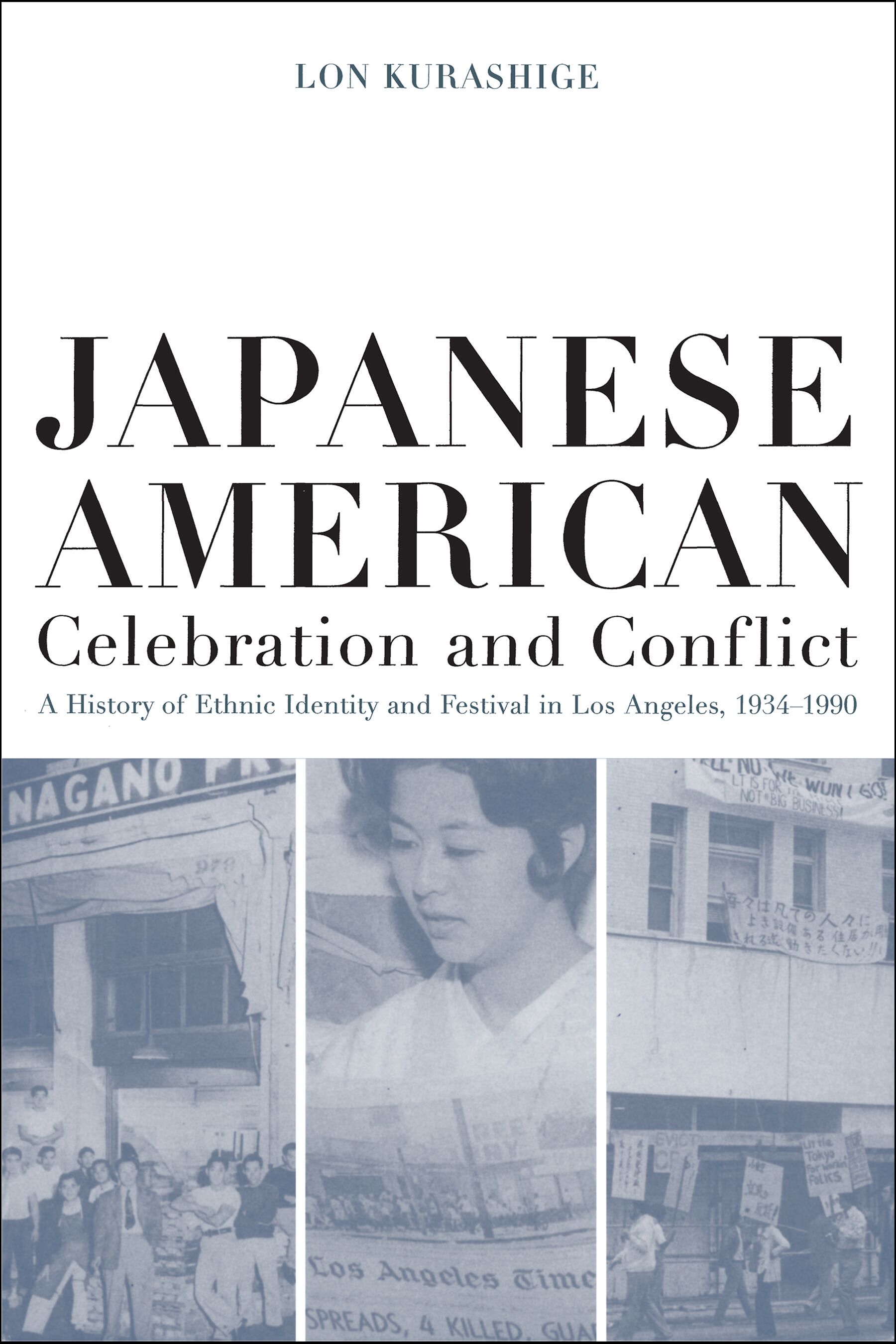
Japanese American Celebration and Conflict
Do racial minorities in the United States assimilate to American values and institutions, or do they retain ethnic ties and cultures? In exploring the Japanese American experience, Lon Kurashige recasts this tangled debate by examining what assimilation and ethnic retention have meant to a particular community over a long period of time. This is an inner history, in which the group identity of one of America's most noteworthy racial minorities takes shape. From the 1930s, when Japanese immigrants controlled sizable ethnic enclaves, to the tragic wartime internment and postwar decades punctuated by dramatic class mobility, racial protest, and the influx of economic investment from Japan, the story is fraught with conflict. The narrative centers on Nisei Week in Los Angeles, the largest annual Japanese celebration in the United States. The celebration is a critical site of political conflict, and the ways it has changed over the years reflect the ongoing competition over what it has meant to be Japanese American. Kurashige reveals, subtly and with attention to gender issues, the tensions that emerged at different moments, not only between those who emphasized Japanese ethnicity and those who stressed American orientation, but also between generations and classes in this complex community.
eBook

From 'Rabble Management' to 'Recovery Management'
Over the past three decades, scholars have documented the emergence of a new model of urban governance predicated on the spatial exclusion of visible poverty. In order to revitalise and recommodify the prime spaces of the urban core, municipal leaders enlist the police to coercively relocate homeless people to marginal spaces. Unfortunately, little is known about the policing of homelessness in those areas into which homeless people are exiled. To address this lacuna, this article employs an ethnographic analysis of police patrols in Los Angeles' Skid Row district. The findings demonstrate that, contrary to the dominant framework of exclusion, policing in marginal space takes on a disciplinary model of 'recovery management' designed to coercively shepherd homeless people into rehabilitative programmes and ameliorate the individual pathologies deemed responsible for homelessness. The article thus provides an analysis of how, why and with what consequences the policing of homelessness varies over space.
Journal Article

Does Race Matter in Government Funding of Nonprofit Human Service Organizations? The Interaction of Neighborhood Poverty and Race
Salamon (Salamon, Lester. M. 1995. Partners in public service. Baltimore, MD: The John Hopkins Univ. Press) and others have argued that government and nonprofit human service organizations work in partnership to address poverty, with government funding the efforts of nonprofits that provide services to the poor. However, this approach does not consider how the racial composition of high-poverty neighborhoods might influence government's willingness to support the nonprofit human service organizations that locate in them. Using data from a probability sample of nonprofit human service organizations in Los Angeles County that were surveyed in 2002, I estimate logit models predicting receipt of government funding. In neighborhoods with a low percentage of African Americans, I find that greater poverty increases the likelihood that the organization will receive government funding. As the percentage of African Americans increases, however, the relationship between government funding and poverty is reversed. Findings suggest that the influence of race on the government–nonprofit partnership in serving poor neighborhoods is an important, if overlooked, issue that should take its place in scholarship on government–nonprofit relations and policy analysis.
Journal Article

Why Some Immigrant Neighborhoods Are Safer than Others: Divergent Findings from Los Angeles and Chicago
Contrary to popular opinion, scholarly research has documented that immigrant communities are some of the safest places around. Studies repeatedly find that immigrant concentration is either negatively associated with neighborhood crime rates or not related to crime at all. But are immigrant neighborhoods always safer places? How does the larger community context within which immigrant neighborhoods are situated condition the immigration-crime relationship? Building on the existing literature, this study examines the relationship between immigrant concentration and violent crime across neighborhoods in Los Angeles and Chicago—two cities with significant and diverse immigrant populations. Of particular interest is whether neighborhoods with high levels of immigrant concentration that are situated within larger immigrant communities are especially likely to enjoy reduced crime rates. This was found to be the case in Chicago but not in Los Angeles, where neighborhoods with greater levels of immigrant concentration experienced higher, not lower, violent crime rates when located within larger immigrant communities. We speculate on the various factors that may account for the divergent findings.
Journal Article

Toward \Strong Democracy\ in Global Cities? Social Capital Building, Theory-Driven Reform, and the Los Angeles Neighborhood Council Experience
With faith in government waning, cultural diversity spiralingy and fiscal stress straining the ability of policy makers to address the policy challenges accompanying these developments, the salience of (re) connecting citizens with government takes on renewed urgency today. Nowhere is this more the case than in urban America, where so-called global cities teeming with ethnic diversity and controlling a disproportionate amount of global business in the world economy confront profound citizen participation challenges, choices, and opportunities. In this installment of Thoery to Practice, the authors cull lessons from their 10-year action theory-based assessment and participation in the city of Los Angeles' neighborhood council experience. Comparing and contrasting their findings in this global city with those from related studies on participatory mechanisms and deliberative processes more generally, they offer six lessons for those seeking to build stronger democracy in urban areas, argue that further advances require a greater research focus on the longitudinal implementation of these efforts rather than just on their design, and contend that university researchers have a role to play in these efforts as long as they appreciate the paradoxical nature of their participation. Expert e-commentary by Brian Cook of Virginia Tech, Tina Nabatchi of Syracuse University, and John Thomas of Georgia State University on the perspectives and arguments culled from Los Angeles' theory-based participatory efforts can be found on the PAR website (go to aspanet. org, click on the link to PAR, and then on the Theory to Practice link). These e-commentaries are accompanied by the authors' response and instructions on how PAR readers can join the exchange.
Journal Article
Success Attained, Deterred, and Denied: Divergent Pathways to Social Mobility in Los Angeles's New Second Generation
This article highlights divergent pathways to mobility among members of the new second generation, identifies key mechanisms affecting the choices they make in their pursuit of success, and explains how specific choices were pivotal in determining outcomes of segmented assimilation. First, the authors evaluate definitions of success and pathways to social mobility, advancing a subject-centered approach to study secondgeneration mobility. Second, the article turns to the results from the authors' ongoing qualitative study of the new second generation in Los Angeles to examine cases that exemplify predictable and anomalous outcomes. Third, the authors zoom in on patterns that emerge from real-life histories to clarify key mechanisms affecting the decisions made by members of the second generation that are consequential in shaping their paths to mobility. The study dispels some enduring myths about group-based cultures, stereotypes, and processes of assimilation. It also advances theoretical debates about intergenerational mobility and immigrant incorporation.
Journal Article
Residential Assistance and Recovery Following the Northridge Earthquake
This paper examines the implementation of post-disaster US federal assistance programmes for residential reconstruction and investigates the relationship between sociodemographic characteristics of places and access to residential assistance following the Northridge earthquake that hit Los Angeles in 1994. The paper also examines the effects of the distribution of assistance on long-term recovery outcomes. Findings suggest that areas with high levels of socially marginalised populations were at a disadvantage in accessing federal residential assistance. Findings also show that the long-term effects of the earthquake differed depending on levels of assistance relative to damage. Areas that received less assistance experienced losses in population and housing units. These findings indicate that post-disaster recovery programmes in the US do not adequately address the wide range of housing needs that emerge in the case of a major disaster in a large metropolitan area. Implications for post-disaster planning as well as for planning under everyday conditions are discussed.
Journal Article