
Catalogue Search | MBRL


Are you sure you want to remove the book from the shelf?

{{itemTitle}}
226
result(s) for
"Neo-Nazism"
Sort by:

Life trajectories into and out of contemporary neo-Nazism : becoming and unbecoming the hateful other
\"This book provides the first comprehensive sociological study of the contemporary National Socialist movement in Sweden, including how it has developed since the 1990s until the present. It covers the ideas and political aspects of the movement, as well as the subjective and very personal stories told by young men and women who in some cases have left the movement and in others remained. Through a large number of detailed stories of the movement's violence, hatred, and ideology, as well as stories of the life plans and dreams involved in re-entering society, the study on which the book is based provides knowledge, hope and new directions for studies on the National Socialist movement. Additionally, the book provides innovative research on the relation between the life trajectories of National Socialists and their significant others, allowing us to establish better and more scientific strategies for preventing radicalization and promoting de-radicalization. The book is aimed for students of sociology, social science and researchers studying hate movements and violent extremism. It is also meant for professionals such as teachers, social workers and youth workers who may encounter radicalization in their work being a vital contribution for policymakers within the field\"-- Provided by publisher.
Book

Alice in charge
Along with the usual concerns of senior year in high school, Alice faces some very difficult situations, including vandalism by a group of Neo-Nazis and a friend's confession that a teacher has been taking advantage of her.
Book
POLITICS OF FORGETTING AND COUNTER MEMORY IN CONTEMPORARY ICELANDIC LITERATURE: SJÓN AND RED MILK
This article discusses the trajectory of cultural memory in post-war Icelandic literature and culture. It draws on works from literary scholars and historians who have shown the difference between the memorialization of World War II in Iceland and elsewhere in Europe. It shows how the lack of social and cultural discussion of the war is influenced by different political and social forces and how it has been limited in scope and ambition. The article shows that there are, however, exceptions to this and takes as its case study the work of the Icelandic writer shown and in particular his novel Red Milk which tells the story of one young Icelandic man’s fascination with Neo-Nazism in the aftermath of World War II.
Journal Article

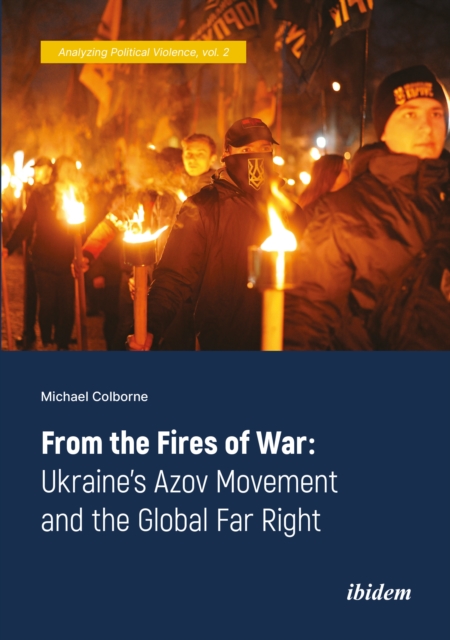
From the Fires of War: Ukraine’s Azov Movement and the Global Far Right
From its roots in revolution and war, Ukraine’s Azov movement has grown from a militia of fringe far-right figures and football hooligans fending off Russian-backed forces into a multipronged social movement that has become the envy of the global far right. In this first English-language book on the Azov movement, Michael Colborne explains how Azov came to be and continues to exploit Ukraine’s fractured social and political situation—including the only ongoing war on European soil – to build one of the most ambitious and dangerous far-right movements in the world.
eBook

I just want to be the friendly face of national socialism
This article is based on a case study of the media narratives of the neo-Nazi organisation Nordic Resistance Movement (NRM) and situates this particular actor within the broader landscape of violent extremism in Sweden today. Drawing on a qualitative content analysis informed by narrative inquiry, I examine various cultural expressions of neo-Nazi ideology in NRM's extensive repertoire of online media. Theoretically, I turn to cultural perspectives on violent extremism to bring to centre stage the role of popular culture and entertainment in the construction of a meaningful narrative of community and belonging built around neo-Nazism in Sweden today. The analysis explores the convergence between different genres, styles, and content into new cultural expressions of national socialism which bleed into mainstream Internet culture and political discourse in new ways. In the online universe of NRM, the extreme blends with the mainstream, the mundane and ordinary with the spectacular and provocative, and the serious with the silly. In this manner, the analysis lays bare the strategies through which NRM seeks to soften, trivialise, and normalise neo-Nazi discourse using the power and appeal of culture and entertainment.
Journal Article

Hitler, for Example: Registers of National Socialist Exemplarity in Contemporary Germany
This article examines whether and how the figure of Adolf Hitler in particular, and National Socialism more generally, operate as moral exemplars in today’s Germany. In conversation with similar studies about Mosely in England, Franco in Spain, and Mussolini in Italy, it seeks to advance our comparative understanding of neofascism in Europe and beyond. In Germany, legal and discursive constraints limit what can be said about the Third Reich period, while even far-right nationalists often condemn Hitler, for either the Holocaust or his military failure. Here I revise the concept of moral exemplarity as elaborated by Caroline Humphry to argue that Hitler and National Socialism do nevertheless work as contemporary exemplars, in at least three fashions: negativity, substitution, and extension. First, they stand as the most extreme markers of negative exemplarity for broad publics that understand them as illustrations of absolute moral depravity. Second, while Hitler himself is widely unpopular, Führer-substitutes such as Rudolf Hess provide alternative figures that German nationalists admire and seek to emulate. Finally, by extension to the realm of the ordinary, National Socialism introduces a cast of exemplars in the figures of loving grandfathers or anonymous fallen soldiers. The moral values for which they stand, I show, appear to be particularly significant for young nationalists. An extended, more open-ended notion of exemplarity, I conclude, can offer important insights about the lingering afterlife of fascist figures in the moral life of European nationalists today.
Journal Article

Death Cults and Dystopian Scenarios: Neo-Nazi Religion and Literature in the USA Today
In this article, I investigate the literary representation of the religious convictions and political strategy of neo-Nazi ideologues who are influential in rightwing authoritarian movements in the USA today. The reason that I do this is because in contemporary fascism, the novel has replaced the political manifesto, the military manual and proselytizing testimony, since fiction can evade censorship and avoid prosecution. I read William Luther Pierce’s Turner Diaries and Hunter together with his text on speculative metaphysics and religious belief, Cosmotheism. Then, I turn to Harold Covington’s Northwestern Quintet with The Brigade, reading this with Christian Identity and his own conception of Nazi religious tolerance. Finally, I look at OT Gunnarsson’s Hear the Cradle Song, reading this together with discussions of racism in Californian Odinism. I propose that what this literature shows is that the doctrinal differences between the three main strands of neo-Nazi religion—Cosmotheism, Christian Identity and Odinism—are less significant than their common ideological functions. These are twofold: (1) the sacralization of violence and (2) the sanctification of elites. The dystopian fictions of fascist literature present civil war scenarios whose white nationalist and genocidal outcome is the result of what are, strictly speaking, supremacist death cults.
Journal Article