
Catalogue Search | MBRL


Are you sure you want to remove the book from the shelf?

{{itemTitle}}
20
result(s) for
"Neon signs History."
Sort by:

Flickering light : a history of neon
Without neon, Las Vegas might still be a sleepy desert town in Nevada and Times Square merely another busy intersection in New York City. Transformed by the installation of these brightly colored signs, these destinations are now world-famous, representing the vibrant heart of popular culture. But for some, neon lighting represents the worst of commercialism. Energized by the conflicting love and hatred people have for neon, Flickering Light explores its technological and intellectual history, from the discovery of the noble gas in late nineteenth-century London to its fading popularity today. Christoph Ribbat follows writers, artists, and musicians-from cultural critic Theodor Adorno, British rock band the Verve, and artist Tracey Emin to Vladimir Nabokov, Langston Hughes, and American country singers-through the neon cities in Europe, America, and Asia, demonstrating how they turned these blinking lights and letters into metaphors of the modern era. He examines how gifted craftsmen carefully sculpted neon advertisements, introducing elegance to modern metropolises during neon's heyday between the wars followed by its subsequent popularity in Las Vegas during the 1950s and '60s. Ribbat ends with a melancholy discussion of neon's decline, describing how these glowing signs and installations came to be seen as dated and characteristic of run-down neighborhoods. From elaborate neon lighting displays to neglected diner signs with unlit letters, Flickering Light tells the engrossing story of how a glowing tube of gas took over the world-and faded almost as quickly as it arrived.
Book
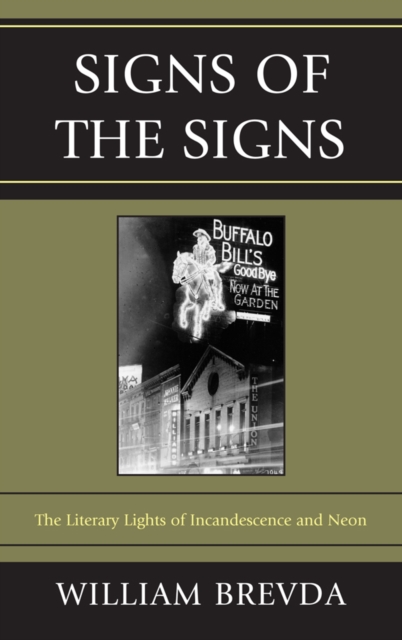
Signs of the signs
This book is a study of signs in American literature and culture. It is mainly about electric signs, but also deals with non-electric signs and related phenomena, such as movie sets. The \"sign\" is considered in both the architectural and semiotic senses of the word. It is argued that the drama and spectacle of the electric sign called attention to the semiotic implications of the \"sign.\" In fiction, poetry, and commentary, the electric sign became a \"sign\" of manifold meanings that this book explores: a sign of the city, a sign of America, a sign of the twentieth century, a sign of modernism, a sign of postmodernism, a sign of noir, a sign of naturalism, a sign of the beats, a sign of signs systems (the Bible to Broadway), a sign of tropes (the Great White way to the neon jungle), a sign of the writers themselves, a sign of the sign itself. If Moby Dick is the great American novel, then it is also the great American novel about signs, as the prologue maintains. The chapters that follow demonstrate that the sign is indeed a \"sign\" of American literature. After the electric sign was invented, it influenced Stephen Crane to become a nightlight impressionist and Theodore Dreiser to make the \"fire sign\" his metaphor for the city. An actual Broadway sign might have inspired F. Scott Fitzgerald's The Great Gatsby. In Manhattan Transfer and U.S.A., John Dos Passos portrayed America as just a spectacular sign. William Faulkner's electric signs are full of sound and fury signifying modernity. The Last Tycoon was a sign of Fitzgerald's decline. The signs of noir can be traced to Poe's \"The Man of the Crowd.\" Absence flickers in the neons of Raymond Chandler's Los Angeles. The death of God haunts the neon wilderness of Nelson Algren. Hitler's \"empire\" was an non-intentional parody of Nathanael West's California. The beats reinvented Times Square in their own image. Jack Kerouac's search for the center of Saturday night was a quest for transcendence.
eBook

Neon
IT WAS THE RAZOR GANGS who brought light to Kings Cross. By the end of the 1920s the Cross may have been described as Sydney’s Montmartre, but its reputation was also that of a wicked dark place festering with crime. John Milton wrote, ‘When night darkens the streets, then wander forth the sons of Belial, flown with insolence and wine.’ This baleful observation was something that the Sydney City Commissioners agreed with and in 1929 they determined that Kings Cross and William Street would be so brightly illuminated ‘that it will be impossible for a visitor from “the Loo” or
Book Chapter

Neon
Neon lights beckon us toward a future city seen from another era. In films like Tokyo Drifter (Seijun Suzuki, 1966) the neon sign, multilingual and cosmopolitan, uprooted and floating above the banalities of the street, presents a vision of the city to come, a spectacular space where light is dedicated to the cause of commerce. Littered with brand names, it speaks a commercial lingua franca founded on a handful of keywords like “shopping” and “new.” Glimpsed in close-up, these neon signs are more than the backdrop for the tale of a vagabond gangster; they are worthy of attention in their
Book Chapter
Star Tribune (Minneapolis) Streetscapes column
\"How far do you have to go in allowing the ... newer owners to make changes in order to save the building?\" The danger of leaving the buildings undesignated became clear for some Park Avenue enthusiasts recently when the 22nd Street home of George Peavey, son of grain elevator pioneer and Peavey Plaza namesake Frank Peavey, was converted from an at-risk-youth center to a mosque. [...]the historic portion of the home remains largely unused, since opening it for public access would require changes like installing an elevator. \"Since the Shriners had it since '29, there were a lot of things that were grandfathered in as far as ADA compliance and such,\" said Scott McMahon, St. Mary's associate vice president for external affairs.
Newsletter

Preserving Neon History
Fifteen years ago, LUMENS Creator Al Nodal approached the then-owners of L.A.'s Broadway-Hollywood building with an offer to relight their rooftop sign at the city's expense with a three-year parts and labor maintenance clause and a five-year clause offering to pay all electricity related to the sign, says [Kim Koga]. (LUMENS has restored three other L.A. landmark neon signs-the Los Angeles Theater, the KRKD Broadway Tour, and the Palace Theater.)
Trade Publication Article
The Record, Stockton, Calif., Michael Fitzgerald column
There are disc (Frisbee) golf holes, parkour obstacles, retro streetlamps, and the usual picnic tables, benches and play sets. The builders fenced off the ravine edges with a single strand of heavy steel cable strung through wooden posts.
Newsletter

The Neon Boneyard by Night
Epstein presents her experience in the organized tour The Neon Boneyard by Night at Neon Museum in Las Vegas NV on Apr 19, 2018. It was organized by National Council on Public History (NCPH). The museum is located in a residential area not far from downtown Las Vegas, is a loving memorial to the history of the casinos and hotels as represented by their most important features, the bright, gaudy, extragavant neon signs that began lighting up the city starting in the 1930s and 1940s.
Book Review