
Catalogue Search | MBRL


Are you sure you want to remove the book from the shelf?

{{itemTitle}}
174
result(s) for
"Netherlands Hague."
Sort by:


International courts and mass atrocity : narratives of war and justice in Croatia
The extra-legal effects of international and domestic war crimes trials continue to puzzle researchers and practitioners. In the former Yugoslav states, the legacy of conflict and issues of transitional justice remains central in politics, society and culture. This work provides a new theoretical and methodological approach to one of these puzzles: why universal human rights norms become distorted or undermined when they reach local publics. It investigates the social and cultural contexts that transitional justice processes take place in by looking at how emotional everyday narratives can hamper the spread of norms in society. In Croatia, these narratives define how the public understands the rule of law, history and minority rights.
Book

Pinkas, Kahal, and the Mediene
This comparative analysis of the records of four Ashkenazi communities in the Dutch Republic of the eighteenth century reveals new insights into the administrative structures and processes of these communities and into the records themselves.
eBook

A conviction in question : the first trial at the International Criminal Court
\"An engrossing narrative of the first case to appear at the International Criminal Court, 'A Conviction in Question' documents the trial of Union of Congolese Patriots leader and warlord Thomas Lubanga Dyilo. Although Lubanga's crimes - including murder, rape, and the forcible conscription of child soldiers - were indisputable, legal wrangling and a clash of personalities caused the trial to be prolonged for an unprecedented six years. This book offers an accessible account of the rapid evolution of international law and the controversial trial at the foundation of the International Criminal Court. A Conviction in Question examines the legal issues behind each of the trial's critical moments, including the participation of Lubanga's victims at the trial and the impact of witness protection. Through eye-witness observation and analysis, Jim Freedman shows that the trial suffered from all the problems associated with ordinary criminal law trials, and uses the Lubanga case to further comment on the role of international courts in a contemporary global context.\"--Book jacket.
Book

The Witnesses
In recent years, the world community has demonstrated a renewed commitment to the pursuit of international criminal justice. In 1993, the United Nations established two ad hoc international tribunals to try those responsible for genocide and crimes against humanity in the former Yugoslavia and Rwanda. Ten years later, the International Criminal Court began its operations and is developing prosecutions in its first two cases (Congo and Uganda). Meanwhile, national and hybrid war crimes tribunals have been established in Sierra Leone, Kosovo, Serbia and Montenegro, Croatia, Bosnia and Herzegovina, East Timor, Indonesia, Iraq, and Cambodia. Thousands of people have given testimony before these courts. Most have witnessed war crimes, including mass killings, torture, rape, inhumane imprisonment, forced expulsion, and the destruction of homes and villages. For many, testifying in a war crimes trial requires great courage, especially as they are well aware that war criminals still walk the streets of their villages and towns. Yet despite these risks, little attention has been paid to the fate of witnesses of mass atrocity. Nor do we know much about their experiences testifying before an international tribunal or the effect of such testimony on their return to their postwar communities. The first study of victims and witnesses who have testified before an international war crimes tribunal,The Witnessesexamines the opinions and attitudes of eighty-seven individuals-Bosnians, Muslims, Serbs, and Croats-who have appeared before the International Criminal Tribunal for the former Yugoslavia.
eBook

The Investigator
The war that broke out in the former Yugoslavia at the end of the twentieth century unleashed unspeakable acts of violence committed against defenseless civilians, including a grizzly mass murder at an Ovčara pig farm in 1991. An international tribunal was set up to try the perpetrators of crimes such as this, and one of the accused was Slavko Dokmanović, who at the time was the mayor of a local town. Vladimír Dzuro, a criminal detective from Prague, was one of the investigators charged with discovering what happened on that horrific night at Ovčara. The story Dzuro presents here, drawn from his daily notes, is devastating. It was a time of brutal torture, random killings, and the disappearance of innocent people. Dzuro provides a gripping account of how he and a handful of other investigators picked up the barest of leads that eventually led them to the gravesite where they exhumed the bodies. They were able to track down Dokmanović, only to find that taking him into custody was a different story altogether. The politics that led to the war hindered justice once it ended. Without any thoughts of risk to their own personal safety, Dzuro and his colleagues were determined to bring Dokmanović to justice. In addition to the story of the pursuit and arrest of Dokmanović, emThe Investigator/em provides a realistic picture of the war crime investigations that led to the successful prosecution of a number of war criminals. Visit warcrimeinvestigator.com for more information or watch a book trailer.
eBook
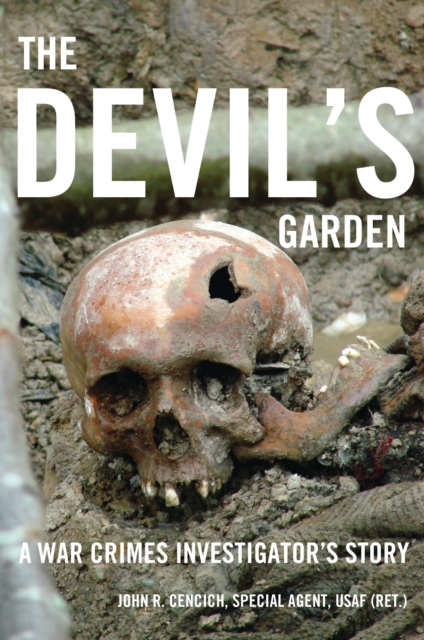
The Devil's Garden
In 2002 John Cencich traveled to a safe house in Belgrade to interview the former head of a Yugoslav secret intelligence agency. In less than an hour, Cencich had what he needed: corroboration of information provided by another spy. This evidence would be used against Slobodan Miloševic in his war crimes trial at The Hague. For the veteran United Nations war crimes investigator, however, the mission was business as usual.The Devil's Gardenis the inside story of the investigation and indictment of Slobodan Miloševic and the identification of fifteen coperpetrators in the joint criminal enterprise (JCE) that had resulted in the massacre of thousands of civilians. As the senior American investigator at The Hague, Cencich drew up the investigative plan, codeveloped the prosecution theory of the JCE, and wrote the first significant draft of the indictment. He also led the international team of police investigators, detectives, and special agents on the case against Miloševic and his inner circle of secret police, assassins, spies, terrorists, underworld figures, and murderous paramilitary leaders for crimes committed throughout Croatia. Here, readers will travel alongside Cencich as he journeys to The Hague and will see how these once-in-a-lifetime experiences affect him to this day. Detailing one of the largest international criminal investigations ever undertaken, this book is a unique blend of history, international law, and true crime in Europe's deadliest battles since World War II.
eBook

Justice in a time of war : the true story behind the international criminal tribunal for the former Yugoslavia
Can we achieve justice during war? Should law substitute for realpolitik? Can an international court act against the global community that created it?
Justice in a Time of War is a translation from the French of the first complete, behind-the-scenes story of the International Criminal Tribunal for the Former Yugoslavia, from its proposal by Balkan journalist Mirko Klarin through recent developments in the first trial of its ultimate quarry, Slobodan Miloševic. It is also a meditation on the conflicting intersection of law and politics in achieving justice and peace.
Le Monde’s review (November 3, 2000) of the original edition recommended Hazan’s book as a nuanced account of the Tribunal that should be a must-read for the new president of Yugoslavia. “The story Pierre Hazan tells is that of an institution which, over the course of the years, has managed to escape in large measure from the initial hidden motives and manipulations of those who created it (not only the Americans).”
With insider interviews filling out every scene, author Pierre Hazan tells a chaotic story of war while the Western powers cobbled together a tribunal in order to avoid actual intervention, hoping to threaten international criminals with indictment and thereby to force an untenable peace. The international lawyers and judges for this rump world court started with nothing—no office space, no assistants, no computers, not even a budget—but they ultimately established the tribunal as an unavoidable actor in the Balkans. This development was also a reflection of the evolving political situation: the West had created the Tribunal in 1993 as an alibi in order to avoid military intervention, but in 1999, the Tribunal suddenly became useful to NATO countries as a means by which to criminalize Miloševic’s regime and to justify military intervention in Kosovo and in Serbia. Ultimately, this hastened the end of Miloševic’s rule and led the way to history’s first war crimes trial of a former president by an international tribunal.
Ironically, this triumph for international law was not really intended by the Western leaders who created the court. They sought to placate, not shape, public opinion. But the determination of a handful of people working at the Tribunal transformed it into an active agent for change, paving the road for the International Criminal Court and greatly advancing international criminal law. Yet the Tribunal’s existence poses as many questions as it answers. How independent can a U.N. Tribunal be from the political powers that created it and sustain it politically and financially ?
Hazan remains cautious though optimistic for the future of international justice. His history remains a cautionary tale to the reader: realizing ideals in a world enamored of realpolitik is a difficult and often haphazard activity.
eBook
The Milošević trial : an autopsy
This book examines the most controversial war crimes trial of the modern era and its contested legacy for the growing fields of international criminal law and post-conflict justice. The international trial of Slobodan Milošević, who presided over the violent collapse of Yugoslavia, was already among the longest war crimes trials when Milošević died in 2006. Yet precisely because it ended without judgment, its significance and legacy are specially contested. The chapters here examine the meaning of the trial's termination and its implications for post-conflict justice. The book's approach is intensively cross-disciplinary, weighing the implications for law, politics, and society that modern war crimes trials create.
eBook