
Catalogue Search | MBRL


Are you sure you want to remove the book from the shelf?

{{itemTitle}}
792
result(s) for
"Netherlands Politics and government."
Sort by:


A tiny spot on the earth
In this survey of the Dutch political culture of the nineteenth and twentieth centuries, Piet de Rooij reveals that the \"polder model\" often used to describe economic and social policymaking based on consensus is a myth. Instead, modern political culture in the Dutch Low Countries began with a revolution and is rife with rivalries among political and ideological factions. He argues that because of its extremely open economy, the country is vulnerable to external political, cultural, and economic pressures, and Dutch politics is a balancing act between profiting from international developments and maintaining sovereignty. The sudden rise of populism and Euroscepticism at the turn of the millennium, then, indicated a loss of this balance. Shining new light on the political culture of the Netherlands, this book provides insights into the polder model and the principles of pillarization in Dutch society.
eBook

The Dutch in the early modern world : a history of a global power
\"Emerging at the turn of the seventeenth century, the Dutch Republic rose to become a powerhouse of economic growth, artistic creativity, military innovation, religious tolerance and intellectual development\"-- Provided by publisher.
Book

The ideology of the extreme right
Though the extreme right was not particularly successful in the 1999 European elections, it continues to be a major factor in the politics of Western Europe. This book, newly available in paperback, provides a comprehensive and detailed analysis of the extreme right in the Netherlands (Centrumdemocraten, Centrumpartij'86), Belgium (Vlaams Blok) and Germany (Die Republikaner, Deutsche Volksunion). On the basis of original research - using party literature - the author concludes that though individual parties might stress different issues, the extreme right party family does share a core ideology of nationalism, xenophobia, welfare chauvinism, and law and order. The author's research and conclusions clearly have broader implications for the study of the extreme right phenomenon and party ideology in general, and the book should be of interest to anyone studying or researching in the areas of European politics, political ideologies, political parties, extremism, racism or nationalism.
eBook

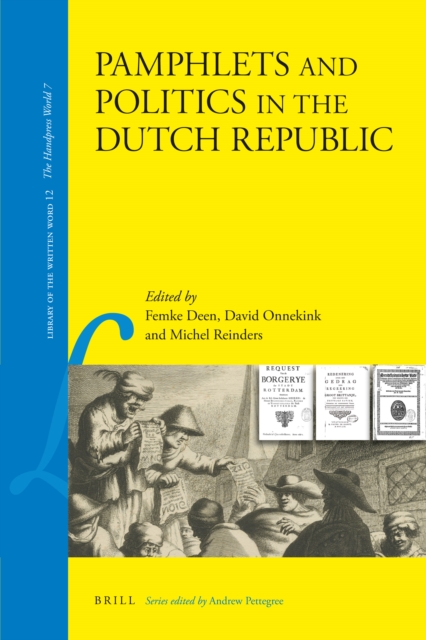
Pamphlets and Politics in the Dutch Republic
This volume explores the relationship between politics and pamphleteering in the Dutch Republic. By analyzing the political role of pamphlets and their interplay with other media in public debates, the articles provide a new understanding of Dutch political culture.
eBook

Britain and the Dutch revolt, 1560-1700
England's response to the Revolt of the Netherlands (1568-1648) has been studied hitherto mainly in terms of government policy, yet the Dutch struggle with Habsburg Spain affected a much wider community than just the English political elite. It attracted attention across Britain and drew not just statesmen and diplomats but also soldiers, merchants, religious refugees, journalists, travellers and students into the conflict. Hugh Dunthorne draws on pamphlet literature to reveal how British contemporaries viewed the progress of their near neighbours' rebellion, and assesses the lasting impact which the Revolt and the rise of the Dutch Republic had on Britain's domestic history. The book explores affinities between the Dutch Revolt and the British civil wars of the seventeenth century - the first major challenges to royal authority in modern times - showing how much Britain's changing commercial, religious and political culture owed to the country's involvement with events across the North Sea. -- Publisher website.
Book
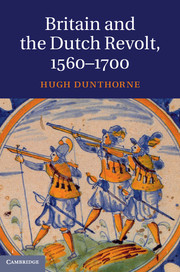
Britain and the Dutch Revolt 1560–1700
England's response to the Revolt of the Netherlands (1568–1648) has been studied hitherto mainly in terms of government policy, yet the Dutch struggle with Habsburg Spain affected a much wider community than just the English political elite. It attracted attention across Britain and drew not just statesmen and diplomats but also soldiers, merchants, religious refugees, journalists, travellers and students into the conflict. Hugh Dunthorne draws on pamphlet literature to reveal how British contemporaries viewed the progress of their near neighbours' rebellion, and assesses the lasting impact which the Revolt and the rise of the Dutch Republic had on Britain's domestic history. The book explores affinities between the Dutch Revolt and the British civil wars of the seventeenth century - the first major challenges to royal authority in modern times - showing how much Britain's changing commercial, religious and political culture owed to the country's involvement with events across the North Sea.
eBook


Commercial Republicanism in the Dutch Golden Age
This book is the first comprehensive study of the radical political thought of the brothers Johan and Pieter de la Court, two eminent theorists from the seventeenth-century Dutch Republic who played a pivotal role in the rise of commercial republicanism.
eBook