
Catalogue Search | MBRL


Are you sure you want to remove the book from the shelf?

{{itemTitle}}
67
result(s) for
"Netherlands-Economic conditions"
Sort by:

Subversive seas : anti-colonial networks across the twentieth-century Dutch empire
\"This revealing portrait of the Dutch Empire repositions our understanding of modern empires from the terrestrial to the oceanic. It highlights the importance of shipping, port cities, and maritime culture to the political struggles of the 1920s and 30s. Port cities such as Jeddah, Shanghai, and Batavia were hotbeds for the spread of nationalism, communism, pan-Islamism, and pan-Asianism and became important centers of opposition to Dutch imperialism through the circulation of passengers, laborers, and religious pilgrims. In response to growing maritime threats, the Dutch government and shipping companies attempted to secure oceanic spaces and maintain hegemony abroad through a web of control. Techniques included maritime policing networks, close collaboration with British and French surveillance entities ashore, and maintaining segregation on ships, which was meant to \"teach\" those on board their position within imperial hierarchies. This innovative study exposes how anti-colonialism was shaped not only within the terrestrial confines of metropole and colony, but across the transoceanic spaces in between. Kris Alexanderson is Assistant Professor of History at the University of the Pacific\"-- Provided by publisher.
Book
The Political Economy of the Dutch Republic
In the first half of the seventeenth century the Dutch Republic emerged as one of Europe's leading maritime powers. The political and military leadership of this small country was based on large-scale borrowing from an increasingly wealthy middle class of merchants, manufacturers and regents This volume presents the first comprehensive account of the political economy of the Dutch republic from the sixteenth to the early nineteenth century. Building on earlier scholarship and extensive new evidence it tackles two main issues: the effect of political revolution on property rights and public finance, and the ability of the nation to renegotiate issues of taxation and government borrowing in changing political circumstances. The essays in this volume chart the Republic's rise during the seventeenth century, and its subsequent decline as other European nations adopted the Dutch financial model and warfare bankrupted the state in the eighteenth century. By following the United Provinces's financial ability to respond to the changing national and international circumstances across a three-hundred year period, much can be learned not only about the Dutch experience, but the wider European implications as well.
eBook


Coordination in Transition
Coordination in Transition analyzes the evolution of the institutional structure of the Dutch political economy since 1950, focusing on the constant adaptation of deliberative institutions to structural economic change.
eBook

The dirty secret of early modern capitalism : the global reach of the Dutch arms trade, warfare and mercenaries in the seventeenth century
\"This book shows how the Dutch accumulation of great wealth was closely linked to their involvement in warfare. By charting Dutch activity across the globe, it explores Dutch participation in the international arms trade, and in wars both at home and abroad. In doing so, it ponders the issue of how capitalism has often historically thrived best when its practitioners are ruthless and ignore the human cost of their search for riches. This complicates the traditional Marxist understanding of capitalists as middle-class exploiters in arguing for a much greater agency among lower-class Dutch soldiers and sailors in their efforts to benefit from skills that were in high demand\"-- Provided by publisher.
Book
An Economic and Social History of the Netherlands, 1800–1920
An Economic and Social History of the Netherlands, 1800–1920 provides a comprehensive account of Dutch history from the late eighteenth to the early twentieth century, examining population and health, the economy, and socio-political history. The Dutch experience in this period is fascinating and instructive: the country saw extremely rapid population growth, awesome death rates, staggering fertility, some of the fastest economic growth in the world, a uniquely large and efficient service sector, a vast and profitable overseas empire, characteristic 'pillarization', and relative tolerance. Michael Wintle also examines the lives of ordinary people: what they ate, how much they earned, what they thought about public affairs, and how they wooed and wed. This book will be of central importance to Dutch specialists, as well as European historians more generally.
eBook

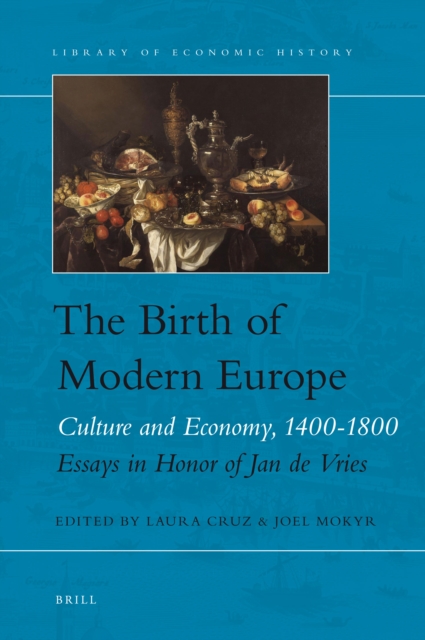
The Birth of Modern Europe
It seems undeniable that Jan de Vries has cast an indelible impression upon the field of early modern economic history. Utilizing the methods and concepts pioneered by de Vries, the contributors in this Festschrift display the depth and breadth of his influence, with applications ranging from trade to architecture, from the Netherlands to China, and from the 1400s to the present day.
eBook

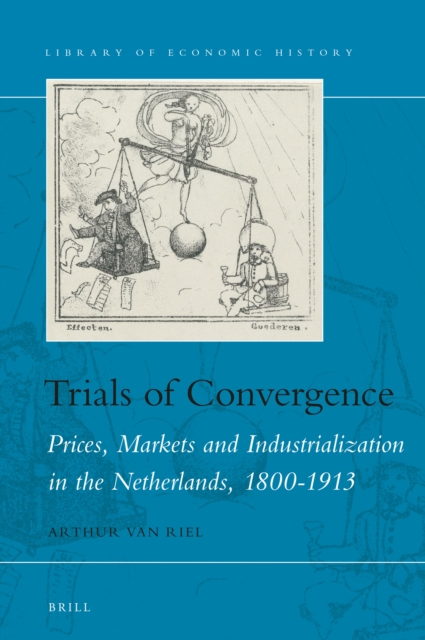
Trials of convergence : prices, markets and industrialization in the Netherlands, 1800-1913
Trials of Convergence analyses the nineteenth century industrialization of the Netherlands from the perspective of prices and factor costs. It shows that its retarded transition was due to the confluent effect of open economy forces, endowments and the erratic adjustment of economic and fiscal institutions.
eBook