
Catalogue Search | MBRL


Are you sure you want to remove the book from the shelf?

{{itemTitle}}
180
result(s) for
"Neumes"
Sort by:


On the Evidence that Confirms the Continuity of Georgian Chant Tradition
The texts of Georgian polyphonic chants (heirmoi), written down in the 19th century using the European notational system, can be found in mediaeval musical manuscripts as well. Is there any connection between these two sources with at least ten century-long time difference? The article reveals nine heirmoi with the final cadences of their last clauses having similar patterns of neume symbol arrangement and similar melodies in corresponding musical scores. The correlation between the earliest and latest melody types has been established. By obtaining the exact probability of occurring this kind of correspondence the strength of the relationship has been assessed. Based on the fact, that the probability obtained proved to be very small, the hypothesis of pure chance has been rejected. The following conclusion has been drawn: it is very likely that despite the faults of the oral transmission method mediaeval hymns safely reached the 19th century due to the non-interrupted musical tradition.
Journal Article

Handhabung – Handzeichen – Musikalische Handstücke
Signs and graphic characters are frozen acts that can be ascribed to hand and finger movements as well as arm and body gestures. The body’s ability to memorize movements, which are activated externally and informs actions like singing, is called cheironomy in music theory. This ensured an oral-gestic tradition before music was written down in mensural and neumatic notation, a process that was initially welcomed as a rationalizing advancement that fascilitated memory and made a more precise codification of musical meaning visable and readily accessible. The question remains, however, whether notation represents progress compared to a performance using hand gestures (whereby the oral-mimetic impulses of music are mostly lost), or whether present day conducting is able to surpass these original impulses.
Journal Article
Handhabung – Handzeichen – Musikalische Handstücke
Signs and graphic characters are frozen acts that can be ascribed to hand and finger movements as well as arm and body gestures. The body’s ability to memorize movements, which are activated externally and informs actions like singing, is called cheironomy in music theory. This ensured an oral-gestic tradition before music was written down in mensural and neumatic notation, a process that was initially welcomed as a rationalizing advancement that fascilitated memory and made a more precise codification of musical meaning visable and readily accessible. The question remains, however, whether notation represents progress compared to a performance using hand gestures (whereby the oral-mimetic impulses of music are mostly lost), or whether present day conducting is able to surpass these original impulses.
Journal Article

O vis eternitatis, Text Expression, and Performance in the Music of Hildegard von Bingen
The article analyzes the responsory O vis eternitatis, the symbolic opening of Hildegard von Bingen’s primary music collection, to show how Hildegard’s musical choices support the key words and concepts of the composition. It examines usual components of construction, such as mode, melisma, range, and repetition, and shows that the piece is suffused with repetition in a manner not previously detailed. The article also explores a feature usually overlooked in writings on Hildegard’s music: the employment of ornamental neumes to highlight text, identifying instances of unusual frequency or rare use of specific neumes. The article then compares three significantly different recordings of O vis eternitatis, concluding that modern difficulties in the performance of ornamental neumes mean that our renditions today can never fully realize Hildegard’s conceptions. Stripped of their ornaments, Hildegard’s compositions resemble statuary from antiquity that has lost its original paint over the centuries—no longer as the creator intended, but still beautiful and deeply pleasing.
Journal Article
Hartker, Gregor und die Taube
An analysis of Ekkehard IV’s statements shows that the well-known image of “Gregor and the Dove” is not intended as a legitimization of the St. Gallen neumes but rather to impart corrective authority on the manuscript in order to confer authority to its owner. Drawing on further illustrations and dedication texts, the author comes to the conclusion that the neumes prescribe an avoidance of faulty chanting and thus disclose to what extent liturgical singing was being controlled. The core of sung liturgy emerges as “chanted theology.”
Journal Article
Hartker, Gregor und die Taube
An analysis of Ekkehard IV’s statements shows that the well-known image of “Gregor and the Dove” is not intended as a legitimization of the St. Gallen neumes but rather to impart corrective authority on the manuscript in order to confer authority to its owner. Drawing on further illustrations and dedication texts, the author comes to the conclusion that the neumes prescribe an avoidance of faulty chanting and thus disclose to what extent liturgical singing was being controlled. The core of sung liturgy emerges as “chanted theology.”
Journal Article
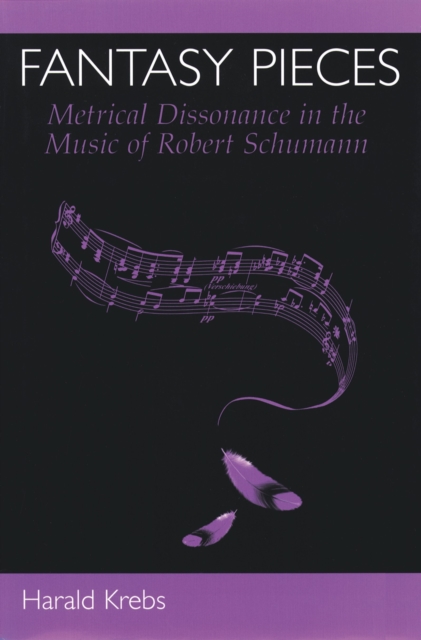
Fantasy pieces : metrical dissonance in the music of Robert Schumann
This book, written in the form of a series of dialogues between the Schumannian characters Florestan and Eusebius, proposes a theory of metrical conflict that rigorously develops the metaphorical application of the concepts of consonance and dissonance to metrical phenomena. An introductory chapter traces the history of this metaphor from its origins in the early 19th century through to the 20th century. In a series of theoretical chapters, the book then presents detailed descriptions of various types of metrical dissonances (particularly important types are grouping dissonance — based on the association of incongruent metrical layers, and displacement dissonance — based on the non-aligned presentation of congruent layers); a system of labels to characterize specific dissonances; explanations of musical processes that arise from the formation, manipulation, and resolution of these dissonances; and a discussion of the interaction of metrical dissonance with pitch structure, form, and extramusical elements. The emphasis throughout is on the description of the ever-changing metrical states within pieces of music, and on the characterization of the metrical progressions formed by these changing states. The theoretical chapters are interspersed with three intermezzi that adopt a historical or performance-related approach to the topic; these deal, respectively, with influences on Schumann's metrical style; with Schumann's compositional process as it relates to metrical dissonance; and with performance issues arising from metrically dissonant passages. Throughout the book, the theory is applied mainly in the analysis of Robert Schumann's music, but analyses of the music of 18th-century, other 19th-century, and early 20th-century composers are also included.
eBook

Universal Neumes: Chant Theory in Messiaen’s Aesthetics
Gregorian chant exerted a pivotal influence on Olivier Messiaen’s spiritual and musical universe. Scholars have noted his theological preference for this repertoire and its central role in his organ playing, and have observed how some of Messiaen’s melodies contain obvious traces from chants. Recent analytical work has ventured further and shown how plainchant in fact served as a melodic and formal matrix behind the composer’s musical language. This article raises the additional claim that Messiaen’s employment of plainchant rested upon an idiosyncratic and questionable – but largely coherent – theory of neumes as a more or less universal feature in music. A quasi-archaeological reconstruction proves necessary to reconstruct this conception from the composer’s fragmentary and enigmatic statements. The article investigates Messiaen’s readings of Vincent d’Indy and Dom André Mocquereau, including ideas from Hugo Riemann, showing that rhythm is a most central element in their similar connections between chant and freedom of expressivity in contemporary music. All in all, chant theory is highlighted as a vital element in analyses of Messiaen’s own music, as well as a theoretical framework that explains many of the composer’s seemingly eclectic connections between different repertoires.
Journal Article

Optical Medieval Music Recognition—A Complete Pipeline for Historic Chants
Manual transcription of music is a tedious work, which can be greatly facilitated by optical music recognition (OMR) software. However, OMR software is error prone in particular for older handwritten documents. This paper introduces and evaluates a pipeline that automates the entire OMR workflow in the context of the Corpus Monodicum project, enabling the transcription of historical chants. In addition to typical OMR tasks such as staff line detection, layout detection, and symbol recognition, the rarely addressed tasks of text and syllable recognition and assignment of syllables to symbols are tackled. For quantitative and qualitative evaluation, we use documents written in square notation developed in the 11th–12th century, but the methods apply to many other notations as well. Quantitative evaluation measures the number of necessary interventions for correction, which are about 0.4% for layout recognition including the division of text in chants, 2.4% for symbol recognition including pitch and reading order and 2.3% for syllable alignment with correct text and symbols. Qualitative evaluation showed an efficiency gain compared to manual transcription with an elaborate tool by a factor of about 9. In a second use case with printed chants in similar notation from the “Graduale Synopticum”, the evaluation results for symbols are much better except for syllable alignment indicating the difficulty of this task.
Journal Article