
Catalogue Search | MBRL


Are you sure you want to remove the book from the shelf?

{{itemTitle}}
180,251
result(s) for
"Neural Networks (Computer)"
Sort by:


Advanced deep learning with TensorFlow 2 and Keras : apply DL, GANs, VAEs, deep RL, unsupervised learning, object detection and segmentation, and more
A second edition of the bestselling guide to exploring and mastering deep learning with Keras, updated to include TensorFlow 2.x with new chapters on object detection, semantic segmentation, and unsupervised learning using mutual information.
eBook
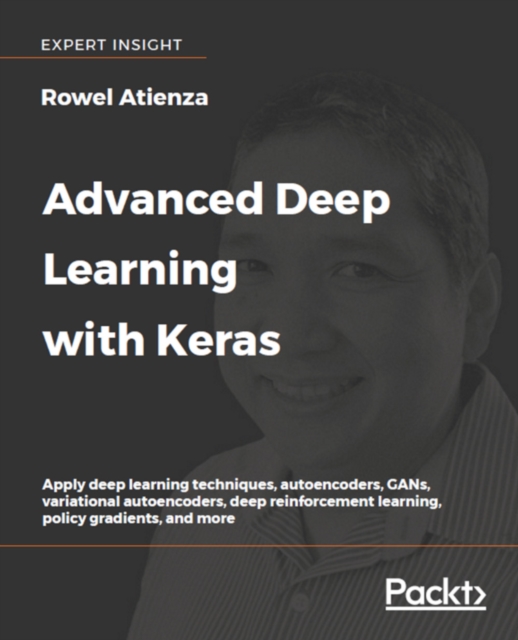
Advanced Deep Learning with Keras
This book covers advanced deep learning techniques to create successful AI. Using MLPs, CNNs, and RNNs as building blocks to more advanced techniques, you'll study deep neural network architectures, Autoencoders, Generative Adversarial Networks (GANs), Variational AutoEncoders (VAEs), and Deep Reinforcement Learning (DRL) critical to many.
eBook


Deep Learning with Pytorch Quick Start Guide
PyTorch is extremely powerful and yet easy to learn. It provides advanced features such as supporting multiprocessor, distributed and parallel computation. This book is an excellent entry point for those wanting to explore deep learning with PyTorch to harness its power.
eBook

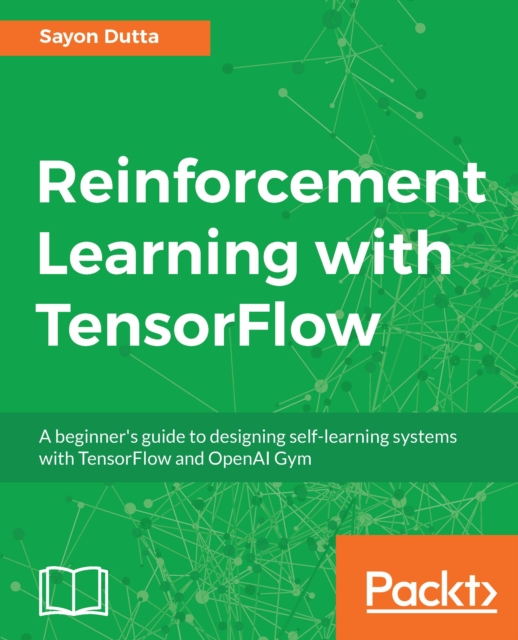
Reinforcement Learning with TensorFlow
Reinforcement learning allows you to develop intelligent, self-learning systems. This book shows you how to put the concepts of Reinforcement Learning to train efficient models.You will use popular reinforcement learning algorithms to implement use-cases in image processing and NLP, by combining the power of TensorFlow and OpenAI Gym.
eBook

Robust optimization of spline models and complex regulatory networks : theory, methods and applications
This book introduces methods of robust optimization in multivariate adaptive regression splines (MARS) and Conic MARS in order to handle uncertainty and non-linearity. The proposed techniques are implemented and explained in two-model regulatory systems that can be found in the financial sector and in the contexts of banking, environmental protection, system biology and medicine. The book provides necessary background information on multi-model regulatory networks, optimization and regression. It presents the theory of and approaches to robust (conic) multivariate adaptive regression splines - R(C)MARS - and robust (conic) generalized partial linear models - R(C)GPLM - under polyhedral uncertainty. Further, it introduces spline regression models for multi-model regulatory networks and interprets (C)MARS results based on different datasets for the implementation. It explains robust optimization in these models in terms of both the theory and methodology. In this context it studies R(C)MARS results with different uncertainty scenarios for a numerical example. Lastly, the book demonstrates the implementation of the method in a number of applications from the financial, energy, and environmental sectors, and provides an outlook on future research.
Book

A Proof that Artificial Neural Networks Overcome the Curse of Dimensionality in the Numerical Approximation of Black–Scholes Partial Differential Equations
Artificial neural networks (ANNs) have very successfully been used in numerical simulations for a series of computational problems
ranging from image classification/image recognition, speech recognition, time series analysis, game intelligence, and computational
advertising to numerical approximations of partial differential equations (PDEs). Such numerical simulations suggest that ANNs have the
capacity to very efficiently approximate high-dimensional functions and, especially, indicate that ANNs seem to admit the fundamental
power to overcome the curse of dimensionality when approximating the high-dimensional functions appearing in the above named
computational problems. There are a series of rigorous mathematical approximation results for ANNs in the scientific literature. Some of
them prove convergence without convergence rates and some of these mathematical results even rigorously establish convergence rates but
there are only a few special cases where mathematical results can rigorously explain the empirical success of ANNs when approximating
high-dimensional functions. The key contribution of this article is to disclose that ANNs can efficiently approximate high-dimensional
functions in the case of numerical approximations of Black-Scholes PDEs. More precisely, this work reveals that the number of required
parameters of an ANN to approximate the solution of the Black-Scholes PDE grows at most polynomially in both the reciprocal of the
prescribed approximation accuracy
eBook