
Catalogue Search | MBRL


Are you sure you want to remove the book from the shelf?

{{itemTitle}}
27,627
result(s) for
"New Jersey"
Sort by:

Driving after class : anxious times in an American suburb
\"A paradoxical situation emerged in the late 1990s: the dramatic upscaling of the suburban American dream, even as the possibilities for achieving and maintaining it diminished. Driving After Class explores middle-class anxieties and suburban life during those years. Drawing on nineteen months of ethnographic research in a suburban New Jersey town as McMansions sprouted up next to subdivisions of moderately sized colonial-style homes and infrastructural essentials like schools and roads became overburdened, each chapter throws into relief subtle gradations within the middle class and among middle-class sensibilities, and brings to life the ways that people were reorienting themselves--both consciously and unconsciously--to the discursive and material displacement of postwar liberal approaches to middle-class life in favor of newly dominant neoliberal logics. The ethnographic moments illustrated in the book, drawn from fieldwork in people's homes, their town hall, and their SUVs, reveal the ways that efforts to appease feelings of insecurity--whether through place-making practices, childrearing strategies, or 'had-to-have' purchases--often made people (and their neighbors) feel and be less secure. The economics and cultural politics of the constellation of these ways of being, which I have termed 'rugged entitlement,' ended up steering many children, youth, and parents into ambivalence about the structuring and texture of their everyday lives: it is exhausting work to be strategically and persistently driving after class. But more often than not, unable to imagine the possibility of crafting another way of life, most curbed these unsettling doubts and resolutely fueled up for the ride\"--Provided by publisher.
Book

Soft Corruption
New Jersey has long been a breeding ground for political corruption, and most of it is perfectly legal. Public officials accept favors from lobbyists, give paid positions to relatives, and rig the electoral process to favor their cronies in a system where campaign money is used to buy government results. Such unethical behavior is known as \"soft corruption,\" and former New Jersey legislator William E. Schluter has been fighting it for the past fifty years.In this searing personal narrative, the former state senator recounts his fight to expose and reform these acts of government misconduct. Not afraid to cite specific cases of soft corruption in New Jersey politics, he paints a vivid portrait of public servants who care more about political power and personal gain than the public good. By recounting events that he witnessed firsthand in the Garden State, he provides dramatic illustrations of ills that afflict American politics nationwide.As he identifies five main forms of soft corruption, Schluter diagnoses the state government's ethical malaise, and offers concrete policy suggestions for how it might be cured. Not simply a dive through the muck of New Jersey politics,Soft Corruptionis an important first step to reforming our nation's political system, a book that will inspire readers to demand that our elected officials can and must do better.Visit:www.softcorruption.com(http://www.softcorruption.com)
eBook


The Life and Times of Richard J. Hughes
The Life and Times of Richard J. Hughesexplores the influential public service of this two-term New Jersey governor. He was the only person in New Jersey history to serve as both governor and chief justice of the New Jersey Supreme Court.
This biography illuminates the governor's accomplishments between 1962 and 1970, including the creation of the Hackensack Meadowlands Commission, formation of the county college system, establishment of stringent antipollution laws, design of the public defender system, and the adoption of a New Jersey sales tax, as well as his pivotal role during the Newark riots. As chief justice, Hughes faced difficult issuesùschool funding, low and moderate income housing needs, freedom of speech, and his decision in the rightto-die case involving Karen Ann Quinlan. With a career characterized by liberal activism, Hughes also contributed nationally and internationally, from serving as host of the 1964 Democratic National Convention to monitoring elections in South Vietnam.
John B. Wefing's research includes interviews with prominent politicians and leaders who worked with Hughes at various points in his career. The result is a rich story of a public servant who possessed a true ability to work with members of both political parties and played a significant role in shaping modern New Jersey.
eBook


Me, Governor?
Me, Governor? is a chronicle of local and state government from a man who lived among political movers and shakers for more than three decades. Richard J. Codey succeeded James McGreevey who resigned as governor of New Jersey following a homosexual affair. At once a political autobiography, filled with lively, incisive anecdotes that record how Codey restored respectability and set a record for good politics and good government in a state so often tarnished, this is also the story about a man and his family.
eBook

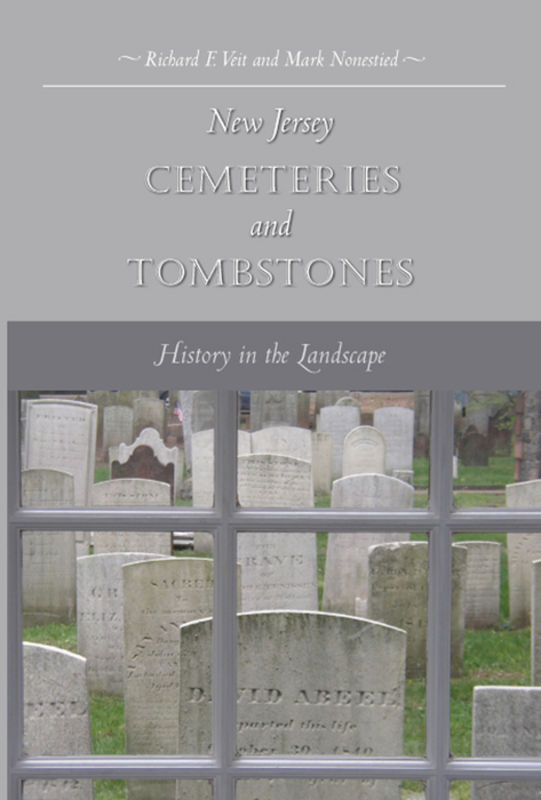
New Jersey Cemeteries and Tombstones
From the earliest memorials used by Native Americans to the elaborate structures of the present day, Richard Veit and Mark Nonestied use grave markers to take an off-beat look at New Jersey's history that is both fascinating and unique.New Jersey Cemeteries and Tombstones presents a culturally diverse account of New Jersey's historic burial places from High Point to Cape May and from the banks of the Delaware to the ocean-washed Shore, to explain what cemeteries tell us about people and the communities in which they lived. The evidence ranges from somber seventeenth-century decorations such as hourglasses and skulls that denoted the brevity of colonial life, to modern times where memorials, such as a life-size granite Mercedes Benz, reflect the materialism of the new millennium. Also considered are contemporary novelties such as pet cemeteries and what they reveal about today's culture. To tell their story the authors visited more than 1,000 burial grounds and interviewed numerous monument dealers and cemetarians.This richly illustrated book is essential reading for history buffs and indeed anyone who has ever wandered inquisitively through their local cemeteries.
eBook


Made in Newark
What does it mean to turn the public library or museum into a civic forum?Made in Newarkdescribes a turbulent industrial city at the dawn of the twentieth century and the ways it inspired the library's outspoken director, John Cotton Dana, to collaborate with industrialists, social workers, educators, and New Women.This is the story of experimental exhibitions in the library and the founding of the Newark Museum Associationùa project in which cultural literacy was intertwined with civics and consumption. Local artisans demonstrated crafts, connecting the cultural institution to the department store, school, and factory, all of which invoked the ideal of municipal patriotism. Today, as cultural institutions reappraise their relevance,Made in Newarkexplores precedents for contemporary debates over the ways the library and museum engage communities, define heritage in a multicultural era, and add value to the economy.
eBook