
Catalogue Search | MBRL


Are you sure you want to remove the book from the shelf?

{{itemTitle}}
26,039
result(s) for
"New Mexico."
Sort by:


Nuclear Nuevo México
In the 1940s military and scientific personnel chose the Pajarito
Plateau to site Project Y of the secret Manhattan Project, where
scientists developed the atomic bomb. Nuevomexicanas/os and Tewa
people were forcibly dispossessed from their ranches and sacred
land in north-central New Mexico with inequitable or no
compensation. Contrary to previous works that suppress
Nuevomexicana/o presence throughout U.S. nuclear history,
Nuclear Nuevo México focuses on recovering the voices and
stories that have been lost or ignored in the telling of this
history. By recuperating these narratives, Myrriah Gómez tells a
new story of New Mexico, one in which the nuclear history is not
separate from the collective colonial history of Nuevo México but
instead demonstrates how earlier eras of settler colonialism laid
the foundation for nuclear colonialism in New Mexico. Gómez
examines the experiences of Nuevomexicanas/os who have been
impacted by the nuclear industrial complex, both the weapons
industry and the commercial industry. Gómez argues that Los Alamos
was created as a racist project that targeted poor and
working-class Nuevomexicana/o farming families, along with their
Pueblo neighbors, to create a nuclear empire. The resulting
imperialism has left a legacy of disease and distress throughout
New Mexico that continues today.
eBook

African American history in New Mexico : portraits from five hundred years
\"Most people think of George McJunkin or the Buffalo Soldiers when they think about African American history in New Mexico, but their history is richer and more complex and continues to this day. This collection is aimed at providing an overview of the dynamic presence of African Americans throughout the state and its history\"--Provided by publisher.
Book
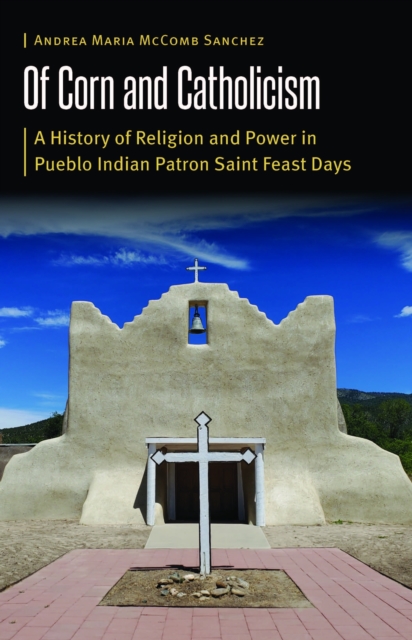
Of Corn and Catholicism
In
Of Corn and Catholicism Andrea Maria McComb Sanchez
examines the development of the patron saint feast days among
Eastern Pueblo Indians of New Mexico from the seventeenth century
to the late nineteenth century. Focusing on the ways Pueblo
religion intertwined with Spanish Catholicism, McComb Sanchez
explores feast days as sites of religious resistance,
accommodation, and appropriation. McComb Sanchez introduces the
term \"bounded incorporation\" to conceptualize how Eastern Pueblo
people kept boundaries flexible: as they incorporated aspects of
Catholicism, they changed Catholicism as well, making it part of
their traditional religious lifeway. McComb Sanchez uses archival
and published primary sources, anthropological records, and her
qualitative fieldwork to discuss how Pueblo religion was kept
secret and safe during the violence of seventeenth-century
Spanish colonialism in New Mexico; how Eastern Pueblos developed
strategies of resistance and accommodation, in addition to
secrecy, to deal with missionaries and Catholicism in the
eighteenth and early nineteenth centuries; how patron saint feast
days emerged as a way of incorporating a foreign religion on the
Pueblos' own terms; and how, by the later nineteenth century,
these feast days played a significant role in both Pueblo and
Hispano communities through the Pueblos' own initiative.
eBook

Village : a novel
This rollicking ride through a single day in the ill-fated village of San Marcos will leave you reeling with laughter, even as you cringe at the misadventures of the hapless Porter Clapp and his pitiable wife, Steph; the jaundiced Onesimo Moro and his ever-watchful spouse, Isabel; and the rest of Crawford's riotous cast. At this story's beginning, a meeting notice from the state water agency, posted at the local store, seems to portend an imminent threat to the valleys precious acequias. But perhaps more ominous--at least to the paranoid Clapp--is the possibility of the outside world meddling with the isolation, blissful or not, of this remote Hispanic plaza town. As the time of the meeting looms, we follow the characters through the day and become immersed in a place unnervingly familiar to anyone who has lived in Northern New Mexico. Crawford spares no one from his acerbic wit and skewering prose, yet there remains an unmistakable affection for the marvelously dysfunctional community and the very faults that he so eloquently parodies. As the tale unfolds, we dread the incipient threat from outside the valley less and begin to hope that something will deflect the downward spiral every character seems doomed to follow--but nothing anticipates or prepares us for the denouement that Crawford skillfully delivers, leaving us punch drunk with mirth.
Book

A Jumble of Needs
A Jumble of Needs examines the leadership of Mexican women immigrants in three colonias in New Mexico, documenting the role of NGOs in shaping women’s activism in these communities. Ethnographer Rebecca Dolhinow uncovers why such attempts to exercise political agency are so rarely successful, revealing that many NGOs promote neoliberal ideals, resulting in continued disenfranchisement, despite the women’s activism.
eBook


Chaco's Northern Prodigies
In the late eleventh and early twelfth centuries, the ancient pueblo sites of Aztec and Salmon in the Middle San Juan region rapidly emerged as population and political centers during the closing stages of Chaco's ascendancy.
eBook

New Mexico's high peaks : a photographic celebration
\"A collection of high quality photographs featuring the impressive summits in New Mexico, this work explores the history and ecology of the wilderness while also sharing Butterfield's tales and anecdotes of the Land of Enchantment\"-- Provided by publisher.
Book

Constructing Community
In central New Mexico, tourists admire the majestic ruins of old Spanish churches and historic pueblos at Abo, Quarai, and Gran Quivira in Salinas Pueblo Missions National Monument. The less-imposing remains of the earliest Indian farming settlements, however, have not attracted nearly as much notice from visitors or from professional archaeologists. InConstructing Community, Alison E. Rautman synthesizes over twenty years of research about this little-known period of early sedentary villages in the Salinas region.Rautman tackles a very broad topic: how archaeologists use material evidence to infer and imagine how people lived in the past, how they coped with everyday decisions and tensions, and how they created a sense of themselves and their place in the world. Using several different lines of evidence, she reconstructs what life was like for the ancestral Pueblo Indian people of Salinas, and identifies some of the specific strategies that they used to develop and sustain their villages over time.Examining evidence of each site's construction and developing spatial layout, Rautman traces changes in community organization across the architectural transitions from pithouses to jacal structures to unit pueblos, and finally to plaza-oriented pueblos. She finds that, in contrast to some other areas of the American Southwest, early villagers in Salinas repeatedly managed their built environment to emphasize the coherence and unity of the village as a whole. In this way, she argues, people in early farming villages across the Salinas region actively constructed and sustained a sense of social community.
eBook