
Catalogue Search | MBRL


Are you sure you want to remove the book from the shelf?

{{itemTitle}}
12
result(s) for
"New Spain Religion 16th century."
Sort by:


Dying in the law of Moses : crypto-Jewish martyrdom in the Iberian world
Miriam Bodian's study of crypto-Jewish martyrdom in Iberian lands depicts
a new type of martyr that emerged in the late 16th century -- a defiant, educated
judaizing martyr who engaged in disputes with inquisitors. By examining closely the
Inquisition dossiers of four men who were tried in the Iberian peninsula or Spanish
America and who developed judaizing theologies that drew from currents of
Reformation thinking that emphasized the authority of Scripture and the religious
autonomy of individual interpreters of Scripture, Miriam Bodian reveals unexpected
connections between Reformation thought and historic crypto-Judaism. The complex
personalities of the martyrs, acting in response to psychic and situational
pressures, emerge vividly from this absorbing book.
eBook

Sacred Habitat
Known as a time of revolutions in science, the early modern era
in Europe was characterized by the emergence of new disciplines and
ways of thinking. Taking this conceit a step further, Sacred
Habitat shows how Spanish friars and missionaries used new
scholarly approaches, methods, and empirical data from their
studies of ecology to promote Catholic goals and incorporate
American nature into centuries-old church traditions.
Ran Segev examines the interrelated connections between
Catholicism and geography, cosmography, and natural history-fields
of study that gained particular prominence during the sixteenth and
seventeenth centuries-and shows how these new bodies of knowledge
provided innovative ways of conceptualizing and transmitting
religious ideologies in the post-Reformation era. Weaving together
historical narratives on Spain and its colonies with scholarship on
the Catholic Reformation, Atlantic science, and environmental
history, Segev contends that knowledge about American nature
allowed pious Catholics to reconnect with their religious
traditions and enabled them to apply their beliefs to a foreign
land.
Sacred Habitat presents a fresh perspective on Catholic
renewal. Scholars of religion and historians of Spain, colonial
Latin America, and early modern science will welcome this
provocative intervention in the history of empire, science,
knowledge, and early modern Catholicism.
eBook
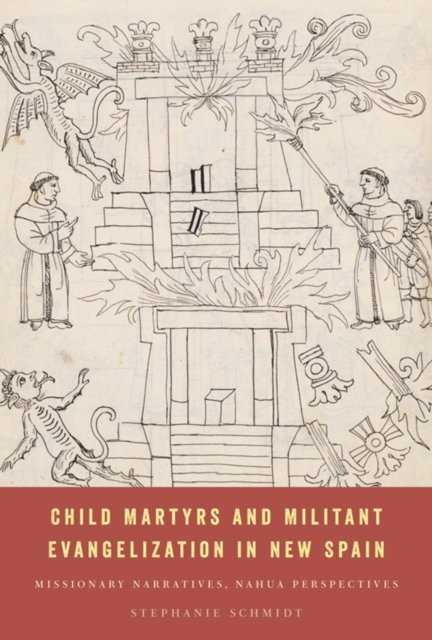
Child Martyrs and Militant Evangelization in New Spain
Examines the many iterations of a story of child
martyrdom in colonial Mexico.
A cornerstone of the evangelization of early New Spain was
the conversion of Nahua boys, especially the children of
elites. They were to be emissaries between Nahua society and
foreign missionaries, hastening the transmission of the gospel.
Under the tutelage of Franciscan friars, the boys also learned
to act with militant zeal. They sermonized and smashed sacred
objects. Some went so far as to kill a Nahua religious leader.
For three boys from Tlaxcala, the reprisals were just as
deadly.
In
Child Martyrs and Militant Evangelization in New
Spain , Stephanie Schmidt sheds light on a rare manuscript
about Nahua child converts who were killed for acts of zealotry
during the late 1520s. This is the Nahuatl version of an
account by an early missionary-friar, Toribio de Benavente
Motolinía. To this day, Catholics venerate the slain boys
as Christian martyrs who suffered for their piety. Yet
Franciscan accounts of the boys’ sacrifice were
influenced by ulterior motives, as the friars sought to deflect
attention from their missteps in New Spain. Illuminating Nahua
perspectives on this story and period, Schmidt leaves no doubt
as to who drove this violence as she dramatically expands the
knowledgebase available to students of colonial Latin
America.
eBook

Inquisition and Purity of Blood in Portugal during the Seventeenth Century
The aim of this paper is to analyse the role played by the Portuguese Holy Office in the process of social discrimination against New Christians, that is, those who were considered to be descendant of Jews converted to Christianity in the late fifteenth century. This article focuses specifically on the different and changing attitudes of the Inquisitors General to the issue of purity of blood during the seventeenth century. In the course of that century, some people considered to be New Christians (with fama or nota) managed to join the Portuguese Holy Office. Nevertheless, this was not due to the fact that Inquisitors General and members of the General Council rejected discrimination using theoretical, religious and moral arguments, but to the impossibility of achieving undoubtful knowledge about the origins of those seeking to join the Inquisition. At the same time, once racial discrimination became institutionalised within the Inquisition during the final third of the sixteenth century, the Inquisitors General became less concerned about the allegations of impure blood made about some of its ministers, so long as it could be demonstrated that they were good Christians and of use to the institution, or else capable of contributing to the specific personal interests of the tribunal’s rector. Nevertheless, not all supposed or real conversos succeeded in joining the Holy Office, as evidenced by cases of self-exclusion and the numerous proofs of “purity of blood” that were not approved. To address these questions, we turn to the proofs of “purity of blood” carried out by the Portuguese Inquisition, as well as to correspondence and documents from other institutions of the Portuguese and Spanish monarchies.
Journal Article
Sin and Synodality: The Struggles of the Third Mexican Council
This paper is a historical and contextual investigation of the practice of synods and synodality in the historical moment of the colonial Church of New Spain. Bishops, clergy, and religious orders vied for ecclesial and spiritual power against civil and royal authorities, and often even against themselves. The bishops of New Spain did not use the language of “enlarging the space of one’s tent”, but they were deeply and genuinely disturbed by the evils present concretely before the eyes of the Church. The Third Mexican Provincial Council of 1585 will be examined as a case study of how the Church has listened to and responded synodally to large-scale abuse of human dignity perpetuated and legitimized by the social order. The paper will then explore how the Council’s decrees anticipate modern notions of synodality. The historical perspective of the bishops of New Spain and contemporary documents of the Synod on Synodality will help form the basis for questions about how Christ is made central in synodal gatherings.
Journal Article
Settlement and Civility as Pre-Requisite of Evangelization in the Chichimeca Frontier
This paper delves into the process of evangelization undertaken by the Spanish in the northern frontier of New Spain during the 16th century, specifically targeting the nomadic Indigenous populations known as Chichimecas. Missionaries encountered unique challenges due to the absence of religious infrastructure, robust political authorities, and the nomadic lifestyle of these groups. To overcome these hurdles, the Spanish implemented a strategy that intertwined evangelization with colonization. The text highlights the significance of constructing physical infrastructure in these frontier territories, such as churches, schools, and dwellings, to facilitate the process of evangelization and colonial control. Moreover, it emphasizes the need to impose a social and political structure on these nomadic communities, transforming them into obedient colonial subjects.
Journal Article

Truth in Many Tongues
Truth in Many Tongues examines how the Spanish monarchy
managed an empire of unprecedented linguistic diversity.
Considering policies and strategies exerted within the Iberian
Peninsula and the New World during the sixteenth century, this book
challenges the assumption that the pervasiveness of the Spanish
language resulted from deliberate linguistic colonization.
Daniel I. Wasserman-Soler investigates the subtle and surprising
ways that Spanish monarchs and churchmen thought about language.
Drawing from inquisition reports and letters; royal and
ecclesiastical correspondence; records of church assemblies,
councils, and synods; and printed books in a variety of genres and
languages, he shows that Church and Crown officials had no single,
unified policy either for Castilian or for other languages. They
restricted Arabic in some contexts but not in others. They
advocated using Amerindian languages, though not in all cases. And
they thought about language in ways that modern categories cannot
explain: they were neither liberal nor conservative, neither
tolerant nor intolerant. In fact, Wasserman-Soler argues, they did
not think predominantly in terms of accommodation or assimilation,
categories that are common in contemporary scholarship on religious
missions. Rather, their actions reveal a highly practical
mentality, as they considered each context carefully before
deciding what would bring more souls into the Catholic Church.
Based upon original sources from more than thirty libraries and
archives in Spain, Italy, the United States, England, and Mexico,
Truth in Many Tongues will fascinate students and scholars
who specialize in early modern Spain, colonial Latin America,
Christian-Muslim relations, and early modern Catholicism.
eBook

Almost millenarian: a critical rereading of Gerónimo de Mendieta’s eschatological thought and its historiography
Franciscan Order stands as a central topic in the sixteenth century Spanish colonial history. Leaders of the spiritual conquest and early settlers of Mexico, Franciscans were among the first that recognized the importance of the New World recently discovered. Among them, fray Gerónimo de Mendieta is globally renowned as one of the most important personalities of his epoch. His works—several cartas, relaciones, and a complete and extensive chronicle—are considered an indispensable source of information. My essay will investigate how Mendieta and his writings were gradually discovered and then incorporated in the larger framework of the sixteenth century history. I will start from what I consider a “first tradition” of studies that runs from the publication of his works in the late eighteenth century until the first half of the nineteenth. I will continue with a “second tradition” that stressed Franciscan mysticism and outlined Mendieta’s role in shaping a “Millenarian Kingdom” of Franciscans in the New World. I will then investigate a third generation of scholars that criticized this latter configuration, and I will end by briefly presenting my own reflection about Mendieta and his works.
Journal Article

PRESENCIA E INFLUENCIA DE LOS PADRES DE LA IGLESIA EN LOS ALBORES DE LA SOCIEDAD NOVOHISPANA. PROPUESTAS METODOLÓGICAS Y LÍNEAS DE INVESTIGACIÓN PARA INVESTIGADORES LATINOAMERICANOS
This research is framed in the context of the social and religious thought of the 16th century in New Spain, with the objective of demonstrating the rich patristic influence in the religious society of the period studied. By analyzing several texts exhaustively, their patristic sources are identified from this double perspective: on the one hand, the specific use of texts and quotations from the Fathers of the Church by the novo-Hispanic writers, through a synchronic review, taking into account in most cases the year of composition of the work, even if its publication is later; secondly, locating relationships of influence or dependence of authors and works, some “textual traditions of novo-Hispanic texts” are pointed out. In this way, more than 850 patristic references are classified in the analyzed texts, thus contributing to the deepening of the theological and spiritual influences of the Novo-Hispanic religious thought of the 16th century. This proves that the knowledge and wide use of patristic texts by the novo-Hispanic authors in general, and the use of the Fathers of the Church in both catechetical and theological works in particular, are not something exclusive to some of the religious orders present in New Spain during the 16th century, but that all of them follow the theological method of the time and evoke the patristic teachings as auctoritas in their writings. In the end, it is proposed to apply this methodology of study in the fields of theological or patristic research in Latin America during the colonial period. Esta investigación se enmarca en el contexto del pensamiento social y religioso del siglo XVI novohispano, con el objetivo de demostrar la rica influencia patrística en la sociedad religiosa del periodo estudiado. Al analizar varios textos de forma exhaustiva, se identifican sus fuentes patrísticas desde esta doble perspectiva: por un lado, el uso específico de textos y citas de los Padres de la Iglesia por parte de los escritores novohispanos, a través de una revisión sincrónica, tomando en cuenta en la mayoría de los casos el año de composición de la obra, aunque su publicación sea posterior; en segundo lugar, ubicadas relaciones de influencia o dependencia de autores y obras, se señalan algunas “tradiciones textuales de textos novohispanos”. De este modo, se clasifican más de 850 referencias patrísticas en los textos analizados, contribuyendo así a la profundización de las influencias teológicas y espirituales del pensamiento religioso novohispano del siglo XVI. Esto comprueba que el conocimiento y amplia utilización de textos patrísticos por parte de los autores novohispanos en general, y la utilización de los Padres de la Iglesia en obras tanto catequéticas como teológicas en particular, no son algo exclusivo de algunas de las órdenes religiosas presentes en Nueva España durante el siglo XVI, sino que todas siguen el método teológico de la época y evocan las enseñanzas patrísticas como auctoritas en sus escritos. Al final se propone aplicar esta metodología de estudio en los campos de investigación teológica o patrística en Latinoamérica durante el periodo colonial.
Journal Article