
Catalogue Search | MBRL


Are you sure you want to remove the book from the shelf?

{{itemTitle}}
63
result(s) for
"New York (State) History Colonial period, ca. 1600-1775."
Sort by:

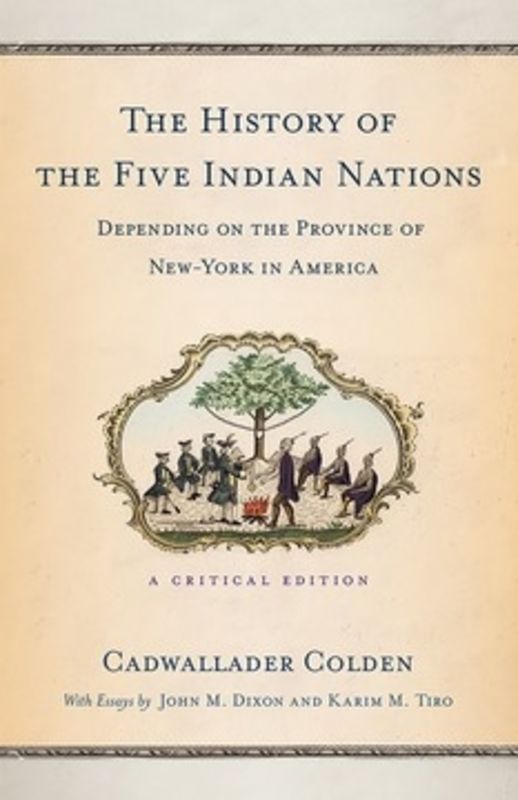
The History of the Five Indian Nations Depending on the Province of New-York in America
\"How should we approachThe History of the Five Indian Nationstoday? The book's information-rich as it is-should be critically interrogated and placed in social, political, and cultural context. The book reflects the outlook of a colonial British agent and, in a more general sense, of early modern European and Euro-American culture. Its claims of empirical objectivity should be historicized.\"-John M. Dixon, \"Imperial Politics, Enlightenment Philosophy, and Transatlantic Print Culture\"
\"The History of the Five Indian Nationsremains an invaluable font of information for understanding the Iroquois during the decades before European invaders began to pour into the Longhouse. Colden's account of Iroquois military and diplomatic exploits is studded with fascinating details. It illuminates internal and external political dynamics as well as the extent and limits of European colonial power. Colden did not necessarily comprehend the cultural logic that guided Iroquois people, but he appreciated them as agents-remarkably audacious ones-in the affairs of all of eastern North America.\"-Karim M. Tiro, \"Iroquois Ways of War and Peace\"
Cadwallader Colden'sHistory of the Five Indian Nations Depending on the Province of New-York in America, originally published in 1727 and revised in 1747, is one of the most important intellectual works published in eighteenth-century British America. Colden was among the most learned American men of his time, and his history of the Iroquois tribes makes fascinating reading. The author discusses the religion, manners, customs, laws, and forms of government of the confederacy of tribes composed of the Mohawks, Oneidas, Onondagas, Cayugas, and Senecas (and, later, the Tuscaroras), and gives accounts of battles, treaties, and trade with these Indians up to 1697.
Since Cornell University Press first reprinted Colden'sHistoryin 1958, the book has served as an invaluable resource for scholars and students interested in Iroquois history and culture, Enlightenment attitudes toward Native Americans, early American intellectual life, and Anglo-French imperial contests over North America. The new Critical Edition features materials not previously included, such as the 1747 introduction, which contains rich and detailed descriptions of Iroquois culture, government, economy, and society. New essays by John M. Dixon and Karim M. Tiro placeThe History of the Five Indian Nations Depending on the Province of New-York in Americain historical and cultural context and provide a balanced introduction to the historic culture of the Iroquois, as well as their relationship to other Native people.
eBook

The pirate's wife : the remarkable true story of Sarah Kidd
In work of narrative nonfiction filled with romance and high seas adventure, a historian and journalist charts the life of Sarah Kidd, who secretly aided and abetted her infamous husband, pirate Captain Kidd, from within the strictures of polite society in seventeenth- and eighteenth-century New York.
BOOK

The Shame and the Sorrow
The Dutch, through the directors of the West India Company, purchased Manhattan Island in 1625. They had come to the New World as traders, not expecting to assume responsibility as the sovereign possessor of a conquered New Netherland. They did not intend to make war on the native peoples around Manhattan Island, but they did; they did not intend to help destroy native cultures, but they did; they intended to be overseas the tolerant, pluralistic, and antimilitaristic people they thought themselves to be-and in so many respects were-at home, but they were not. For the Dutch intruders, establishing a settled presence away from the homeland meant the destabilization of the adventurers' values and self-regard. They found that the initially peaceful encounters with the indigenous people soon took on the alarming overtones of an insurgency as the influx of the Dutch led to a complete upheaval and eventual disintegration of the social and political worlds of the natives. How are the Dutch to be judged? Donna Merwick, inThe Shame and the Sorrow, asks this question. She points to a betrayal both of their own values and of the native peoples. She also directs us to the self-delusion of hegemonic control. Her work belongs alongside the best of today's postcolonial studies in the description of cross-cultural violence and subtle questioning of the nature of writing its history.
eBook

The European invasion of North America : colonial conflict along the Hudson-Champlain corridor, 1609-1760
\"This comprehensive resource follows the pivotal and often overlooked efforts of the Iroquois Confederacy, the Dutch, the French, and the English colonies to control the strategic waterways of the Hudson-Champlain corridor from their discovery to the fall of New France\"-- Provided by publisher.
Book

Stuyvesant Bound
Stuyvesant Boundis an innovative and compelling evaluation of the last director general of New Netherland. Donna Merwick examines the layers of culture in which Peter Stuyvesant forged his career and performed his responsibilities, ultimately reappraising the view of Stuyvesant long held by the majority of U.S. historians and commentators. Borrowing its form from the genre of eighteenth- and nineteenth-?century learned essays,Stuyvesant Boundinvites the reader to step into a premodern worldview as Merwick considers Stuyvesant's role in history from the perspectives of duty, belief, and loss. Stuyvesant is presented as a mid-seventeenth-century magistrate obliged by his official oath to manage New Netherland, including installing Calvinist politics and belief practices under the fragile conditions of early modern spirituality after the Protestant Reformation. Merwick meticulously reconstructs the process by which Stuyvesant became his own archivist and historian when, recalled to The Hague to answer for his surrender of New Netherland in 1664, he gathered together papers amounting to almost 50,000 words and offered them to the States General. Though Merwick weaves the theme of loss throughout this meditation on Stuyvesant's career, the association culminates in New Netherland's fall to the English in 1664 and Stuyvesant's immediate recall to Holland to defend his surrender. Rigorously researched and unabashedly interpretive,Stuyvesant Boundmakes a major contribution to recovery of the cultural and religious diversity that marked colonial America.
eBook


New Netherland : a Dutch colony in seventeenth-century America
This volume covers the history of the Dutch colony New Netherland on the North American continent, dealing with themes such as the patterns of immigration, government and justice, the economy, religion, social structure, material culture, and mentality of the colonists.
eBook


A Factious People
First published in 1971 and long out of print, this classic account of Colonial-era New York chronicles how the state was buffeted by political and sectional rivalries and by conflict arising from a wide diversity of ethnic and religious identities. New York's highly volatile and contentious political life, Patricia U. Bonomi shows, gave rise to a number of interest groups for whose support political leaders had to compete, resulting in new levels of democratic participation.
eBook