
Catalogue Search | MBRL


Are you sure you want to remove the book from the shelf?

{{itemTitle}}
2,262
result(s) for
"New York Public Library"
Sort by:
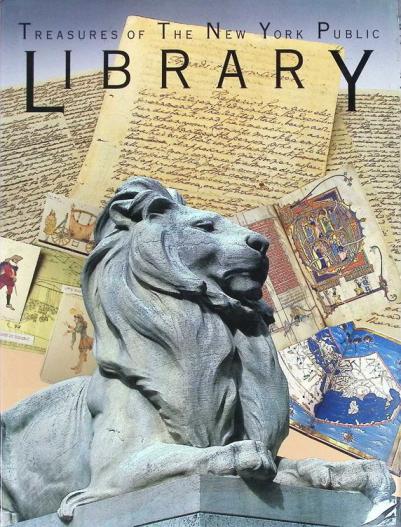
Treasures of the New York Public Library
This expansive volume serves as a curated showcase of the extraordinary holdings of the New York Public Library (NYPL), one of the world's preeminent research institutions. Through the scholarly lens of Marshall B. Davidson and the curatorial expertise of Bernard McTigue, the book documents the library's evolution from the private collections of Astor, Lenox, and Tilden into a \"palace for the people.\" It features original photography by Jonathan Wallen, capturing the intricate details of artifacts that span the history of human civilization
BOOK

Reading Publics: New York City's Public Libraries, 1754-1911
This lively, nuanced history of New York City's early public libraries traces their evolution within the political, social, and cultural worlds that supported them. On May 11, 1911, the New York Public Library opened its \"marble palace for book lovers\" on Fifth Avenue and 42nd Street. This was the city's first public library in the modern sense, a tax-supported, circulating collection free to every citizen. Since before the Revolution, however, New York's reading publics had access to a range of \"public libraries\" as the term was understood by contemporaries. In its most basic sense a public library in the eighteenth and most of the nineteenth centuries simply meant a shared collection of books that was available to the general public and promoted the public good. From the founding in 1754 of the New York Society Library up to 1911, public libraries took a variety of forms. Some of them were free, charitable institutions, while others required a membership or an annual subscription. Some, such as the Biblical Library of the American Bible Society, were highly specialized; others, like the Astor Library, developed extensive, inclusive collections. What all the public libraries of this period had in common, at least ostensibly, was the conviction that good books helped ensure a productive, virtuous, orderly republic-that good reading promoted the public good. Tom Glynn's vivid, deeply researched history of New York City's public libraries over the course of more than a century and a half illuminates how the public and private functions of reading changed over time and how shared collections of books could serve both public and private ends. Reading Publics examines how books and reading helped construct social identities and how print functioned within and across groups, including but not limited to socioeconomic classes. The author offers an accessible while scholarly exploration of how republican and liberal values, shifting understandings of \"public\" and \"private,\" and the debate over fiction influenced the development and character of New York City's public libraries in the eighteenth and nineteenth centuries. Reading Publics is an important contribution to the social and cultural history of New York City that firmly places the city's early public libraries within the history of reading and print culture in the United States.
eBook

The lions at night
\"By day, the library lions Patience and Fortitude guard the iconic New York Public Library. But when the sun goes down, and the library closes, their work is done, and it is time for fun. This debut wordless picture book brings the reader along on a late-night subway trip to the wild and wonderful Coney Island, where the two lions fit right in and indulge in some classic New York City-style fun. Will they make it back to the library before dawn? And will anyone notice that they've been gone?\" -- Amazon.
Book
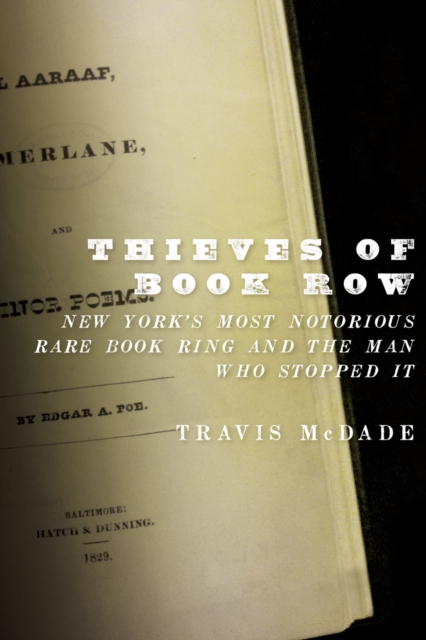
Thieves of Book Row
In Thieves of Book Row, Travis McDade tells the gripping tale of the worst book-theft ring in American history, and the intrepid detective who brought it down. Both a fast-paced, true-life thriller, Thieves of Book Row provides a fascinating look at the history of crime and literary culture.
eBook

Murder in the manuscript room : a 42nd Street Library mystery
\"When a murder desecrates the somber, book-lined halls of New York City's iconic 42nd Street Library, Raymond Ambler, the library's curator of crime fiction, has a personal interest in solving the crime. His quest to solve the murder is complicated by personal entanglements involving his friend--or perhaps more-than-friend--Adele Morgan. Not only does Adele's relationship with the young woman staffer who was murdered get in the way of Ambler's investigation, more disturbing for him is Adele's growing interest in a darkly handsome Islamic scholar\"--Amazon.com.
Book

Regina Anderson Andrews, Harlem Renaissance Librarian
The first African American to head a branch of the New York Public Library (NYPL), Regina Andrews led an extraordinary life. Allied with W. E. B. Du Bois, Andrews fought for promotion and equal pay against entrenched sexism and racism and battled institutional restrictions confining African American librarians to only a few neighborhoods within New York City. Andrews also played a key role in the Harlem Renaissance, supporting writers and intellectuals with dedicated workspace at her 135th Street Branch Library. After hours she cohosted a legendary salon that drew the likes of Langston Hughes and Zora Neale Hurston. Her work as an actress and playwright helped establish the Harlem Experimental Theater, where she wrote plays about lynching, passing, and the Underground Railroad. Ethelene Whitmire's new biography offers the first full-length study of Andrews' activism and pioneering work with the NYPL. Whitmire's portrait of her sustained efforts to break down barriers reveals Andrews's legacy and places her within the NYPL's larger history.
eBook

Trace
\"An African-American middle schooler who has recently lost both his parents sees a ghost wearing old-fashioned clothing in the basement of the New York Public Library\"-- Provided by publisher.
Book


Go forth and tell : the life of Augusta Baker, librarian and master storyteller
\"A luminous picture book biography about librarian and storyteller Augusta Baker, the first Black coordinator of children's services at all branches of the New York Public library\"-- Provided by publisher.
Book
