Search Results Heading

MBRLSearchResults

mbrl.module.common.modules.added.book.to.shelf
Title added to your shelf!
View what I already have on My Shelf.
Oops! Something went wrong.
While trying to add the title to your shelf something went wrong :( Kindly try again later!
Are you sure you want to remove the book from the shelf?

Oops! Something went wrong.
While trying to remove the title from your shelf something went wrong :( Kindly try again later!
    Done
    Filters
    Reset
  • Discipline
      Discipline
      Clear All
      Discipline
  • Is Peer Reviewed
      Is Peer Reviewed
      Clear All
      Is Peer Reviewed
  • Series Title
      Series Title
      Clear All
      Series Title
  • Reading Level
      Reading Level
      Clear All
      Reading Level
  • Year
      Year
      Clear All
      From:
      -
      To:
  • More Filters
      More Filters
      Clear All
      More Filters
      Content Type
    • Item Type
    • Is Full-Text Available
    • Subject
    • Country Of Publication
    • Publisher
    • Source
    • Target Audience
    • Donor
    • Language
    • Place of Publication
    • Contributors
    • Location
1,003,147 result(s) for "Newspapers"
Sort by:
Addressing the Power Imbalance: A Legislative Proposal for Effectuating Competitive Payments from Platforms to Newspapers
The purpose of this study is to explore the underpayment to newspapers from Facebook and Google attributable to the power imbalance between individual news publishers and the dominant platforms, and to describe how a pending bill in Congress—the Journalism Competition and Preservation Act (JCPA)—could effectuate competitive payments to news publishers, effectively simulating a world in which the power imbalance is removed. Facebook and Google (the “dominant platforms”) appropriate the value added of news publishers generally—and newspapers specifically—by reframing articles in rich previews containing headlines, summaries, and photos; and by curating the content alongside advertisements. This reframing and curation decrease the likelihood of a user clicking into the article, thereby depriving news publishers of clicks while enriching the dominant tech platforms. By exploiting their monopsony power over newspapers, Facebook and Google effectively pay a price of zero for accessing and “crawling” the newspapers’ content. This study finds that allowing current market forces to dictate the newspapers’ “pay shares”—that is, the portion of platform revenues that redounds to newspaper publishers—ensures that newspapers are compensated at rates significantly below competitive levels. This underpayment results in underemployment of journalists and other news employees, as well as host of social ills associated with local news deserts, including less competent local governments, greater spread of partisanship and misinformation, removal of economic stimulus to local economies, and a reduction in the diversity of viewpoints, particularly among minority populations. The best way to correct this market failure is for the government to permit the news publishers (either newspapers alone, or all news publishers) to coordinate in their dealings with the digital platforms over payment terms and conditions, as contemplated in the JCPA.
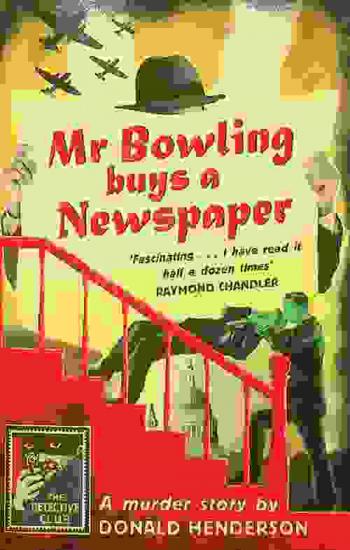
Mr Bowling buys a newspaper : a story of crime
In Raymond Chandler's favourite novel, Mr Bowling buys the newspapers only to find out what the latest is on the murders he's just committed... Mr Bowling is getting away with murder. On each occasion he buys a newspaper to see whether anyone suspects him. But there is a war on, and the clues he leaves are going unnoticed. Which is a shame, because Mr Bowling is not a conventional serial killer: he wants to get caught so that his torment can end. How many more newspapers must he buy before the police finally catch up with him? Donald Henderson was an actor and playwright who had also written novels as D. H. Landels, but with little success. While working for the BBC in London during the Second World War, his fortunes finally changed with Mr Bowling Buys a Newspaper, a darkly satirical portrayal of a murderer that was to be promoted enthusiastically by Raymond Chandler as his favourite detective novel. But even the author of The Big Sleep could not save it from oblivion: it has remained out of print for more than 60 years. This Detective Club classic is introduced by award-winning novelist Martin Edwards, author of The Story of Classic Crime in 100 Books, who reveals new information about Henderson's often troubled life and writing career.
The broken table : the Detroit Newspaper Strike and the state of American labor
When the Detroit newspaper strike was settled in December 2000, it marked the end of five years of bitter and violent dispute. No fewer than six local unions, representing 2,500 employees, struck against the Detroit News, the Detroit Free Press, and their corporate owners, charging unfair labor practices. The newspapers hired permanent replacement workers and paid millions of dollars for private security and police enforcement; the unions and their supporters took their struggle to the streets by organizing a widespread circulation and advertising boycott, conducting civil disobedience, and publishing a weekly strike newspaper. In the end, unions were forced to settle contracts on management’s terms, and fired strikers received no amnesty. In The Broken Table, Chris Rhomberg sees the Detroit strike as a historic collision of two opposing forces: a system in place since the New Deal governing disputes between labor and management, and decades of increasingly aggressive corporate efforts to eliminate unions. As a consequence, one of the fundamental institutions of American labor relations—the negotiation table—has been broken, Rhomberg argues, leaving the future of the collective bargaining relationship and democratic workplace governance in question. The Broken Table uses interview and archival research to explore the historical trajectory of this breakdown, its effect on workers’ economic outlook, and the possibility of restoring democratic governance to the business-labor relationship. Emerging from the New Deal, the 1935 National Labor Relations Act protected the practice of collective bargaining and workers’ rights to negotiate the terms and conditions of their employment by legally recognizing union representation. This system became central to the democratic workplace, where workers and management were collective stakeholders. But efforts to erode the legal protections of the NLRA began immediately, leading to a parallel track of anti-unionism that began to gain ascendancy in the 1980s. The Broken Table shows how the tension created by these two opposing forces came to a head after a series of key labor disputes over the preceding decades culminated in the Detroit newspaper strike. Detroit union leadership charged management with unfair labor practices after employers had unilaterally limited the unions’ ability to bargain over compensation and work conditions. Rhomberg argues that, in the face of management claims of absolute authority, the strike was an attempt by unions to defend workers’ rights and the institution of collective bargaining, and to stem the rising tide of post-1980s anti-unionism. In an era when the incidence of strikes in the United States has been drastically reduced, the 1995 Detroit newspaper strike stands out as one of the largest and longest work stoppages in the past two decades. A riveting read full of sharp analysis, The Broken Table revisits the Detroit case in order to show the ways this strike signaled the new terrain in labor-management conflict. The book raises broader questions of workplace governance and accountability that affect us all.