
Catalogue Search | MBRL


Are you sure you want to remove the book from the shelf?

{{itemTitle}}
538
result(s) for
"Nieuws."
Sort by:

Taking journalism seriously : news and the academy
Taking Journalism Seriously: News and the Academy argues that scholars have remained too entrenched within their own disciplinary areas resulting in isolated bodies of scholarship. This is the first book to critically survey journalism scholarship in one volume and organize it by disparate fields. The book reviews existing journalism research in such diverse fields as sociology, history, language studies, political science, and cultural analysis and dissects the most prevalent and understated research in each discipline.
eBook

Cyberfactories : how news agencies produce news
Have you ever wondered how organizations decide which news is important? This insightful book portrays in detail everyday work in three news agencies: Swedish TT, Italian ANSA and the worldwide Reuters. This unique study is about organizing rather than journalism, revealing two accelerating phenomena: cybernization (machines play a more and more central role in news production) and cyborgization (people rely more and more on machines). Barbara Czarniawska reveals that technological developments lead to many unexpected consequences and complications. Cyberfactories will prove essential to researchers interested in contemporary forms of organizing, studies of technology, and media. It will also appeal to a lay reader interested in how news is produced.
Book
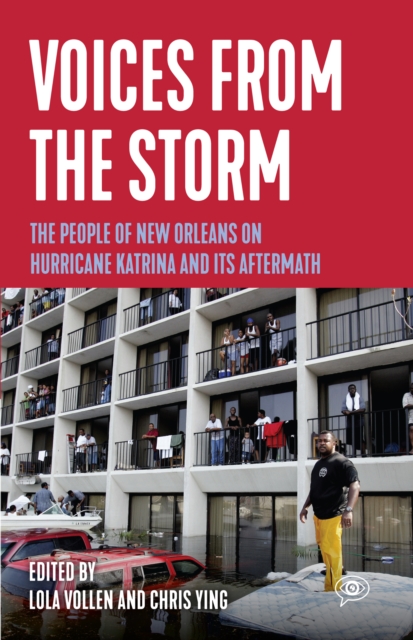
Voices from the Storm
Hurricane Katrina inflicted damage on a scale unprecedented in American history, nearly destroying a major city and killing thousands of its citizens. With far too little help from indifferent, incompetent government agencies, the poor bore the brunt of the disaster. The residents of traditionally impoverished and minority communities suffered incalculable losses and endured unimaginable conditions. And the few facilities that did exist to help victims quickly became miserable, dangerous places. Now, the victims of Hurricane Katrina find themselves spread across the United States, far from the homes they left and faced with the prospect of starting anew. Families are struggling to secure jobs, homes, schools, and a sense of place in unfamiliar surroundings. Meanwhile, the rebuilding of their former home remains frustrating out of their hands. This bracing read brings readers to the heart of the disaster and its aftermath as those who survived it speak with candor and eloquence of their lives then and now.
eBook

Race, sex, and social order in early New Orleans
Winner, 2009 Kemper and Leila Williams Prize in Louisiana History, The Historic New Orleans Collection and the Louisiana Historical Association
A microcosm of exaggerated societal extremes—poverty and wealth, vice and virtue, elitism and equality—New Orleans is a tangled web of race, cultural mores, and sexual identities. Jennifer M. Spear's examination of the dialectical relationship between politics and social practice unravels the city's construction of race during the eighteenth and early nineteenth centuries.
Spear brings together archival evidence from three different languages and the most recent and respected scholarship on racial formation and interracial sex to explain why free people of color became a significant population in the early days of New Orleans and to show how authorities attempted to use concepts of race and social hierarchy to impose order on a decidedly disorderly society. She recounts and analyzes the major conflicts that influenced New Orleanian culture: legal attempts to impose racial barriers and social order, political battles over propriety and freedom, and cultural clashes over place and progress. At each turn, Spear's narrative challenges the prevailing academic assumptions and supports her efforts to move exploration of racial formation away from cultural and political discourses and toward social histories.
Strikingly argued, richly researched, and methodologically sound, this wide-ranging look at how choices about sex triumphed over established class systems and artificial racial boundaries supplies a refreshing contribution to the history of early Louisiana.
eBook

The Archaeology of New Netherland
The Archaeology of New Netherland illuminates the
influence of the Dutch empire in North America, assembling evidence
from seventeenth-century settlements located in present-day New
York, New Jersey, Connecticut, Pennsylvania, and Delaware.
Archaeological data from this important early colony has often been
overlooked because it lies underneath major urban and industrial
regions, and this collection makes a wealth of information widely
available for the first time.
Contributors to this volume begin by discussing the global
context of Dutch colonization and reviewing typical Dutch material
culture of the time as seen in ceramics from Amsterdam households.
Next, they focus on communities and activities at colonial sites
such as forts, trading stations, drinking houses, and farms. The
essays examine the agency and impact of Indigenous people and
enslaved Africans, particularly women, in the society of New
Netherland, and they trace interactions between Dutch settlers and
Europeans from other colonies including New Sweden. The volume also
features landmark studies of cooking pots, marbles, tobacco pipes,
and other artifacts.
The research in this volume offers an invitation to investigate
New Netherland with the same sustained rigor that archaeologists
and historians have shown for English colonialism. The many topics
outlined here will serve as starting points for further work on
early Dutch expansion in America.
Contributors:
Craig Lukezic | John P. McCarthy | Charles Gehring | Marijn Stolk |
Ian Burrow | Adam Luscier | Matthew Kirk | Michael T. Lucas |
Kristina S. Traudt | Marie-Lorraine Pipes | Anne-Marie Cantwell |
Diana diZerega Wall | Lu Ann De Cunzo | Wade P. Catts | William B.
Liebeknecht | Marshall Joseph Becker | Meta F. Janowitz | Richard
G. Schaefer | Paul R. Huey | David A. Furlow
eBook

Crescent City Girls
What was it like to grow up black and female in the segregated South?To answer this question, LaKisha Simmons blends social history and cultural studies, recreating children's streets and neighborhoods within Jim Crow New Orleans and offering a rare look into black girls' personal lives.
eBook

Masterless Mistresses
During French colonial rule in Louisiana, nuns from the French
Company of Saint Ursula came to New Orleans, where they educated
women and girls of European, Indian, and African descent, enslaved
and free, in literacy, numeracy, and the Catholic faith. Although
religious women had gained acceptance and authority in
seventeenth-century France, the New World was less welcoming. Emily
Clark explores the transformations required of the Ursulines as
their distinctive female piety collided with slave society, Spanish
colonial rule, and Protestant hostility.
The Ursulines gained prominence in New Orleans through the social
services they provided--schooling, an orphanage, and refuge for
abused and widowed women--which also allowed them a self-sustaining
level of corporate wealth. Clark traces the conflicts the Ursulines
encountered through Spanish colonial rule (1767-1803) and after the
Louisiana Purchase, as Protestants poured into Louisiana and were
dismayed to find a powerful community of self-supporting women and
a church congregation dominated by African Americans. The unmarried
nuns contravened both the patriarchal order of the slaveholding
American South and the Protestant construction of femininity that
supported it. By incorporating their story into the history of
early America, Masterless Mistresses exposes the limits of
the republican model of national unity.
eBook

Nación Ǵenízara : ethnogenesis, place, and identity in New Mexico
Nación Genízara examines the history, cultural evolution, and survival of the Genízaro people. The contributors to this volume cover topics including ethnogenesis, slavery, settlements, poetics, religion, gender, family history, and mestizo genetics. Fray Angélico Chávez defined Genízaro as the ethnic term given to indigenous people of mixed tribal origins living among the Hispano population in Spanish fashion. They entered colonial society as captives taken during wars with Utes, Apaches, Comanches, Kiowas, Navajos, and Pawnees. Genízaros comprised a third of the population by 1800. Many assimilated into Hispano and Pueblo society, but others in the land-grant communities maintained their identity through ritual, self-government, and kinship.
Today the persistence of Genízaro identity blurs the lines of distinction between Native and Hispanic frameworks of race and cultural affiliation. This is the first study to focus exclusively on the detribalized Native experience of the Genízaro in New Mexico.
eBook

Cultural Construction of Empire
From 1866 through 1886, the U.S. Army occupied southern Arizona and New Mexico in an attempt to claim it for settlement by Americans. Through a postcolonial lens, Janne Lahti examines the army, its officers, their wives, and the enlisted men as agents of an American empire whose mission was to serve as a group of colonizers engaged in ideological as well as military, conquest.
Cultural Construction of Empireexplores the cultural and social representations of Native Americans, Hispanics, and frontiersmen constructed by the officers, enlisted men, and their dependents. By differentiating themselves from these \"less civilized\" groups, white military settlers engaged various cultural processes and practices to accrue and exercise power over colonized peoples and places for the sake of creating a more \"civilized\" environment for other settlers. Considering issues of class, place, and white ethnicity, Lahti shows that the army's construction of empire took place not on the battlefield alone but also in representations of and social interactions in and among colonial places, peoples, settlements, and events, and in the domestic realm and daily life inside the army villages.
eBook