
Catalogue Search | MBRL


Are you sure you want to remove the book from the shelf?

{{itemTitle}}
44,427
result(s) for
"Nigeria"
Sort by:


The Roots of Political Instability in Nigeria
The constant drumbeat of headlines about Darfur, Zimbabwe, Sudan, Somalia, as well as the other states in Africa that are beleaguered by political instability have made the causes of failed states and intra-state political conflicts a major issue, both academic and practical. Using Harry Eckstein and Ted R. Gurr's congruence-consonance theoretical framework of regime classification, E.C. Ejiogu examines the internal variations of society evident in the Nigerian state to explain why the country experiences political conflict and instability. The first time this theoretical framework has been applied to an African country; E.C. Ejiogu offers a balanced and interdisciplinary analysis of the evolution in the Nigerian political system and the role played by evolved social traits in society. Exploring themes such as colonial rule and legacies, economic development, political authority and religion, Ejiogu insists that it is critical to examine Africa's diverse nationalities in terms of their geography, social, economic and authority patterns as critical elements that are disregarded in accounts of their political development. At a time when the question of state building in Africa is still unresolved, this timely book is a major contribution to the literature on transition processes in African politics and is particularly relevant to scholars and policy makers wanting to grapple with the issues associated with Africa's political disorder and the other social problems it spawns.
eBook

Dangerous love : the landscapes within
This is the story of Omovo, a young office worker and artist, who lives with his father and step-mother. In the communal world of the compound, Omovo has both friends and enemies, but most importantly there is Ifeyinwa, a beautiful married woman whom he loves with a passion. Overshadowing everything is the image of a nation struggling to come to terms with the atrocity of the recent civil war.
Book

The Biafran humanitarian crisis, 1967-1970 international human rights and joint church aid
This book focuses on the humanitarian crisis in Biafra from 1967 to 1970 and the historic response of church groups from different parts of the world. This is the first scholarly work to establish the Joint Church Aid as the foundation of modern day international humanitarian aid.
eBook


The Last Authority
The liberation struggle in South Africa ended apartheid and the last stronghold of colonialism in Africa. This struggle attracted the support of many African countries that contributed and helped the oppressed people of South Africa towards free elections. Nigeria is among the countries in Africa that contributed some of the most significant assistance to the anti-apartheid movement. As democracy and majority government replaced apartheid in South Africa, many young South Africans (the so-called 'born free') are not aware of the contributions of Nigeria in the history of the liberation struggle. The book blames this ignorance on a deliberate policy of silence by the government and media in South Africa.
eBook

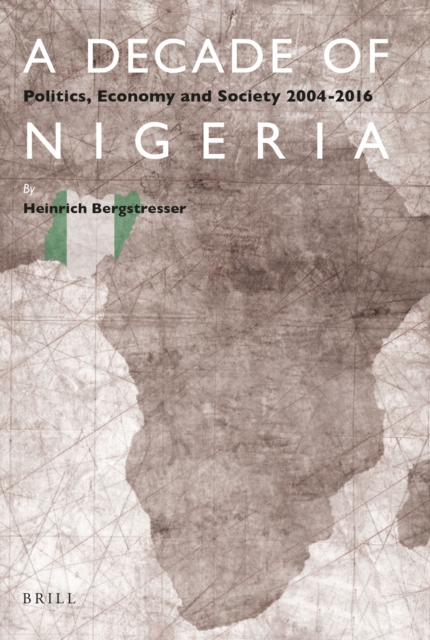
A Decade of Nigeria
This chronology for 2004 to 2016 compiles the chapters on Nigeria previously published in the Africa Yearbook. Politics, Economy and Society South of the Sahara. This decade, however, covers the most crucial events such as stabilising the democratic process, a short-lived economic boom, the rise of Boko Haram and its Islamist insurgency, the amnesty and the renewed violence in the Niger Delta, the rise of unprecedented crime in the Middle Belt and the election defeat of a sitting president. In a sense, all these events were shaping the country's political and socioeconomic system and are having a long-lasting impact.
eBook


Muslim Civic Cultures and Conflict Resolution: The Challenge of Democratic Federalism in Nigeria
The question of whether Islam is compatible with democracy may best be answered not from the classical sources or even from the cauldron of Middle East politics but from the lived experiences of Muslim communities around the world. In large and diverse countries, the varied political values of different cultures can make or break the democratic experiment. Regardless of their cultural context, transitions from military to civilian rule require attention to the grassroots civic cultures that form the foundations of democratic federalism. John Paden, a noted expert on West African and Islamic societies, uses Nigeria as a critical case study of how a diverse country with a significant Muslim population is working to make the transition to a democratic society. Although little-studied, the non-Arab Muslim communities of West Africa are an important indicator as to whether Islamic democracy in a diverse nation is possible. Nigeria's success is vital to regional and global stability. As the largest country in Africa, with a population that is about half Muslim and half Christian or traditional animist, Nigeria is also the seventh largest producer of oil in the world and has gone through a series of political traumas ranging from civil war to military rule. The current democratic government is trying to balance rule-of-law concerns at a time when many communal tensions are coming to the surface. Muslim Civic Cultures and Conflict Resolution in Nigeria takes us inside the complex world of Nigerian politics, with a focus on the ways Muslim civic cultures deal with matters of leadership and conflict resolution. The book provides an essential context to the current international concern with issues ranging from Shari'a law and communal violence, to the broader war on terrorism. It argues that the requirement for regional political cooperation serves as a counterbalance to more extreme forms of political expression. Paden shows that if the Nigerian political model of democratic federalism works, then there is a real world, peaceful alternative to the \"clash of civilizations\" predicted by the intellectual world and threatened by al Qaeda.
eBook