
Catalogue Search | MBRL


Are you sure you want to remove the book from the shelf?

{{itemTitle}}
1,794
result(s) for
"Nixon, Richard Milhous"
Sort by:


With Honor
In 1968, at the peak of the Vietnam War, centrist Congressman Melvin Laird (R-WI) agreed to serve as Richard Nixon’s secretary of defense. It was not, Laird knew, a move likely to endear him to the American public—but as he later said, “Nixon couldn’t find anybody else who wanted the damn job.” For the next four years, Laird deftly navigated the morass of the war he had inherited. Lampooned as a “missile head,” but decisive in crafting an exit strategy, he doggedly pursued his program of Vietnamization, initiating the withdrawal of U.S. military personnel and gradually ceding combat responsibilities to South Vietnam. In fighting to bring the troops home faster, pressing for more humane treatment of POWs, and helping to end the draft, Laird employed a powerful blend of disarming Midwestern candor and Washington savvy, as he sought a high moral road bent on Nixon’s oft-stated (and politically instrumental) goal of peace with honor. The first book ever to focus on Laird’s legacy, this authorized biography reveals his central and often unrecognized role in managing the crisis of national identity sparked by the Vietnam War—and the challenges, ethical and political, that confronted him along the way. Drawing on exclusive interviews with Laird, Henry Kissinger, Gerald Ford, and numerous others, author Dale Van Atta offers a sympathetic portrait of a man striving for open government in an atmosphere fraught with secrecy. Van Atta illuminates the inner workings of high politics: Laird’s behind-the-scenes sparring with Kissinger over policy, his decisions to ignore Nixon’s wilder directives, his formative impact on arms control and health care, his key role in the selection of Ford for vice president, his frustration with the country’s abandonment of Vietnamization, and, in later years, his unheeded warning to Donald Rumsfeld that “it’s a helluva lot easier to get into a war than to get out of one.” Best Books for Regional Special Interests, selected by the American Association of School Librarians, and Best Books for Special Interests, selected by the Public Library Association
eBook

Nixon’s Back Channel to Moscow
Most Americans consider détente-the reduction of tensions
between the United States and the Soviet Union-to be among the
Nixon administration's most significant foreign policy successes.
The diplomatic back channel that national security advisor Henry
Kissinger established with Soviet ambassador Anatoly Dobrynin
became the most important method of achieving this thaw in the Cold
War. Kissinger praised back channels for preventing leaks,
streamlining communications, and circumventing what he perceived to
be the US State Department's unresponsive and self-interested
bureaucracy. Nixon and Kissinger's methods, however, were widely
criticized by State Department officials left out of the loop and
by an American press and public weary of executive branch
prevarication and secrecy.
Richard A. Moss's penetrating study documents and analyzes
US-Soviet back channels from Nixon's inauguration through what has
widely been heralded as the apex of détente, the May 1972 Moscow
Summit. He traces the evolution of confidential-channel diplomacy
and examines major flashpoints, including the 1970 crisis over
Cienfuegos, Cuba, the Strategic Arms Limitations Talks (SALT), US
dealings with China, deescalating tensions in Berlin, and the
Vietnam War. Moss argues that while the back channels improved
US-Soviet relations in the short term, the Nixon-Kissinger methods
provided a poor foundation for lasting policy.
Employing newly declassified documents, the complete record of
the Kissinger-Dobrynin channel-jointly compiled, translated,
annotated, and published by the US State Department and the Russian
Foreign Ministry-as well as the Nixon tapes, Moss reveals the
behind-the-scenes deliberations of Nixon, his advisers, and their
Soviet counterparts. Although much has been written about détente,
this is the first scholarly study that comprehensively assesses the
central role of confidential diplomacy in shaping America's foreign
policy during this critical era.
eBook


Haig's Coup
When General Alexander M. Haig Jr. returned to the White House on May 3, 1973, he found the Nixon administration in worse shape than he had imagined. President Richard Nixon, reelected in an overwhelming landslide just six months earlier, had accepted the resignations of his top aides-the chief of staff H. R. Haldeman and the domestic policy chief John Ehrlichman-just three days earlier. Haldeman and Ehrlichman had enforced the president's will and protected him from his rivals and his worst instincts for four years. Without them, Nixon stood alone, backed by a staff that lacked gravitas and confidence as the Watergate scandal snowballed. Nixon needed a savior, someone who would lift his fortunes while keeping his White House from blowing apart. He hoped that savior would be his deputy national security adviser, Alexander Haig, whom he appointed chief of staff. But Haig's goal was not to keep Nixon in office-it was to remove him. InHaig's Coup,Ray Locker uses recently declassified documents to tell the true story of how Haig orchestrated Nixon's demise, resignation, and subsequent pardon. A story of intrigues, cover-ups, and treachery, this incisive history shows how Haig engineered the \"soft coup\" that ended our long national nightmare and brought Watergate to an end.
eBook
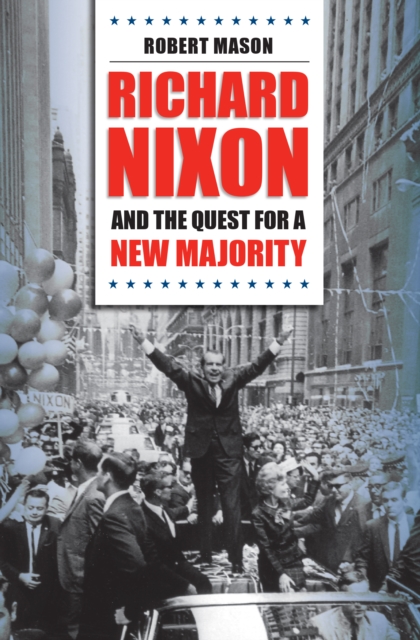
Richard Nixon and the quest for a new majority
In recent years historians have paid substantial attention to the origins of modern political conservatism and the record of the Nixon administration in building a Republican majority in the late twentieth century. In Richard Nixon and the Quest for a New Majority, Robert Mason analyzes Nixons response to the developing conservative climate and challenges revisionist claims about the activist nature of the Nixon administration. Nixon was an activist in intent, Mason contends, but not in deed. Nixons \"silent majority\" speech of 1969 not only undermined the growth of the antiwar movement, Mason shows, but also identified a constituency for Nixon to cultivate in order to secure reelection. However, the implementation of his new-majority project was hindered by the resort to dirty tricks against political opponents and the ineffectual pursuit of a policy agenda. Although some Nixon initiatives were enacted, says Mason, they were not substantial enough to rival the Democrats' bread-and-butter issues. While Nixon built Republican strength at the presidential level, Mason argues that he did not succeed in mobilizing popular support for broad-based political conservatism.
eBook

Campaign of the Century
Based on massive new research, a compelling and surprising
account of the twentieth century's closest election The
1960 presidential election between John F. Kennedy and Richard
Nixon is one of the most frequently described political events of
the twentieth century, yet the accounts to date have been
remarkably unbalanced. Far more attention is given to Kennedy's
side than to Nixon's. The imbalance began with the first book on
that election, Theodore White's The Making of the President
1960 -in which (as he later admitted) White deliberately cast
Kennedy as the hero and Nixon as the villain-and it has been
perpetuated in almost every book since then. Few historians have
attempted an unbiased account of the election, and none have done
the archival research that Irwin F. Gellman has done. Based on
previously unused sources such as the FBI's surveillance of JFK and
the papers of Leon Jaworski, vice-presidential candidate Henry
Cabot Lodge, and many others, this book presents the first
even-handed history of both the primary campaigns and the general
election. The result is a fresh, engaging chronicle that shatters
long†'held myths and reveals the strengths and weaknesses of both
candidates.
eBook

A Matter of Simple Justice
In August 1972, Newsweek proclaimed that \"the person in Washington who has done the most for the women's movement may be Richard Nixon.\" Today, opinions of the Nixon administration are strongly colored by foreign policy successes and the Watergate debacle. Its accomplishments in advancing the role of women in government have been largely forgotten. Based on the \"A Few Good Women\" oral history project at the Penn State University Libraries, A Matter of Simple Justice illuminates the administration's groundbreaking efforts to expand the role of women—and the long-term consequences for women in the American workplace. At the forefront of these efforts was Barbara Hackman Franklin, a staff assistant to the president who was hired to recruit more women into the upper levels of the federal government. Franklin, at the direction of President Nixon, White House counselor Robert Finch, and personnel director Fred Malek, became the administration's de facto spokesperson on women's issues. She helped bring more than one hundred women into executive positions in the government and created a talent bank of more than a thousand names of qualified women. The Nixon administration expanded the numbers of women on presidential commissions and boards, changed civil service rules to open thousands more federal jobs to women, and expanded enforcement of antidiscrimination laws to include gender discrimination. Also during this time, Congress approved the Equal Rights Amendment and Nixon signed Title IX of the Education Amendments into law. The story of Barbara Hackman Franklin and those \"few good women\" shows how the advances that were made in this time by a Republican presidency both reflected the national debate over the role of women in society and took major steps toward equality in the workplace for women.
eBook

Nixon's Business
Richard Nixon considered establishing a strong peacetime economy one of his most important political objectives, [not least for] distinguishing himself from the cautious policies of President Dwight Eisenhower. Using Richard Neustadt's analytical framework of presidential power, Nigel Bowles develops five case studies around President Nixon's economic policies. The thoughtful, insightful analysis goes far to help us understand the sources of Richard Nixon's authority and power, and his use of both. For each of the \"issue-stories\" (as Bowles terms them), he considers the president's bargaining advantages: his authority (constitutional and statutory), popular prestige, and personal qualities. He then answers Neustadt's twin questions: \"What was the president's inheritance?\" and \"What was his legacy?\" Bowles's chosen cases represent fiscal policy, wage and price policy, international monetary policy, and domestic monetary policy. Through these analyses, Bowles offers new perspectives on Nixon's use of authority and power; his dealings with and views of senior politicians and power-brokers; his ruthlessness and political ingenuity; the ways his experiences as congressman, senator, and vice president shaped his approach to the presidency; and his subordination of other objectives to his drive for re-election in 1972. He concludes that Nixon used the limited authority he had under the separation of powers to the fullest degree, often thereby augmenting his power in the short-term, but undermining it in the longer-term. Nixon's Businessis the first book to make systematic use of Neustadt's crucial framework in understanding a specific presidency; the first to analyze empirically the components of Nixon's authority and power; and the first to demonstrate the implications of both for understanding the institution of the United States presidency.
eBook
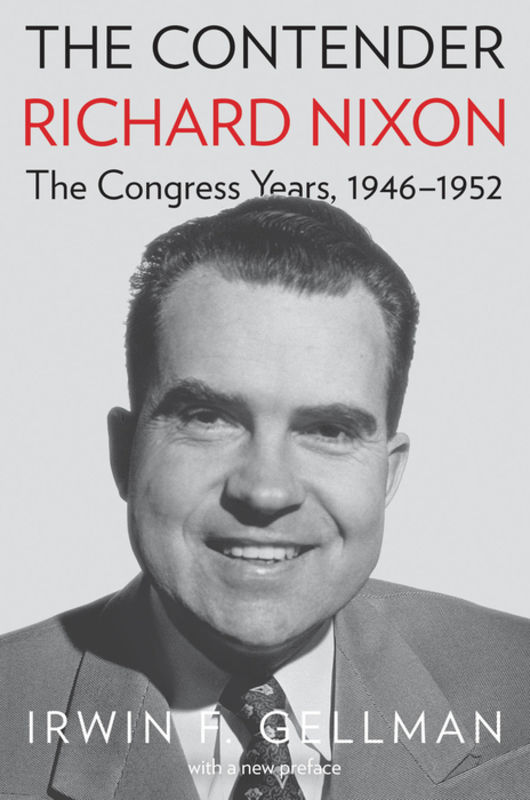
The Contender
The definitive account of Richard Nixon's congressional career, back in print with a new preface Unsurpassed in the fifteen years since its original publication, Irwin F. Gellman's exhaustively researched work is the definitive account of Richard Nixon's rise from political unknown to the verge of achieving the vice-presidency. To document Nixon's congressional career, Gellman combed the files of Nixon's 1946, 1948, and 1950 campaigns, papers from the executive sessions of the House Un-American Activities Committee (HUAC), and every document dated through 1952 at the Richard Nixon Library. This singular volume corrects many earlier written accounts. For example, there was no secret funding of Nixon's senate campaign in 1950, and Nixon won universal praise for his evenhandedness as a member of HUAC. The first book of a projected five-volume examination of this complex man's entire career, this work stands as the definitive political portrait of Nixon as a fast-rising young political star.
eBook