
Catalogue Search | MBRL


Are you sure you want to remove the book from the shelf?

{{itemTitle}}
265
result(s) for
"Nombres, Théorie des."
Sort by:

Number theory : a very short introduction
\"Number theory is the branch of mathematics that is primarily concerned with the counting numbers. Of particular importance are the prime numbers, the 'building blocks' of our number system. The subject is an old one, dating back over two millennia to the ancient Greeks, and for many years has been studied for its intrinsic beauty and elegance, not least because several of its challenges are so easy to state that everyone can understand them, and yet no-one has ever been able to resolve them. But number theory has also recently become of great practical importance - in the area of cryptography, where the security of your credit card, and indeed of the nation's defense, depends on a result concerning prime numbers that dates back to the 18th century. Recent years have witnessed other spectacular developments, such as Andrew Wiles's proof of 'Fermat's last theorem' (unproved for over 250 years) and some exciting work on prime numbers. In this Very Short Introduction Robin Wilson introduces the main areas of classical number theory, both ancient and modern. Drawing on the work of many of the greatest mathematicians of the past, such as Euclid, Fermat, Euler, and Gauss, he situates some of the most interesting and creative problems in the area in their historical context\"-- Amazon.com.
BOOK

Rigid Character Groups, Lubin-Tate Theory, and (𝜑,Γ)-Modules
The construction of the $p$-adic local Langlands correspondence for $\\mathrm{GL}_2(\\mathbf{Q}_p)$ uses in an essential way Fontaine's theory of cyclotomic $(\\varphi ,\\Gamma )$-modules. Here cyclotomic means that $\\Gamma = \\mathrm {Gal}(\\mathbf{Q}_p(\\mu_{p^\\infty})/\\mathbf{Q}_p)$ is the Galois group of the cyclotomic extension of $\\mathbf Q_p$. In order to generalize the $p$-adic local Langlands correspondence to $\\mathrm{GL}_{2}(L)$, where $L$ is a finite extension of $\\mathbf{Q}_p$, it seems necessary to have at our disposal a theory of Lubin-Tate $(\\varphi ,\\Gamma )$-modules. Such a generalization has been carried out, to some extent, by working over the $p$-adic open unit disk, endowed with the action of the endomorphisms of a Lubin-Tate group. The main idea of this article is to carry out a Lubin-Tate generalization of the theory of cyclotomic $(\\varphi ,\\Gamma )$-modules in a different fashion. Instead of the $p$-adic open unit disk, the authors work over a character variety that parameterizes the locally $L$-analytic characters on $o_L$. They study $(\\varphi ,\\Gamma )$-modules in this setting and relate some of them to what was known previously.
eBook
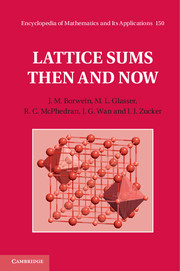
Lattice Sums Then and Now
The study of lattice sums began when early investigators wanted to go from mechanical properties of crystals to the properties of the atoms and ions from which they were built (the literature of Madelung's constant). A parallel literature was built around the optical properties of regular lattices of atoms (initiated by Lord Rayleigh, Lorentz and Lorenz). For over a century many famous scientists and mathematicians have delved into the properties of lattices, sometimes unwittingly duplicating the work of their predecessors. Here, at last, is a comprehensive overview of the substantial body of knowledge that exists on lattice sums and their applications. The authors also provide commentaries on open questions, and explain modern techniques which simplify the task of finding new results in this fascinating and ongoing field. Lattice sums in one, two, three, four and higher dimensions are covered.
eBook
Projective group structures as absolute Galois structures with block approximation
The authors prove: A proper profinite group structure $\\mathbf{G $ is projective if and only if $\\mathbf{G $ is the absolute Galois group structure of a proper field-valuation structure with block approximation.
eBook

Journey from Natural Numbers to Complex Numbers
This book is for those interested in number systems, abstract algebra, and analysis. It provides an understanding of negative and fractional numbers with theoretical background and explains rationale of irrational and complex numbers in an easy to understand format.
eBook
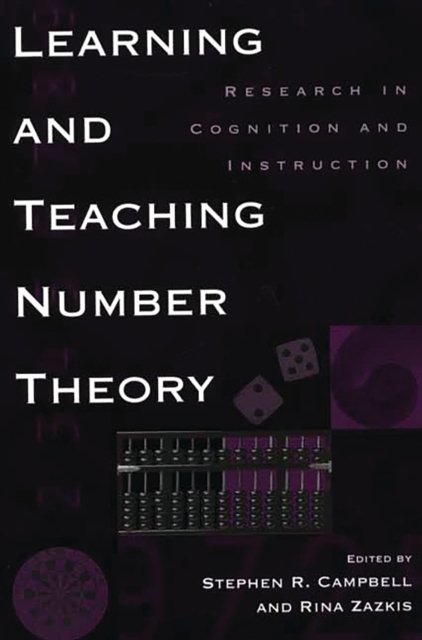
Learning and Teaching Number Theory: Research in Cognition and Instruction
Number theory has been a perennial topic of inspiration and importance throughout the history of philosophy and mathematics.Despite this fact, surprisingly little attention has been given to research in learning and teaching number theory per se.
eBook
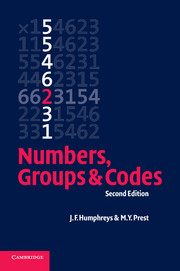
Numbers, Groups and Codes
This textbook is an introduction to algebra via examples. The book moves from properties of integers, through other examples, to the beginnings of group theory. Applications to public key codes and to error correcting codes are emphasised. These applications, together with sections on logic and finite state machines, make the text suitable for students of computer science as well as mathematics students. Attention is paid to historical development of the mathematical ideas. This second edition contains new material on mathematical reasoning skills and a new chapter on polynomials has been added. The book was developed from first-level courses taught in the UK and USA. These courses proved successful in developing not only a theoretical understanding but also algorithmic skills. This book can be used at a wide range of levels: it is suitable for first- or second-level university students, and could be used as enrichment material for upper-level school students.
eBook

Overlapping Iterated Function Systems from the Perspective of Metric Number Theory
In this paper we develop a new approach for studying overlapping iterated function systems. This approach is inspired by a famous
result due to Khintchine from Diophantine approximation which shows that for a family of limsup sets, their Lebesgue measure is
determined by the convergence or divergence of naturally occurring volume sums. For many parameterised families of overlapping iterated
function systems, we prove that a typical member will exhibit similar Khintchine like behaviour. Families of iterated function systems
that our results apply to include those arising from Bernoulli convolutions, the
For each
Last of all, we introduce a property of an iterated function system that we call being consistently
separated with respect to a measure. We prove that this property implies that the pushforward of the measure is absolutely continuous.
We include several explicit examples of consistently separated iterated function systems.
eBook

Comparison of Relatively Unipotent Log de Rham Fundamental Groups
In this paper, we prove compatibilities of various definitions of relatively unipotent log de Rham fundamental groups for certain
proper log smooth integral morphisms of fine log schemes of characteristic zero. Our proofs are purely algebraic. As an application, we
give a purely algebraic calculation of the monodromy action on the unipotent log de Rham fundamental group of a stable log curve. As a
corollary we give a purely algebraic proof to the transcendental part of Andreatta–Iovita–Kim’s article: obtaining in this way a
complete algebraic criterion for good reduction for curves.
eBook
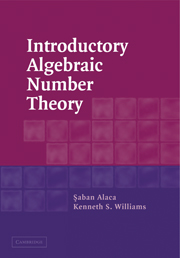
Introductory Algebraic Number Theory
Algebraic number theory is a subject which came into being through the attempts of mathematicians to try to prove Fermat's last theorem and which now has a wealth of applications to diophantine equations, cryptography, factoring, primality testing and public-key cryptosystems. This book provides an introduction to the subject suitable for senior undergraduates and beginning graduate students in mathematics. The material is presented in a straightforward, clear and elementary fashion, and the approach is hands on, with an explicit computational flavour. Prerequisites are kept to a minimum, and numerous examples illustrating the material occur throughout the text. References to suggested reading and to the biographies of mathematicians who have contributed to the development of algebraic number theory are given at the end of each chapter. There are over 320 exercises, an extensive index, and helpful location guides to theorems and lemmas in the text.
eBook