
Catalogue Search | MBRL


Are you sure you want to remove the book from the shelf?

{{itemTitle}}
4,856
result(s) for
"Non-Western Philosophy"
Sort by:
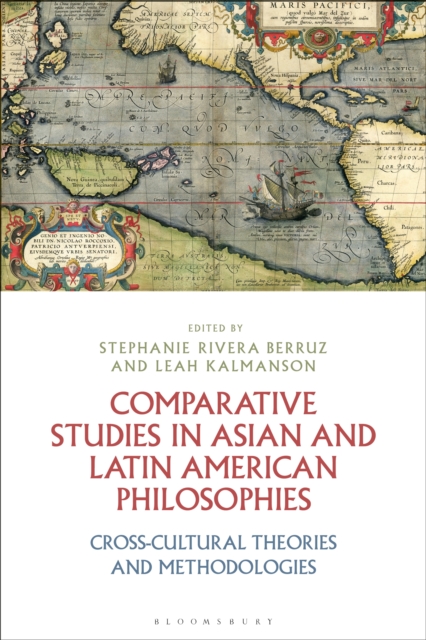
Comparative Studies in Asian and Latin American Philosophies
Comparative philosophy is an important site for the study of non-Western philosophical traditions, but it has long been associated with “East-West” dialogue. Comparative Studies in Asian and Latin American Philosophies shifts this trajectory to focus on cross-cultural conversations across Asia and Latin America. A team of international contributors discuss subjects ranging from Orientalism in early Latin American studies of Asian thought to liberatory politics in today’s globalized world. They bring together resources including Latin American feminism, Aztec teachings on ethics, Buddhist critiques of essentialism, and Confucian morality. Chapters address topics such as educational reform, the social practices surrounding breastfeeding, martial arts as political resistance, and the construction of race and identity. Together the essays reflect the philosophical diversity of Asia and Latin America while foregrounding their shared concerns on issues of Eurocentrism and coloniality. By bringing these critical perspectives to bear on the theories and methods of cross-cultural philosophy, Comparative Studies in Asian and Latin American Philosophies offers new insights into the nature and practice of philosophical comparison.
eBook


Queer Types in Ancient Indian Medicine Texts. The Case of Vārtā and Tr̥n.aputrika Individuals
Brahmanical culture, which elaborated the idea of
dharma
(or socio-cosmic order) and at the same time claimed to be founded on it, intended to base on this conception the construction of taxonomies through which to classify all reality. As far as human beings are concerned, they respond to dharmic norms to the extent that they can form pairs (
mithuna
s) capable of generating. In this article, I will explore the case of certain queer individuals, who, as non-heteronormative, escape the possibility of fertile pairings, and are therefore judged as a sterile presence. In order to do so, I will make use of some interpretative devices formulated by Deleuze and Guattari and by Foucault, to highlight how Brahmanical ideology in ancient India intended to classify, represent, control, and discipline people's bodies from conception. I will preliminarily focus on the analysis of some passages of texts by ancient Indian grammarians related to the notion of gender, to clarify how grammatical classifications come up against cases in which the grammatical gender does not correspond to the sexual gender exhibited by some individuals. Therefore, I will devote an extensive investigation to excerpts from classical works of Indian medicine, specifically delving into the analysis of two types of individuals, the
vārtā
s and the
tr̥ṇaputrika
s, to shed light on how the identity of these individuals was ideologically framed as the result of pathological anomalies that deviate from the perimeter of the notion of
dharma
.
Journal Article
What’s in it for Her?: Codependence (saṃyoga) and Independence (kaivalya) from the Perspective of prakṛti
The
Sāṃkhyakārikā
repeatedly emphasizes that
prakṛti
(material nature) and her constituents exist solely for the sake of the
puruṣa
(the self). And yet, since she is blind, she needs
puruṣa
to see her full glory, and he needs to witness her actions to become liberated (21). Gauḍapāda explains their connection in terms of a pitcher filled with hot or cold liquid, which takes on that property, temporarily, through association. This article looks closely at commentarial passages to explore both the nature of their conjunction and codependence (
saṃyoga
), which leads to mistaken identification, as well as the method given in the
Sāṃkhyakārikā
for their ultimate separation and independence (
kaivalya
) through the practice of negation of the twenty-five true principles (
tattvābhyāsa
), which evolve from this association of
puruṣa
and
prakṛti
, comparing this with similar ideas in the
Pātañjalayogaśāstra
. While these concepts have been examined before, it has generally been from a rationalistic, masculine, and linear viewpoint that reduces
prakṛti
to mere matter or one that goes to the other extreme, reading later concepts backward and glorifying her as a Tantric goddess. In a world of shifting gender paradigms, this article seeks to re-examine their entanglement through the perspective of
prakṛti
, to understand how this intimate union is of benefit to her too, and, in turn, what we can learn through understanding the world from this angle.
Journal Article
“Fulfilling My Perfection of Morality”: The Origin and Development of the Concept śīla-pāramitā (Part 1)
The concept of
śīla-pāramitā
(Pali.
sīlapāramī
), “the perfection of morality” is one of a collection of spiritual virtues accomplished by a bodhisattva for achieving Buddhahood. This paper explores the origin and development of
śīla-pāramitā
by tracing its roots from early Buddhist scriptures to its later articulations in the
Cariyāpiṭaka
and early Mahāyāna texts. In early Buddhist texts like the Nikāyas and Āgamas,
śīla
primarily refers to moral discipline, encompassing rules for both laypeople and monastics. The paper then analyzes how
śīla
, originally linked to the ethical conduct of monastics and lay followers alike, gradually evolved into a perfection (
pāramitā
) in Mahāyāna Buddhism, acquiring a central role in the Bodhisattva’s cultivation of virtues. In this process, the meaning and scope of
śīla-pāramitā
underwent significant changes. By analyzing these developments, we gain a deeper understanding of the origins of Mahāyāna Buddhism and provides valuable insights into its ethical and doctrinal progression.
Journal Article
Does Liberation Entail Disembodiment? Re-examining the Concept of Pratiprasava in the Yogasūtra
One of the central concepts in understanding the spiritual goal of Pātañjala Yoga is
pratiprasava,
which means a process of reversal. Yet disagreements persist over how
pratiprasava
and
kaivalya
(liberation) are to be interpreted. Two main lines of interpretation may be identified as the ‘ontological’ and ‘epistemological’ approaches. According to the first interpretation,
pratiprasava
means the literal dissolution of the empirical world, including one’s physical body and mind. According to the second, it means undoing of the misidentification of
puruṣa
with
prakṛti
. I will defend an interpretation that combines aspects of both of these approaches. I suggest that
pratiprasava
has two sequential stages: the epistemological stage and the ontological stage. In the epistemological stage,
pratiprasava
is the first stage of freedom (
kaivalya
) from all sorts of physical and mental bondages. This type of freedom is attained when all negative and positive effects of
prakṛti’s
manifestation no longer affect the yogin while living in this physical body. In the subsequent ontological stage,
pratiprasava
is final freedom from existence altogether, including the body and mind. Based on this understanding of the two stages of
pratiprasava
, I will contend that there are correspondingly two types of
kaivalya
: embodied and disembodied.
Journal Article