
Catalogue Search | MBRL


Are you sure you want to remove the book from the shelf?

{{itemTitle}}
229
result(s) for
"Non-governmental organizations Influence."
Sort by:


The Role of American NGOs in China's Modernization
In the waning years of the Cold War, the United States and China began to cautiously engage in cultural, educational, and policy exchanges, which in turn strengthened new security and economic ties. These links have helped shape the most important bilateral relationship in the late-twentieth and early twenty-first centuries.
This book explores the dynamics of cultural exchange through an in-depth historical investigation of three organizations at the forefront of U.S.-China non-governmental relations: the Hopkins-Nanjing Center for Chinese and American Studies, the National Committee on United States-China Relations, and The 1990 Institute. Norton Wheeler reveals the impact of American non-governmental organizations (NGOs) on education, environment, fiscal policy, and civil society in contemporary China. In turn, this book illuminates the important role that NGOs play in complementing formal diplomacy and presents a model of society-to-society relations that moves beyond old debates over cultural imperialism. Finally, the book highlights the increasingly significant role of Chinese Americans as bridges between the two societies.
Based on extensive archival research and interviews with leading American and Chinese figures, this book will be of interest to students and scholars of Chinese politics and history, international relations and transnational NGOs.
eBook

The cosmopolitan potential of exclusive associations
This book assesses the extent to which transnational non-state associations help to cultivate greater respect for the moral equality of all humans and to build transnational communities. It shows that such cosmopolitan ideals can arise from unexpected places in our world without the self-conscious intention of advancing a common human community.
eBook


Taking Aim at the Arms Trade
Taking Aim at The Arms Trade: NGOs, Global Civil Society and the World Military Order takes a critical look at the ways in which NGOs portray the arms trade as a problem of international politics and the strategies they use to effect change. NGOs have been pivotal in bringing the suffering caused by the arms trade to public attention, documenting its negative impact on human rights, conflict, security and development around the world, and pushing for measures to control or eradicate the trade. Overall, however, their activity has helped sideline debate on Northern military predominance while facilitating intervention in the South based on liberal understandings of the arms trade, conflict, development and human rights. They thus contribute to the perpetuation of a hierarchical world military order and the construction of the South as a site of Northern benevolence and intervention. Stavrianakis exposes the tensions inherent in NGOs' engagement with the arms trade and argues for a re-examination of dominant assumptions about NGOs as global civil society actors.
eBook

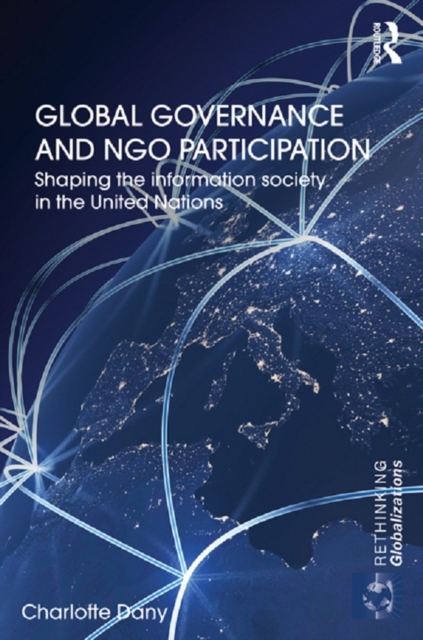
Global Governance and NGO Participation
This book explores the limits of NGO influence and the conditions that constrain NGOs when they participate in international negotiations
Through an empirically rich study of the UN World Summits on the Information Society (WSIS) this book conceptualizes structural power mechanisms that shape global ICT governance and analyses the impact of NGOs on communication rights, intellectual property rights, financing, and Internet governance. The institutional framework of UN negotiations makes it easy for states to exclude NGOs from crucial meetings and to neglect their most relevant demands, in part explaining why NGOs had only limited influence on the policy outcomes of the WSIS in Geneva 2003 and Tunis 2005, although high numbers of NGOs participated. Using a critical perspective, Dany demonstrates that despite the far-reaching participation rights for civil society actors, structural power mechanisms continued to limit the influence of participating NGOs and this contradicts the widely held assumption that extensive NGO participation necessarily increases NGO influence on the policy outcomes.
This book will be of interest to students and scholars of international relations, global governance, the United Nations, and global information and communication politics.
eBook

An Invitation to Explore the Role of NGOs
The chapter invites the reader to investigate how non-governmental organizations influenced the sustainable development discourse. Nongovernmental organizations’ influence may not have been known and predictable, but their influence was significant. The traditions established at Stockholm largely remain intact as diplomats prepare for the upcoming Rio+20 United Nations Conference on Sustainable Development in 2012.
The chapter also provides information on the research design and methodology as well as introducing the chapters in the remainder of the book.
Book Chapter

Sustaining non-profit organizations: Strategic, managerial and financial perspectives
This study explores the complex challenges that Non-Governmental Organizations (NGOs) face. The research highlights the impact of strategic planning, managerial capabilities and financial management on NGOs sustainability. Sustainability is defined to mean durability and continuity of the organization.
Data were collected from 75 NGOs using a survey to examine the roles of strategic planning, financial management, and managerial skills in supporting NGO sustainability.
Contrary to initial assumptions, the findings reveal that while strategic planning and strong managerial capabilities are crucial for long-term sustainability, financial management does not show a direct impact. The study suggests that NGOs should focus on developing comprehensive strategic plans and enhancing their managerial capacities to effectively navigate complex environments and achieve their goals.
This research contributes to the conversation on NGO management by highlighting the important intersection of resource-based competencies and stakeholder engagement in building resilient and successful organizations.
Journal Article