
Catalogue Search | MBRL


Are you sure you want to remove the book from the shelf?

{{itemTitle}}
4,230
result(s) for
"Nonfiction television programs"
Sort by:

What is the story of Scooby-Doo?
\"Your favorite characters are now part of the Who HQ library! Nothing mysterious about it! Learn all about how Scooby and his friends took over Saturday mornings--and then the world--in this debut title in the What Is the Story Of? series. Most kids are familiar with the always-hungry, scaredy-cat Great Dane called Scooby-Doo and his true-blue friends of Mystery Inc. But how did Scooby and the gang make it onto the silver screen? Author M. D. Payne lays out the whole groovy tale in this book that's sure to have readers shouting, \"Zoinks!\"\" -- Provided by publisher.
Book
The Killing Season Uncut
Australians came to the ABC's The Killing Season in their droves, their fascination with the Rudd-Gillard struggle as unfinished as the saga itself.Rudd and Gillard dominate the drama as they strain to claim the narrative of Labor's years in power. The journey to screen for each of their interviews is telling in itself. Kevin Rudd gives his painful account of the period and recalled in vivid detail the events of losing the prime ministership. Julia Gillard is frank and unsparing of her colleagues.More than a hundred people were interviewed for The Killing Season -ministers, backbenchers, staffers, party officials, pollsters and public servants-recording their vivid accounts of the public and private events that made the Rudd and Gillard governments and then brought them undone. It is a damning portrait of a party at war with itself: the personal rivalries and the bitter defeats that have come to define the Rudd-Gillard era.\"The making of The Killing Season matched the drama on screen and that's a story we wanted to tell. And now we have a place for the episodes of rich material we could have put into a 5-part series.\" - Sarah Ferguson
eBook

The Killing Season uncut
Australians came to the ABC's The Killing Season in their droves, their fascination with the Rudd-Gillard struggle as unfinished as the saga itself. Rudd and Gillard dominate the drama as they strain to claim the narrative of Labor's years in power. The journey to screen for each of their interviews is telling in itself. Kevin Rudd gives his painful account of the period and recalled in vivid detail the events of losing the prime ministership. Julia Gillard is frank and unsparing of her colleagues. More than a hundred people were interviewed for The Killing Season -- ministers, backbenchers, staffers, party officials, pollsters and public servants -- recording their vivid accounts of the public and private events that made the Rudd and Gillard governments and then brought them undone. It is a damning portrait of a party at war with itself: the personal rivalries and the bitter defeats that have come to define the Rudd-Gillard era.
Book

Reacting to Reality Television
The unremitting explosion of reality television across the schedules has become a sustainable global phenomenon generating considerable popular and political fervour.
The zeal with which television executives seize on the easily replicated formats is matched equally by the eagerness of audiences to offer themselves up as television participants for others to watch and criticise. But how do we react to so many people breaking down, fronting up, tearing apart, dominating, empathising, humiliating, and seemingly laying bare their raw emotion for our entertainment? Do we feel sad when others are sad? Or are we relieved by the knowledge that our circumstances might be better? As reality television extends into the experiences of the everyday, it makes dramatic and often shocking the mundane aspects of our intimate relations, inviting us as viewers into a volatile arena of mediated morality.
This book addresses the impact of this endless opening out of intimacy as an entertainment trend that erodes the traditional boundaries between spectator and performer demanding new tools for capturing television's relationships with audiences. Rather than asking how the reality television genre is interpreted as 'text' or representation the authors investigate the politics of viewer encounters as interventions, evocations, and more generally mediated social relations.
The authors show how different reactions can involve viewers in tournaments of value, as women viewers empathise and struggle to validate their own lives. The authors use these detailed responses to challenge theories of the self, governmentality and ideology.
A must read for both students and researchers in audience studies, television studies and media and communication studies.
eBook

Fooling with the Amish
Using Amish Mafia as a window into the interplay between the real and the imagined, this book dissects the peculiar appeals and potential dangers of deception in reality TV and popular entertainment.When Amish Mafia was released in 2012, viewers were fascinated by the stories of this secret group of Amish and Mennonite enforcers who used threats, extortion, and violence to keep members of the Amish community in line—and to line their own pockets. While some of the stories were based loosely on actual events, the group itself was a complete fabrication. Its members were played by ex-Amish and ex-Mennonite young adults acting out scenarios concocted by the show's producers. What is most extraordinary about Amish Mafia is that, even though it was fictional, it was cleverly constructed to appear real. Discovery Channel, which aired it, assiduously maintained that it was real; whole episodes were devoted to proving that it was real; and many viewers (including smart reality TV fans) were fooled into believing it was real. In Fooling with the Amish, Dirk Eitzen examines the fakery in Amish Mafia and how actual viewers of the show responded to it to discover answers to two questions that have long puzzled media scholars: What is it about the so-called reality of reality shows that appeals to and gratifies viewers? How and why are people taken in by falsehoods in the media? Eitzen's ultimate answer to these questions is that, in taking liberties with facts, Amish Mafia works very much like gossip. This helps to explain the workings not just of this and other reality TV shows but also of other forms of media fakery, including fake news.The book winds through numerous fascinating case studies of media fakery, from P. T. Barnum's famous humbugs of the nineteenth century to recent TV news scandals. It examines the social and emotional appeals of other forms of entertaining fakery, including professional wrestling and supermarket tabloids. It explains how and why conventions of contrivance evolved in reality TV as well as the ethics of media fakery. And, for readers interested in the Amish, it tells how the ex-Amish stars of Amish Mafia got involved in the show and the impact that involvement had on their lives.
eBook

Crimesploitation
\"Due to the graphic nature of this program, viewer discretion is advised.\" Most of us have encountered this warning while watching television at some point. It is typically attached to a brand of reality crime TV that Paul Kaplan and Daniel LaChance call \"crimesploitation\": spectacles designed to entertain mass audiences by exhibiting \"real\" criminal behavior and its consequences. This book examines their enduring popularity in American culture. Analyzing the structure and content of several popular crimesploitation shows, including Cops, Dog: The Bounty Hunter, and To Catch a Predator, as well as newer examples like Making a Murderer and Don't F**K with Cats, Kaplan and LaChance highlight the troubling nature of the genre: though it presents itself as ethical and righteous, its entertainment value hinges upon suffering. Viewers can imagine themselves as deviant and ungovernable like the criminals in the show, thereby escaping a law-abiding lifestyle. Alternatively, they can identify with law enforcement officials, exercising violence, control, and \"justice\" on criminal others. Crimesploitation offers a sobering look at the depictions of criminals, policing, and punishment in modern America.
eBook
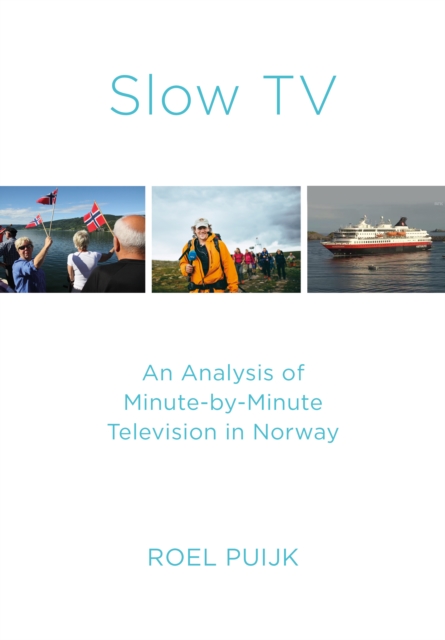
Slow TV
Slow TV, developed by Norwegian public service broadcaster NRK, is broadcasting in which the event on television lasts as long as in real time, and has been adopted by others including BBC Four and Netflix. This unique study discusses concepts of slowness, innovation, genre, media event, reception, local and national identity. 56 col. illus.
eBook

The Cultural Impact of Rupaul's Drag Race
Insightful and provocative, and new in paperback. Examines the social, cultural, political and commercial implications of RuPaul's Drag Race, from its groundbreaking, subversive entry into the reality television arena, to a now mainstream, increasingly non-LGBTQ+, audience reach and relationship with fans. International contributors. 40 b/w illus. New Books Network (New Books in Popular Culture) interview with Cameron Crookston.
eBook

China's cultural diplomacy in Indonesia : the case of a transnational singing contest
The emphasis on cultural connectivity in China's growing presence and involvement in Southeast Asia highlights the importance China places on people-to-people exchanges as part of its global engagement strategy.
eBook
Iconic America. Season 1, Episode 3, The Gadsden flag
Iconic America uncovers the story of the Gadsden Flag. From Franklin to the Tea Party, Marines, and social movements, its history resonates today. While some perceive it as an extremist symbol, others view it as a patriotic reminder of our legacy. Explore the flag’s multifaceted nature, unveiling its role as both a divisive and quintessentially American symbol.
Streaming Video