
Catalogue Search | MBRL


Are you sure you want to remove the book from the shelf?

{{itemTitle}}
12,715
result(s) for
"Nonlinear control theory"
Sort by:


Nonlinear dynamics in MEMS systems: Overcoming pull-in challenges and exploring innovative solutions
Micro-Electro-Mechanical Systems (MEMS) play a pivotal role in modern technology, with applications ranging from biomedical monitoring to inertial navigation, RF communication, and energy harvesting. However, their nonlinear dynamics, arising from electrostatic coupling, geometric and material nonlinearities, and multi-physics interactions, present substantial challenges. Pull-in instability, predominantly initiated by even-order nonlinear terms, signifies a pivotal concern that can culminate in device failure, stiction, and irreversible damage. This paper presents novel methodologies for the comprehensive elimination of pull-in instability in MEMS. The re-engineering of the spring in the MEMS oscillator has yielded a specialized spring with a meticulously designed restoring-force formula, which effectively counteracts the influence of even-order nonlinear forces to mitigate pull-in instability. Furthermore, modifying the MEMS system’s structure, material properties, or governing equations to eliminate the quadratic nonlinear term—a primary cause of pull-in instability—significantly delays the onset of pull-in, despite the persistence of higher-order even nonlinearities. A novel MEMS model has been developed to address higher-order even nonlinearities with high effectiveness. When parameters Ωi and ωi are suitably chosen, this model fully eliminates all even nonlinearities. Furthermore, AI-assisted modeling techniques are employed to capture the complex nonlinear behaviors of MEMS with high accuracy and efficiency, enhancing device design and enabling effective control strategies. The integration of these approaches offers a comprehensive solution to the problem of pull-in instability, thereby creating new possibilities for the development of more reliable, efficient, and innovative MEMS devices. These developments will have profound impacts across multiple application fields.
Journal Article


The Inverted Pendulum Benchmark in Nonlinear Control Theory: A Survey
Abstract For at least fifty years, the inverted pendulum has been the most popular benchmark, among others, in nonlinear control theory. The fundamental focus of this work is to enhance the wealth of this robotic benchmark and provide an overall picture of historical and current trend developments in nonlinear control theory, based on its simple structure and its rich nonlinear model. In this review, we will try to explain the high popularity of such a robotic benchmark, which is frequently used to realize experimental models, validate the efficiency of emerging control techniques and verify their implementation. We also attempt to provide details on how many standard techniques in control theory fail when tested on such a benchmark. More than 100 references in the open literature, dating back to 1960, are compiled to provide a survey of emerging ideas and challenging problems in nonlinear control theory accomplished and verified using this robotic system. Possible future trends that we can envision based on the review of this area are also presented.
Journal Article

Advances in statistical control, algebraic systems theory, and dynamic systems characteristics : a tribute to Michael K. Sain
Dedicated to Michael K. Sain, this volume is a collection of invited chapters covering advances in stochastic optimal control theory and algebraic systems theory. It is ideal for use as a supplementary textbook in a graduate course on optimal control or algebraic systems theory.
eBook

Neural control engineering : the emerging intersection between control theory and neuroscience
How powerful new methods in nonlinear control engineering can be applied to neuroscience, from fundamental model formulation to advanced medical applications.Over the past sixty years, powerful methods of model-based control engineering have been responsible for such dramatic advances in engineering systems as autolanding aircraft, autonomous vehicles, and even weather forecasting. Over those same decades, our models of the nervous system have evolved from single-cell membranes to neuronal networks to large-scale models of the human brain. Yet until recently control theory was completely inapplicable to the types of nonlinear models being developed in neuroscience. The revolution in nonlinear control engineering in the late 1990s has made the intersection of control theory and neuroscience possible. In Neural Control Engineering, Steven Schiff seeks to bridge the two fields, examining the application of new methods in nonlinear control engineering to neuroscience. After presenting extensive material on formulating computational neuroscience models in a control environment-including some fundamentals of the algorithms helpful in crossing the divide from intuition to effective application-Schiff examines a range of applications, including brain-machine interfaces and neural stimulation. He reports on research that he and his colleagues have undertaken showing that nonlinear control theory methods can be applied to models of single cells, small neuronal networks, and large-scale networks in disease states of Parkinson's disease and epilepsy. With Neural Control Engineering the reader acquires a working knowledge of the fundamentals of control theory and computational neuroscience sufficient not only to understand the literature in this trandisciplinary area but also to begin working to advance the field. The book will serve as an essential guide for scientists in either biology or engineering and for physicians who wish to gain expertise in these areas.
eBook

Time-scaling of affine systems by control inputs
This study investigates the structure of affine systems through an exploration of time-scaling properties induced by control inputs. By leveraging the Frobenius theorem and the principles of involutive distributions, we uncover that system dynamics can be effectively decomposed into time-scaled flows of commuting vector fields. This decomposition enhances the geometric understanding of affine systems and provides a theoretical perspective that may inform future developments in control design and performance evaluation. The proposed framework is general and flexible, and is expected to provide a foundation for future theoretical advances in nonlinear control theory, which may potentially be extended to practical applications such as plant design or performance optimization.
Journal Article

The Control Strategies for Charging and Discharging of Electric Vehicles in the Vehicle–Grid Interaction Modes
In response to the challenges posed by large-scale, uncoordinated electric vehicle charging on the power grid, Vehicle-to-Grid (V2G) technology has been developed. This technology seeks to synchronize electric vehicles with the power grid, improving the stability of their connections and fostering positive energy exchanges between them. The key component for implementing V2G technology is the bidirectional AC/DC converter. This study concentrates on the non-isolated bidirectional AC/DC converter, providing a detailed analysis of its two-stage operation and creating a mathematical model. A dual closed-loop control structure for voltage and current is designed based on nonlinear control theory, along with a constant current charge–discharge control strategy. Furthermore, midpoint potential balance is achieved through zero-sequence voltage injection control, and power signals for the switching devices are generated using Space Vector Pulse Width Modulation (SVPWM) technology. A simulation model of the V2G system is then constructed in MATLAB/Simulink for analysis and validation. The findings demonstrate that the control strategy proposed in this paper improves the system’s robustness, dynamic performance, and resistance to interference, thus reducing the effects of large-scale, uncoordinated electric vehicle charging on the power grid.
Journal Article
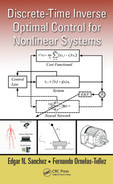
Discrete-Time Inverse Optimal Control for Nonlinear Systems
This book presents a novel inverse optimal control approach for stabilization and trajectory tracking of discrete-time nonlinear systems. This approach avoids the need to solve the associated Hamilton-Jacobi-Bellman equation and minimizes a cost functional, resulting in efficient controllers. The book also proposes the use of recurrent neural networks to model discrete-time nonlinear systems. Combined with the inverse optimal control scheme, such models constitute a powerful tool to deal with uncertainties such as unmodeled dynamics and disturbances. Simulations illustrate the effectiveness of the synthesized controllers.
eBook

Entropy of Generating Series for Nonlinear Input-Output Systems and Their Interconnections
This paper has two main objectives. The first is to introduce a notion of entropy that is well suited for the analysis of nonlinear input-output systems that have a Chen-Fliess series representation. The latter is defined in terms of its generating series over a noncommutative alphabet. The idea is to assign an entropy to a generating series as an element of a graded vector space. The second objective is to describe the entropy of generating series originating from interconnected systems of Chen-Fliess series that arise in the context of control theory. It is shown that one set of interconnections can never increase entropy as defined here, while a second set has the potential to do so. The paper concludes with a brief introduction to an entropy ultrametric space and some open questions.
Journal Article