
Catalogue Search | MBRL


Are you sure you want to remove the book from the shelf?

{{itemTitle}}
1,729
result(s) for
"Nonprofit organizations Membership."
Sort by:


The Influence of Board Diversity, Board Diversity Policies and Practices, and Board Inclusion Behaviors on Nonprofit Governance Practices
This study examines how and when nonprofit board performance is impacted by board diversity. Specifically, we investigate board diversity policies and practices as well as board inclusion behaviors as mediating mechanisms for the influence of age, gender, and racial/ethnic diversity of the board on effective board governance practices. The empirical analysis, using a sample of 1,456 nonprofit board chief executive officers, finds that board governance practices are directly influenced by the gender and racial diversity of the board and that board inclusion behaviors together with diversity policies and practices mediate the influence of the board's gender and racial diversity on internal and external governance practices. Additionally, we found an interaction effect that indicates when boards have greater gender diversity, the negative impact of racial diversity on governance practices is mitigated. The findings suggest that board governance can be improved with more diverse membership, but only if the board behaves inclusively and there are policies and practices in place to allow the diverse members to have an impact.
Journal Article

Explaining the Transnational Design of International Organizations
Past decades have witnessed a shift in international cooperation toward growing involvement of transnational actors (TNAs), such as nongovernmental organizations, multinational corporations, and philanthropic foundations. This article offers a comprehensive theoretical and empirical account of TNA access to IOs. The analysis builds on a novel data set, covering formal TNA access to 298 organizational bodies from fifty IOs over the time period 1950 to 2010. We identify the most profound patterns in TNA access across time, issue areas, policy functions, and world regions, and statistically test competing explanations of the variation in TNA access. The central results are three-fold. First, the empirical data confirm the existence of a far-reaching institutional transformation of IOs over the past sixty years, pervading all issue areas, policy functions, and world regions. Second, variation in TNA access within and across IOs is mainly explained by a combination of three factors: functional demand for the resources of TNAs, domestic democratic standards in the membership of IOs, and state concerns with national sovereignty. Third, existing research suffers from a selection bias that has led it to overestimate the general importance of a new participatory norm in global governance for the openness of IOs.
Journal Article
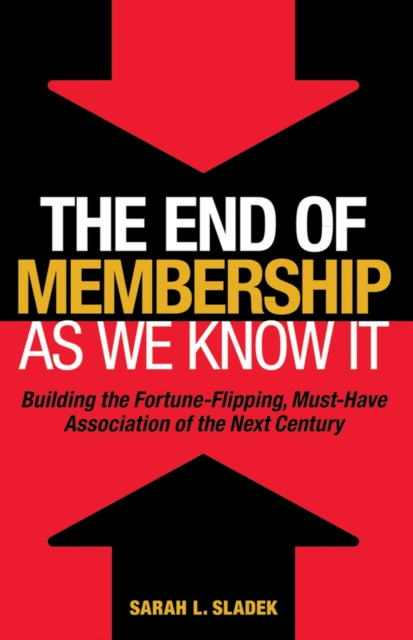
The End of Membership As We Know It
How new membership models can help associations survive and thrive in today's evolving environment The era when associations could count on members joining and renewing, even with a relatively unchanging menu of membership benefits, has passed. No, membership is not dead, argues author Sarah Sladek. But associations do need to change their thinking and their models. In The End of Membership As We Know It: Building the Fortune-Flipping, Must-Have Association of the Next Century, Sladek offers practical, proven ways that associations can respond to changes affecting participation such as the generational shifts in the workforce, social changes, and technology-eased access to content and community. The End of Membership As We Know It explains: How niche the new competitive advantage is Why organizational culture has an enormous impact on recruitment and retention What emerging member-prospects value and want Why and how to focus on member ROI instead of program ROI How to craft and deliver compelling benefits rather than features How to extend your reach Which emerging models are taking root and showing promise Providing numerous real-world examples along with specific guidance, The End of Membership As We Know It is a must-have guide for moving your membership model into the future.
eBook

Strategic leadership, change and growth in not-for-profit, membership-based, value-driven organisations
PurposeThis research paper takes an interdisciplinary approach, drawing from empirical data, to explore the relationship between organisational change management and strategic leadership to promote growth in value-driven, membership-based organisations through a qualitative multi-case-based analysis and to provide a discussion on the philosophies and practices of leadership teams which underpin successful organisational change within such not-for-profit organisations.Design/methodology/approachEach participating organisation had 700+ members, had previously experienced prolonged periods of auditable membership growth and employed distinctly different organisational models to facilitate growth. A qualitative multi-case study approach was adopted informed by 32 interviews with eight leadership teams. A thematic analysis provided a comparative review of responses.FindingsAll case study organisations emphasised the significance of strategic leadership teams and clearly communicated vision and flexible organisational structures as central to their strategic planning and subsequent growth. This builds on previous research which has explored organisational change in not-for-profit organisations and strategic leadership in not-for-profit organisations, which explores the strong linkages between the roles and functions of strategic leadership, organisational structures designed with the adaptive capacity to manage continuous and convergent change and their impact on sustained growth. Such linkages are more specifically supported by extended tenure of office for those in senior leadership roles, clear delineation of roles and responsibilities, the adoption of an outward growth-oriented focus and adaptable structures that encourage wider participation in leadership and management functions for the fulfilment of the organisation's mission. Most significantly, these organisations plan with change and growth in mind.Practical implicationsThe findings of this research have transferable value to other not-for-profit, membership-based, value-driven organisations as well as other faith-based organisations, which will help to provide future linkages between leadership structures, decision-making and organisational design and its impact on the not-for-profit organisations' capacity for sustained growth.Originality/valueThis research challenges previous conceptions on UK church growth trends and observes that all the case organisations presented different organisational structures which were intentionally designed, context specific and developed by leadership teams with sustained growth in mind. Results from psychometric testing of participants confirmed that senior leaders of large value-driven organisations that have demonstrated a capacity for sustained growth are consistently likely to exhibit leadership characteristics which demonstrate a balanced capacity for personal humility and a committed resolve or professional will, which is also reflected in a pragmatic-type leadership style, building on previous psychometric testing research in this context.
Journal Article

Boundary Organizations: Enabling Collaboration among Unexpected Allies
Our research examines how parties challenging established social systems collaborate with defenders of those systems to achieve mutual goals. With field interviews and observations from four community projects in the open-source movement, we examine how these projects collaborated with firms defending proprietary approaches to software development. Drawing on social movement and organizational theory, we explain how challenging parties not only mobilize to achieve their goals but how they are able to transform contestation into collaboration. Open-source projects and firms held divergent interests but discovered areas of convergent interest and were able to adapt their organizing practices to collaborate through the creation of a boundary organization. By showing how boundary organizations help challengers and defenders manage four critical domains of organizing practices—governance, membership, ownership, and control over production—we provide analytic levers for determining when boundary organizations work. At the same time, we reveal the subsequent triadic role structure that unfolded among communities, the boundary organizations they designed, and firms.
Journal Article

The radicalness of innovation in nonprofit community sport organizations
Our study examined and compared the type, process, conditions, and consequences of radical and incremental innovations in community sport organizations (CSOs), which are a type of nonprofit membership association. Interviews were conducted with the president (or representative) of 14 CSOs engaged with both radical and incremental innovations. Radical innovations were reported to be mostly technical (but also administrative), undertaken with the goal of club growth and enhancing club management, adopted and further adapted from outside the organization, influenced by the culture and expertise of the board and the culture and capacity of the CSO at large, and informed by market opportunity and best practices. The radical innovations were reported to be successful in reaching their intended goals, and a wide variety of unanticipated (positive) consequences was also realized. The findings have implications for the management of radical (and incremental) innovation in the focal nonprofit context and contribute to theorizing about the radicalness of organizational innovation.
Journal Article

Prevalence of financial conflicts of interest among panel members producing clinical practice guidelines in Canada and United States: cross sectional study
Objective To determine the prevalence of financial conflicts of interest among members of panels producing clinical practice guidelines on screening, treatment, or both for hyperlipidaemia or diabetes.Design Cross sectional study.Setting Relevant guidelines published by national organisations in the United States and Canada between 2000 and 2010.Participants Members of guideline panels.Main outcome measures Prevalence of financial conflicts of interest among members of guideline panels and chairs of panels.Results Fourteen guidelines met our search criteria, of which five had no accompanying declaration of conflicts of interest by panel members. 288 panel members had participated in the guideline development process. Among the 288 panel members, 138 (48%) reported conflicts of interest at the time of the publication of the guideline and 150 (52%) either stated that they had no such conflicts or did not have an opportunity to declare any. Among 73 panellists who formally declared no conflicts, 8 (11%) were found to have one or more. Twelve of the 14 guideline panels evaluated identified chairs, among whom six had financial conflicts of interest. Overall, 150 (52%) panel members had conflicts, of which 138 were declared and 12 were undeclared. Panel members from government sponsored guidelines were less likely to have conflicts of interest compared with guidelines sponsored by non-government sources (15/92 (16%) v 135/196 (69%); P<0.001).Conclusions The prevalence of financial conflicts of interest and their under-reporting by members of panels producing clinical practice guidelines on hyperlipidaemia or diabetes was high, and a relatively high proportion of guidelines did not have public disclosure of conflicts of interest. Organisations that produce guidelines should minimise conflicts of interest among panel members to ensure the credibility and evidence based nature of the guidelines' content.
Journal Article

The Role of Organizations in Fostering Public Service Motivation
In seeking to explain the antecedents of public service motivation, James Perry focuses on the formative role of sociohistorical context. This study tests Perry's theory and examines the role that organizational factors play in shaping public service motivation, based on responses from a national survey of state government health and human service managers. The findings support the role of sociohistorical context, showing that public service motivation is strongly and positively related to level of education and membership in professional organizations. The results also underscore the significant influence of organizational institutions, indicating that red tape and length of organizational membership are negatively related to public service motivation, whereas hierarchical authority and reform efforts have a positive relationship. Therefore, public organizations have both an opportunity and a responsibility to create an environment that allows employees to feel they are contributing to the public good.
Journal Article
