
Catalogue Search | MBRL


Are you sure you want to remove the book from the shelf?

{{itemTitle}}
45
result(s) for
"Noodles Japan."
Sort by:


The noodle narratives
Tasty, convenient, and cheap, instant noodles are one of the most remarkable industrial foods ever. Consumed around the world by millions, they appeal to young and old, affluent and impoverished alike. The authors examine the history, manufacturing, marketing, and consumption of instant noodles. By focusing on three specific markets, they reveal various ways in which these noodles enable diverse populations to manage their lives. The first market is in Japan, where instant noodles have facilitated a major transformation of post-war society, while undergoing a seemingly endless tweaking in flavors, toppings, and packaging in order to entice consumers. The second is in the United States, where instant noodles have become important to many groups including college students, their nostalgic parents, and prison inmates. The authors also take note of \"heavy users,\" a category of the chronically hard-pressed targeted by U.S. purveyors. The third is in Papua New Guinea, where instant noodles arrived only recently and are providing cheap food options to the urban poor, all the while transforming them into aspiring consumers. Finally, this study examines the global \"Big Food\" industry. As one of the food system’s singular achievements, the phenomenon of instant noodles provides insight into the pros and cons of global capitalist provisioning.
eBook

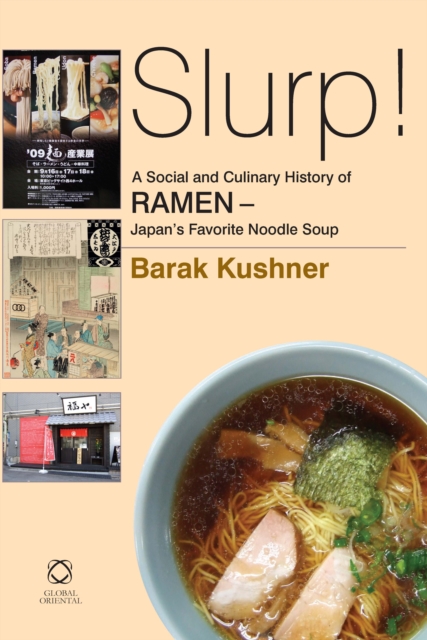
Slurp! A Social and Culinary History of Ramen – Japan’s Favorite Noodle Soup
Based on research in Chinese and Japanese, as well as interviews with comedians, food service professionals, entertainment managers, store-owners, customers, and scholars of food history, Kushner explores the history of ramen and Japan's noodle culture over the last 1,000 years.
eBook

Noodles on a bicycle
Children watch in amazement as the bicycle food deliverers of Tokyo stack their noodle bowls like architects, zip through the city like acrobats, and deliver delicious noodles to students, office workers, and families.
CHILDBOOK

Effects of Incorporation of Porous Tapioca Starch on the Quality of White Salted (Udon) Noodles
White salted (udon) noodles are one of the major staple foods in Asian countries, particularly in Japan. Noodle manufacturers prefer the Australian noodle wheat (ANW) varieties to produce high-quality udon noodles. However, the production of this variety has reduced significantly in recent years, thus affecting the Japanese noodle market. Noodle manufacturers often add tapioca starch to compensate for the flour scarcity; however, the noodle-eating quality and texture are significantly reduced. This study, therefore, investigated the effect of the addition of porous tapioca starch on the cooking quality and texture of udon noodles. For this, tapioca starch was initially subjected to enzyme treatment, ultrasonication, and a combination of both to produce a porous starch where a combined enzyme (0.4% alpha amylase)–ultrasound treatment (20 kHz) yielded a porous starch with increased specific surface area and better absorbent properties which are ideal for udon noodle manufacturing, Later, udon noodles were prepared using three varieties of ANW, a hard Mace variety, and commercial wheat flour by incorporating the prepared porous tapioca starch at a concentration of 5% and 10% of dry ingredients. Adding this porous starch resulted in a lower cooking time with higher water absorption and desirable lower cooking loss compared to the control sample with 5% of the porous starch chosen as the optimum formulation. Increasing the level of the porous starch reduced the hardness of the noodles whilst maintaining the desired instrumental texture. Additionally, a multivariate analysis indicated a good correlation between responses’ optimum cooking time and water absorption capacity as well as turbidity and cooking loss, and a cluster analysis grouped noodle samples prepared from different varieties into the same clusters based on the porous starch added, indicating the possibility of different market strategies to improve the quality of the udon noodles produced from different wheat varieties.
Journal Article

Characterisation of breakfast, lunch, dinner and snacks in the Japanese context: an exploratory cross-sectional analysis
To characterise different meal types by examining the contribution of specific meals to the total intakes and the nutritional quality of each meal.
A cross-sectional analysis was conducted based on dietary data collected using 4-d dietary record. Diet quality was assessed by the Healthy Eating Index-2015 and Nutrient-Rich Food Index 9.3.
Japan.
Adults aged 20-81 years (n 639).
Diet quality was, on average, highest for dinner, followed, in order, by lunch, breakfast and snacks. Breakfast, lunch, dinner and snacks, on average, accounted for 21 %, 32 %, 40 % and 11 % of total energy intake, respectively. For many nutrients, the percentage contribution to total intake did not vary within each meal, broadly in line with that for energy: 18-24 % for breakfast, 26-35 % for lunch, 35-49 % for dinner and 4-15 % for snacks. However, intakes of many foods largely depended on one meal type. The foods mainly eaten at dinner were potatoes, pulses, total vegetables, fish, meat and alcoholic beverages (52-70 %), in contrast to noodles (58 %) at lunch and bread (71 %) and dairy products (50 %) at breakfast. The foods mainly eaten at snacks were confectioneries (79 %) and sugar-sweetened beverages (52 %). Conversely, rice and eggs were more evenly distributed across three main meals (19-41 % and 30-38 %, respectively), while fruit and non-energetic beverages were more evenly distributed across all meal types (17-30 % and 19-35 %, respectively).
These findings provide the background information on each meal type in Japanese and may help inform the development of meal-based guidelines and public health messages.
Journal Article
Sodium sources in the Japanese diet: difference between generations and sexes
Globally, the Na consumption of most people exceeds the WHO recommendation. To be effective, salt reduction programmes require assessment of the dietary sources of Na. Due to methodological difficulties however, comprehensive assessments are rare. Here, we identified Na sources in the Japanese diet using a 4 d diet record that was specifically designed for Na source description.
A cross-sectional study.
Apparently healthy men (n 196) and women (n 196) aged 20-69 years.
The subjects were recruited from twenty-three of forty-seven prefectures in Japan.
The proportion of discretionary Na intake in total Na intake was 52·3 % in men and 57·1 % in women, and was significantly lower in younger subjects. The two major food groups contributing to Na intake were seasonings such as salt or soya sauce (61·7 % of total Na intake in men, 62·9 % in women) and fish and shellfish (6·7 % in men, 6·6 % in women). The third major contributor differed between men and women (noodles in men, 4·9 %; bread in women, 5·0 %). Further, the contribution of each food group to total Na intake differed among age groups.
While individual efforts to decrease Na intake remain important, population approaches to reducing Na content in processed foods are already equally important and will assume greater importance in the future even in Japan, an Asian country facing a rapid Westernization in dietary habits.
Journal Article

Meal-specific dietary patterns and their contribution to overall dietary patterns in the Japanese context: Findings from the 2012 National Health and Nutrition Survey, Japan
•To our knowledge, this is the first study to investigate meal-specific dietary patterns in Japan.•Four dietary patterns were identified for each meal (breakfast, lunch, and dinner).•Meal-specific dietary patterns differentially contributed to overall dietary patterns.
Most studies on dietary patterns have focused on the total daily intake of foods without differentiating intake at specific eating occasions. The aim of this study was to identify meal-specific (breakfast, lunch, and dinner) dietary patterns and examine their contribution to overall dietary patterns, using data from the 2012 National Health and Nutrition Survey, Japan.
Dietary intake was assessed with a 1-d weighed dietary record for 15 618 Japanese adults ≥20 y of age.
Using principal component analysis based on daily consumption of 22 food groups, four overall dietary patterns were identified: vegetable/fruit/fish/pulse, bread/dairy, meat/fat, and noodle/seasoning patterns. Four meal-specific dietary patterns, which were independently identified in the same manner based on consumption at each eating occasion, were as follows:
• Breakfast: rice/vegetable/fish/pulse/seasoning, bread/dairy/fruit/sugar, meat/egg/fat, and tea/coffee patterns;
• Lunch: bread/dairy, noodle/seasoning, meat/fat, and vegetable/pulse/potato/sugar patterns; and
• Dinner: meat/vegetable/seasoning, noodle/alcoholic beverage, fish/sugar/alcoholic beverage, and other grains/fat patterns.
The major contributors to interindividual variation in the vegetable/fruit/fish/pulse overall dietary pattern included the rice/vegetable/fish/pulse/seasoning breakfast (28%), the vegetable/pulse/potato/sugar lunch (15%), and the fish/sugar/alcoholic beverage dinner (19%). For other overall dietary patterns, the major contributors were generally patterns with similar characteristics, namely the bread/dairy/fruit/sugar breakfast (33%) and the bread/dairy lunch (24%) for the bread/dairy overall dietary pattern; the meat/egg/fat breakfast (13%), the meat/fat lunch (33%), the meat/vegetable/seasoning dinner (28%), and the other grains/fat dinner (11%) for the meat/fat overall dietary pattern; and the noodle/seasoning lunch (51%) and the noodle/alcoholic beverage dinner (25%) for the noodle/seasoning overall dietary pattern.
Major meal-specific dietary patterns were identified in the Japanese context, which differentially contributed to major overall dietary patterns.
Journal Article

The untold history of Ramen
A rich, salty, and steaming bowl of noodle soup, ramen has become an international symbol of the cultural prowess of Japanese cuisine. In this highly original account of geopolitics and industrialization in Japan, George Solt traces the meteoric rise of ramen from humble fuel for the working poor to international icon of Japanese culture. Ramen's popularity can be attributed to political and economic change on a global scale. Using declassified U.S. government documents and an array of Japanese sources, Solt reveals how the creation of a black market for American wheat imports during the U.S. occupation of Japan (1945–1952), the reindustrialization of Japan's labor force during the Cold War, and the elevation of working-class foods in redefining national identity during the past two decades of economic stagnation (1990s–2000s), all contributed to the establishment of ramen as a national dish. This book is essential reading for scholars, students of Japanese history and food studies, and anyone interested in gaining greater perspective on how international policy can influence everyday foods around the world.
eBook