
Catalogue Search | MBRL


Are you sure you want to remove the book from the shelf?

{{itemTitle}}
7,141
result(s) for
"Norm (mathematics)"
Sort by:

Graph theoretic methods in multiagent networks
This accessible book provides an introduction to the analysis and design of dynamic multiagent networks. Such networks are of great interest in a wide range of areas in science and engineering, including: mobile sensor networks, distributed robotics such as formation flying and swarming, quantum networks, networked economics, biological synchronization, and social networks. Focusing on graph theoretic methods for the analysis and synthesis of dynamic multiagent networks, the book presents a powerful new formalism and set of tools for networked systems.
The book's three sections look at foundations, multiagent networks, and networks as systems. The authors give an overview of important ideas from graph theory, followed by a detailed account of the agreement protocol and its various extensions, including the behavior of the protocol over undirected, directed, switching, and random networks. They cover topics such as formation control, coverage, distributed estimation, social networks, and games over networks. And they explore intriguing aspects of viewing networks as systems, by making these networks amenable to control-theoretic analysis and automatic synthesis, by monitoring their dynamic evolution, and by examining higher-order interaction models in terms of simplicial complexes and their applications.
The book will interest graduate students working in systems and control, as well as in computer science and robotics. It will be a standard reference for researchers seeking a self-contained account of system-theoretic aspects of multiagent networks and their wide-ranging applications.
This book has been adopted as a textbook at the following universities:
University of Stuttgart, GermanyRoyal Institute of Technology, SwedenJohannes Kepler University, AustriaGeorgia Tech, USAUniversity of Washington, USAOhio University, USA
eBook

Robust Optimization
Robust optimization is still a relatively new approach to optimization problems affected by uncertainty, but it has already proved so useful in real applications that it is difficult to tackle such problems today without considering this powerful methodology. Written by the principal developers of robust optimization, and describing the main achievements of a decade of research, this is the first book to provide a comprehensive and up-to-date account of the subject.
Robust optimization is designed to meet some major challenges associated with uncertainty-affected optimization problems: to operate under lack of full information on the nature of uncertainty; to model the problem in a form that can be solved efficiently; and to provide guarantees about the performance of the solution.
The book starts with a relatively simple treatment of uncertain linear programming, proceeding with a deep analysis of the interconnections between the construction of appropriate uncertainty sets and the classical chance constraints (probabilistic) approach. It then develops the robust optimization theory for uncertain conic quadratic and semidefinite optimization problems and dynamic (multistage) problems. The theory is supported by numerous examples and computational illustrations.
An essential book for anyone working on optimization and decision making under uncertainty,Robust Optimizationalso makes an ideal graduate textbook on the subject.
eBook

Distributed Control of Robotic Networks
This self-contained introduction to the distributed control of robotic networks offers a distinctive blend of computer science and control theory. The book presents a broad set of tools for understanding coordination algorithms, determining their correctness, and assessing their complexity; and it analyzes various cooperative strategies for tasks such as consensus, rendezvous, connectivity maintenance, deployment, and boundary estimation. The unifying theme is a formal model for robotic networks that explicitly incorporates their communication, sensing, control, and processing capabilities--a model that in turn leads to a common formal language to describe and analyze coordination algorithms. Written for first- and second-year graduate students in control and robotics, the book will also be useful to researchers in control theory, robotics, distributed algorithms, and automata theory. The book provides explanations of the basic concepts and main results, as well as numerous examples and exercises. Self-contained exposition of graph-theoretic concepts, distributed algorithms, and complexity measures for processor networks with fixed interconnection topology and for robotic networks with position-dependent interconnection topology Detailed treatment of averaging and consensus algorithms interpreted as linear iterations on synchronous networks Introduction of geometric notions such as partitions, proximity graphs, and multicenter functions Detailed treatment of motion coordination algorithms for deployment, rendezvous, connectivity maintenance, and boundary estimation
eBook
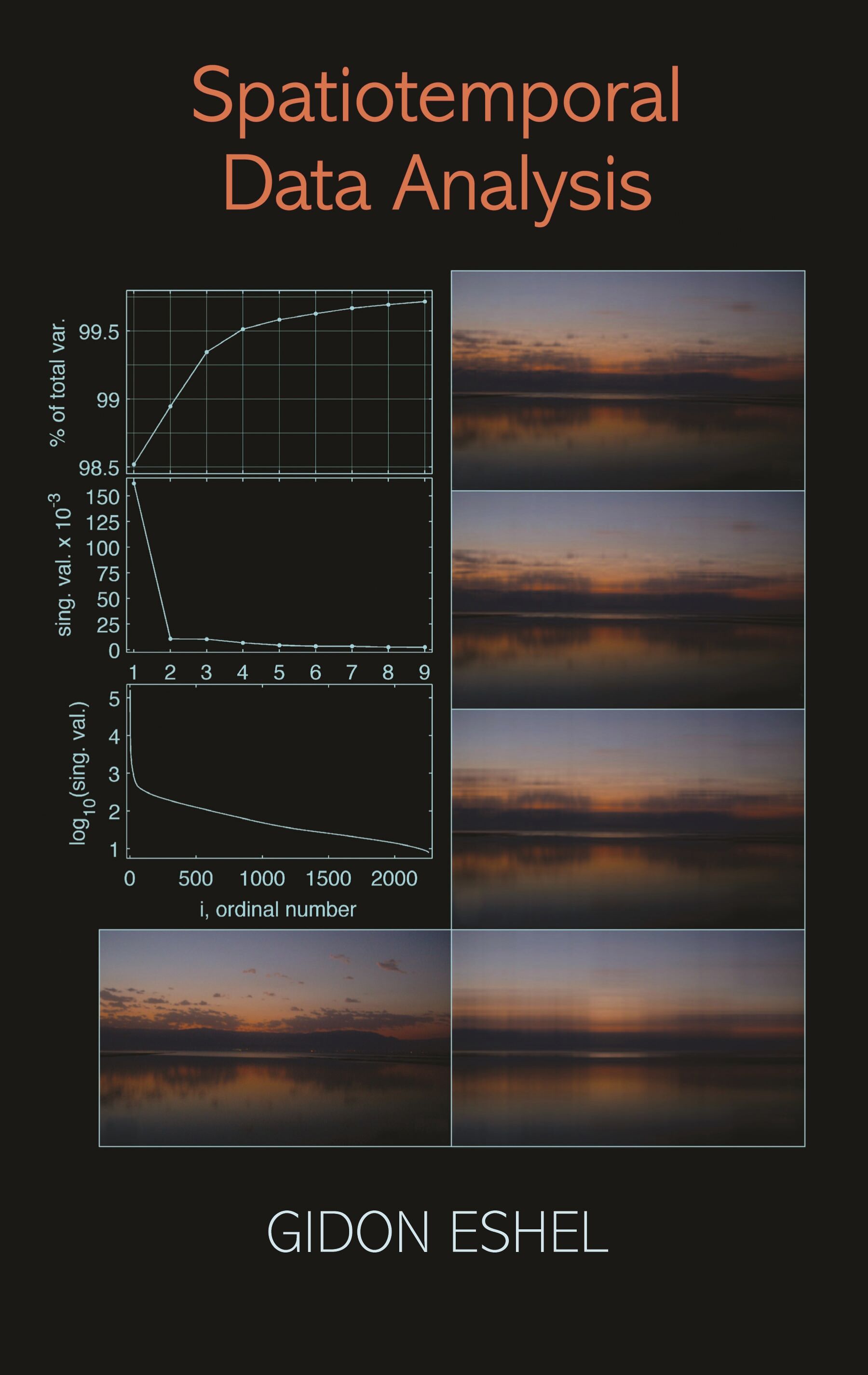
Spatiotemporal data analysis
A severe thunderstorm morphs into a tornado that cuts a swath of destruction through Oklahoma. How do we study the storm's mutation into a deadly twister? Avian flu cases are reported in China. How do we characterize the spread of the flu, potentially preventing an epidemic? The way to answer important questions like these is to analyze the spatial and temporal characteristics--origin, rates, and frequencies--of these phenomena. This comprehensive text introduces advanced undergraduate students, graduate students, and researchers to the statistical and algebraic methods used to analyze spatiotemporal data in a range of fields, including climate science, geophysics, ecology, astrophysics, and medicine.
Gidon Eshel begins with a concise yet detailed primer on linear algebra, providing readers with the mathematical foundations needed for data analysis. He then fully explains the theory and methods for analyzing spatiotemporal data, guiding readers from the basics to the most advanced applications. This self-contained, practical guide to the analysis of multidimensional data sets features a wealth of real-world examples as well as sample homework exercises and suggested exams.
eBook

Positive definiteness of functions with applications to operator norm inequalities
Positive definiteness is determined for a wide class of functions relevant in the study of operator means and their norm comparisons.
Then, this information is used to obtain an abundance of new sharp (unitarily) norm inequalities comparing various operator means and
sometimes other related operators.
eBook

Thermodynamics
This book places thermodynamics on a system-theoretic foundation so as to harmonize it with classical mechanics. Using the highest standards of exposition and rigor, the authors develop a novel formulation of thermodynamics that can be viewed as a moderate-sized system theory as compared to statistical thermodynamics. This middle-ground theory involves deterministic large-scale dynamical system models that bridge the gap between classical and statistical thermodynamics.
The authors' theory is motivated by the fact that a discipline as cardinal as thermodynamics--entrusted with some of the most perplexing secrets of our universe--demands far more than physical mathematics as its underpinning. Even though many great physicists, such as Archimedes, Newton, and Lagrange, have humbled us with their mathematically seamless eurekas over the centuries, this book suggests that a great many physicists and engineers who have developed the theory of thermodynamics seem to have forgotten that mathematics, when used rigorously, is the irrefutable pathway to truth.
This book uses system theoretic ideas to bring coherence, clarity, and precision to an extremely important and poorly understood classical area of science.
eBook

Australian primary school teachers' perceived barriers to and enablers for the integration of children's literature in mathematics teaching and learning
This qualitative survey study set out to investigate in-service and pre-service primary school teachers' perceived barriers to and enablers for the integration of children's literature in mathematics teaching and learning in an
Australian educational context. While research over the past three decades have documented pedagogical benefits of teaching mathematics using children's literature, research into teachers' perceptions regarding the use of such resources
is virtually non-existent. The study thus filled this research gap by drawing responses from open-ended survey questions of 94 in-service and 82 pre-service teachers in Australia. A thematic analysis revealed 13 perceived barriers
classified under five themes with Lack of Pedagogical Knowledge and Confidence, and Time Constraint, representing 75% of all perceived barriers. Moreover, 14 perceived enablers were identified and classified under five themes with
Pedagogical Benefits and Love of Stories representing around 70% of all perceived enablers. Findings also showed that most of the teachers in the study (around 75%) never or infrequently used children's literature in their mathematics
classrooms. The study highlights the role of professional learning and teacher training in ensuring that both in- and pre-service teachers have the necessary pedagogical knowledge, experience and confidence in using children's literature
to enrich their mathematics teaching. [Author abstract]
Journal Article
Documenting two emerging sociomathematical norms for examining functions in mathematics teachers’ online asynchronous discussions
This study investigated novice mathematics teachers participating in an online teacher education course focused on covariational reasoning and understanding the behavior of functions. The analysis centered on documenting the emergence of participants’ sociomathematical norms for engaging in online asynchronous discussions. In this paper, we characterized participants’ initial mathematical discourse and documented two emergent sociomathematical norms, namely explaining why and emergent shape discourse. When participants explained why, they used specific quantities or symbolic representations of functions to justify why function graphs have particular visual features. When participants engaged in emergent shape discourse, they coordinated change between covarying quantities to justify why function graphs behave in certain ways. This study provides evidence that online settings can provide context for mathematics teachers engaging in legitimate collaborative mathematical activity and that activity can be enhanced by participation in discourse featuring specific sociomathematical norms. We discuss conjectures regarding the potential of reflective discussion activities paired with the Notice and Wonder Framework to support the emergence of generative sociomathematical norms. We also discuss potential relationships between characteristics of participants’ mathematical discourse and their membership with the core and periphery of a social network.
Journal Article

The Stokes Complex for Virtual Elements with Application to Navier–Stokes Flows
In the present paper, we investigate the underlying Stokes complex structure of the Virtual Element Method for Stokes and Navier–Stokes introduced in previous papers by the same authors, restricting our attention to the two dimensional case. We introduce a Virtual Element space
Φ
h
⊂
H
2
(
Ω
)
and prove that the triad
{
Φ
h
,
V
h
,
Q
h
}
(with
V
h
and
Q
h
denoting the discrete velocity and pressure spaces) is an exact Stokes complex. Furthermore, we show the computability of the associated differential operators in terms of the adopted degrees of freedom and explore also a different discretization of the convective trilinear form. The theoretical findings are supported by numerical tests.
Journal Article

Phase Retrieval via Matrix Completion
This paper develops a novel framework for phase retrieval, a problem which arises in X-ray crystallography, diffraction imaging, astronomical imaging, and many other applications. Our approach, called PhaseLift, combines multiple structured illuminations together with ideas from convex programming to recover the phase from intensity measurements, typically from the modulus of the diffracted wave. We demonstrate empirically that a complex-valued object can be recovered from the knowledge of the magnitude of just a few diffracted patterns by solving a simple convex optimization problem inspired by the recent literature on matrix completion. More importantly, we also demonstrate that our noise-aware algorithms are stable in the sense that the reconstruction degrades gracefully as the signal-to-noise ratio decreases. Finally, we introduce some theory showing that one can design very simple structured illumination patterns such that three diffracted figures uniquely determine the phase of the object we wish to recover.
Journal Article