
Catalogue Search | MBRL


Are you sure you want to remove the book from the shelf?

{{itemTitle}}
17
result(s) for
"North Atlantic Treaty Organization Europe History 20th century."
Sort by:

The price of alliance : the politics and procurement of Leopard tanks for Canada's NATO brigade
\"The first major reappraisal of Pierre Trudeau's controversial defence policy, The Price of Alliance uses the 1976 procurement of Leopard tanks for Canada's troops in Europe to shed light on Canada's relationship with NATO. After six years of pressure from Canada's allies, Trudeau was convinced that Canadian tanks in Europe were necessary to support foreign policy objectives, and the tanks symbolized an increased Canadian commitment to NATO. Drawing on interviews and records from Canada, NATO, the US, and Germany, Frank Maas addresses the problems of defence policymaking within a multi-country alliance, and the opportunities and difficulties of Canadian defence procurement.\"-- Provided by publisher.
BOOK

Euromissiles
In Euromissile
s, Susan Colbourn tells the story of the height of nuclear
crisis and the remarkable waning of the fear that gripped the
globe. In the Cold War conflict that pitted nuclear
superpowers against one another, Europe was the principal
battleground. Washington and Moscow had troops on the ground and
missiles in the fields of their respective allies, the NATO nations
and the states of the Warsaw Pact. Euromissiles-intermediate-range
nuclear weapons to be used exclusively in the regional theater of
war-highlighted how the peoples of Europe were dangerously placed
between hammer and anvil. That made European leaders uncomfortable
and pushed fearful masses into the streets demanding peace in their
time. At the center of the story is NATO. Colbourn highlights the
weakness of the alliance seen by many as the most effective bulwark
against Soviet aggression. Divided among themselves and uncertain
about the depth of US support, the member states were riven by the
missile issue. This strategic crisis was, as much as any summit
meeting between US president Ronald Reagan and Soviet general
secretary Mikhail Gorbachev, the hinge on which the Cold War
turned. Euromissiles is a history of diplomacy and
alliances, social movements and strategy, nuclear weapons and
nagging fears, and politics. To tell that history, Colbourn takes a
long view of the strategic crisis-from the emerging dilemmas of
allied defense in the early 1950s through the aftermath of the INF
Treaty thirty-five years later. The result is a dramatic and
sweeping tale that changes the way we think about the Cold War and
its culmination.
eBook

International Intervention in the Balkans since 1995
This volume offers an analysis of the activities of the international community in the Balkans since the 1995 Dayton Agreement. There has been substantial investment in the region but so far the gains have been limited and doubts remain as to the extent that sustainable security has been enhanced. There is a need for serious reassessment of policies and priorities, but this depends on a careful analysis of past successes and failures. The contributors seek to provide this by examining intervention, not just in terms of military action and the activities of major international agencies at state level, but also the activities of outside NGOs within the local environment.
eBook

Facing down the Soviet Union : Britain, the USA, NATO and nuclear weapons, 1976-1983
\"Facing Down the Soviet Union reveals for the first time the historic deliberations regarding the Chevaline upgrade to Britain's Polaris force, the decisions to procure the Trident C-4 and then D-5 system from the Americans in 1980 and 1982. It also details the highly controversial decision to base Ground Launched Cruise Missiles in the UK in 1983. Chevaline was one of the most expensive and technically difficult defence projects the British had yet undertaken. It took much of its rationale from intelligence assessments of Soviet anti-ballistic missiles which had planted doubts as to the effectiveness of Polaris as the UK's strategic deterrent. The Polaris-Chevaline system remained in service until it was gradually replaced with Trident in 1994. The first deal over Trident (the C-4 decision in 1980) was informed by the Chevaline experience and the penalties of a lack of commonality with the United States. The decision benefitted from a comprehensive study known as the Duff-Mason Report which was the key background document used by the Conservative government of Mrs. Thatcher in the purchase of C-4. The decision to opt for the increased striking power of Trident II D-5 was also driven by the penalties of time-limited commonality with the Americans. It remains operational with both the Royal Navy and United States Navy\"-- Provided by publisher.
Book

NATO's Secret Armies
This fascinating new study shows how the CIA and the British secret service, in collaboration with the military alliance NATO and European military secret services, set up a network of clandestine anti-communist armies in Western Europe after World War II.
These secret soldiers were trained on remote islands in the Mediterranean and in unorthodox warfare centres in England and in the United States by the Green Berets and SAS Special Forces. The network was armed with explosives, machine guns and high-tech communication equipment hidden in underground bunkers and secret arms caches in forests and mountain meadows. In some countries the secret army linked up with right-wing terrorist who in a secret war engaged in political manipulation, harrassement of left wing parties, massacres, coup d'états and torture.
Codenamed 'Gladio' ('the sword'), the Italian secret army was exposed in 1990 by Italian Prime Minister Giulio Andreotti to the Italian Senate, whereupon the press spoke of \"The best kept, and most damaging, political-military secret since World War II\" (Observer, 18. November 1990) and observed that \"The story seems straight from the pages of a political thriller.\" (The Times, November 19, 1990). Ever since, so-called 'stay-behind' armies of NATO have also been discovered in France, Spain, Portugal, Germany, Belgium, the Netherlands, Luxemburg, Denmark, Norway, Sweden, Finland, Switzerland, Austria, Greece and Turkey. They were internationally coordinated by the Pentagon and NATO and had their last known meeting in the NATO-linked Allied Clandestine Committee (ACC) in Brussels in October 1990.
eBook
Defining the Atlantic Community
In this volume, essays by scholars from both sides of the Atlantic open new perspectives on the construction of the \"Atlantic community\" during World War II and the early Cold War years. Based on original approaches bringing together diplomatic history and the history of culture and ideas, the book shows how atlantism came to provide a solid ideological foundation for the security community of North American and European nations which took shape in the 1940s. The idea of a transatlantic community based on shared histories, values, and political and economic institutions was instrumental to the creation of the Atlantic Alliance, and partly accounts for the continuing existence of the Atlantic partnership after the Cold War. At the same time, this study breaks new ground by arguing that the emergence of the idea of \"Atlantic community\" also reflected deeper trends in transatlantic relations; in fact, it was the outcome of the re-definition of \"the West\" due to the rise of the US and the decline of Europe in the international arena during the first half of the Twentieth Century.
Acknowledgments Introduction, Marco Mariano Part I: American Vistas 1: How Europe Became Atlantic: Walter Lippmann and the New Geography of the Atlantic Community, Ronald Steel 2: Wilsonianism, Pre-Wilsonian American Liberalism, and the Atlantic Community, Frank Ninkovich 3: The Atlantic Community as Christendom: Some Reflections on Christian Atlanticism in America, c.1900-1950, Emiliano Alessandri 4: Re-mapping America: Continentalism, Globalism, and the Rise of the Atlantic Community, 1939-1949, Marco Mariano Part II: Transatlantic Crossings 5: Social Protection and the Promise of a Secure Future in Wartime Europe and America, Maurizio Vaudagna 6: What Winning Stories Teach: The Marshall Plan and Atlanticism as Enduring Narratives, David Ellwood 7: The Congress for Cultural Freedom: Constructing an Intellectual Atlantic Community, Giles Scott-Smith Part III: At the Receiving End 8: The Anglo-American ‘Special Relationship’ in the Atlantic Context During the Late 1940s and 1950s, Kathleen Burk 9: When the High Seas Finally Reached Italian Shores: Italy’s Inclusion in the Atlantic Communitas, Mario Del Pero 10: The Atlantic Community and the Restoration of the Global Balance of Power: The Western Alliance, Japan, and the Cold War, 1947-51, Yuichi Hosoya 11: Old West versus New West: Perón’s ‘Third Position,’ Latin America, and the Atlantic Community, Loris Zanatta Notes on Contributors Index
Marco Mariano is Assistant Professor of History at the University of Eastern Piedmont in Vercelli, Italy and a member of the Piero Bairati Interuniversity Center for American and European American Studies.
eBook

Energy and the Politics of the North Atlantic
Since the onset of the Second Industrial Revolution in the second
half of the nineteenth century, energy has become a key axis of
politics and international relations, particularly for the United
States and Western Europe. In Energy and the Politics of the
North Atlantic , George A. Gonzalez documents how the United
States-thanks to its copious reserves of oil, coal, and natural
gas-was able to assume a dominant position in the world system by
the 1920s. This energy/economic imbalance was an important causal
factor underlying the eruption of World War II. After 1945, and in
the context of the Cold War with communism, the United States used
its access to both fossil fuels and nuclear power as a means to
defeat the Soviet Union and its allies. Driving American foreign
policy, Gonzalez argues, is a domestic system of urban sprawl based
on the automobile and the energy reserves necessary to maintain it.
The massive consumer demand created by urban sprawl underpins US
foreign policy in the Middle East, while concerns over access to
energy drive the European Union project.
eBook
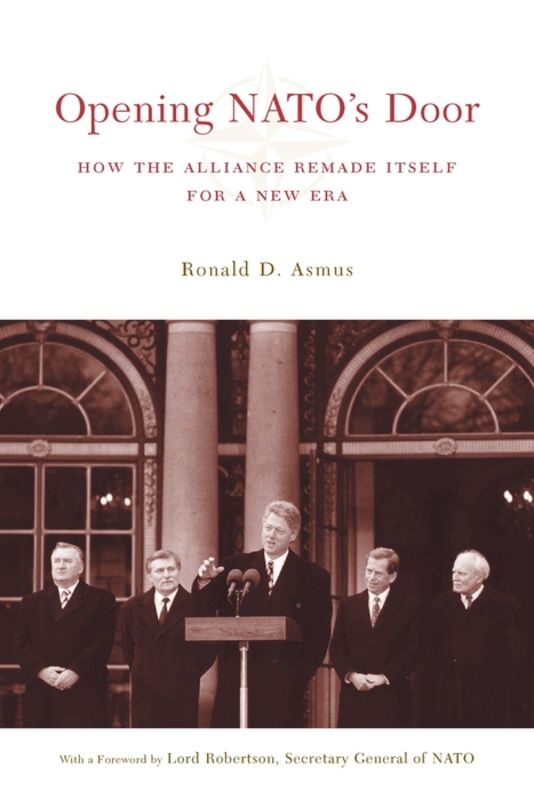
Opening NATO's Door
How and why did NATO, a Cold War military alliance created in 1949 to counter Stalin's USSR, become the cornerstone of new security order for post-Cold War Europe? Why, instead of retreating from Europe after communism's collapse, did the U.S. launch the greatest expansion of the American commitment to the old continent in decades? Written by a high-level insider, Opening NATO's Door provides a definitive account of the ideas, politics, and diplomacy that went into the historic decision to expand NATO to Central and Eastern Europe. Drawing on the still-classified archives of the U.S. Department of State, Ronald D. Asmus recounts how and why American policymakers, against formidable odds at home and abroad, expanded NATO as part of a broader strategy to overcome Europe's Cold War divide and to modernize the Alliance for a new era. Asmus was one of the earliest advocates and intellectual architects of NATO enlargement to Central and Eastern Europe after the collapse of communism in the early 1990s and subsequently served as a top aide to Secretary of State Madeleine Albright and Deputy Secretary Strobe Talbott, responsible for European security issues. He was involved in the key negotiations that led to NATO's decision to extend invitations to Poland, Hungary, and the Czech Republic, the signing of the NATO-Russia Founding Act, and finally, the U.S. Senate's ratification of enlargement. Asmus documents how the Clinton Administration sought to develop a rationale for a new NATO that would bind the U.S. and Europe together as closely in the post-Cold War era as they had been during the fight against communism. For the Clinton Administration, NATO enlargement became the centerpiece of a broader agenda to modernize the U.S.-European strategic partnership for the future. That strategy reflected an American commitment to the spread of democracy and Western values, the importance attached to modernizing Washington's key alliances for an increasingly globalized world, and the fact that the Clinton Administration looked to Europe as America's natural partner in addressing the challenges of the twenty-first century. As the Alliance weighs its the future following the September 11 terrorist attacks on the U.S. and prepares for a second round of enlargement, this book is required reading about the first post-Cold War effort to modernize NATO for a new era.
eBook

The President, the 'Theologians' and the Europeans: The Johnson Administration and NATO Nuclear Sharing
This article examines Lyndon Johnson's handling of the North Atlantic Treaty Organization (NATO) nuclear-sharing issue and specifically plans for a NATO Multilateral Force during the first three years of his presidency. The article argues that although Johnson did not confront the nuclear sharing/Multilateral Force issue directly for the first year of his presidency, he subsequently made sensible policy decisions in the face of a number of challenges. These included pressure for a speedy resolution of the nuclear-sharing issue from within his own State Department and from the government of the Federal Republic of Germany on the one side, and opposition to the Multilateral Force from the British and French governments on the other. The nuclear-sharing issue is discussed in the context of challenges to NATO, most notably French President Charles de Gaulle's rejection of US leadership and his withdrawal of French forces from NATO's integrated military structure in 1966 and broader debates about nuclear consultation within the alliance. The article concludes that by using the advisory process well and through some deft diplomacy, particularly refusing to demand a quick resolution to the nuclear-sharing problem, the Johnson administration had effectively resolved the nuclear-sharing issue by late 1966.
Journal Article