
Catalogue Search | MBRL


Are you sure you want to remove the book from the shelf?

{{itemTitle}}
1,308
result(s) for
"Northern Mariana Islands"
Sort by:

Afetna Point, Saipan : archaeological investigations of a Latte Period village and historic context in the Commonwealth of the Northern Mariana Islands
When Ferdinand Magellan first anchored off the island of Guam in 1521, the inhabitants of the small Chamorro village at Afetna Point on the southwest coast of Saipan were likely unaware. Archaeological investigations of the traditional village yielded Latte Period burials, ceramics, stone and shell tools, microfossils from food remains, and charcoal from cooking features dating between A.D. 1450 and 1700. No direct evidence of Spanish Contact before forced abandonment of the island circa 1730 was encountered, after which time Saipan remained virtually unpopulated until the arrival of Carolinian and Chamorro settlers from Guam nearly a century later. Spanish settlement in 1668, the German occupation from 1898-1914, and the Japanese sugarcane period from 1914-1944 left few traces at the site until WWII and subsequent American administration. Afetna Point and Saipan have therefore been a contested landscape for centuries, but the island's prehistory has deep roots that tie the Mariana Islands and its modern culture to ancestral SE Asia.
Book
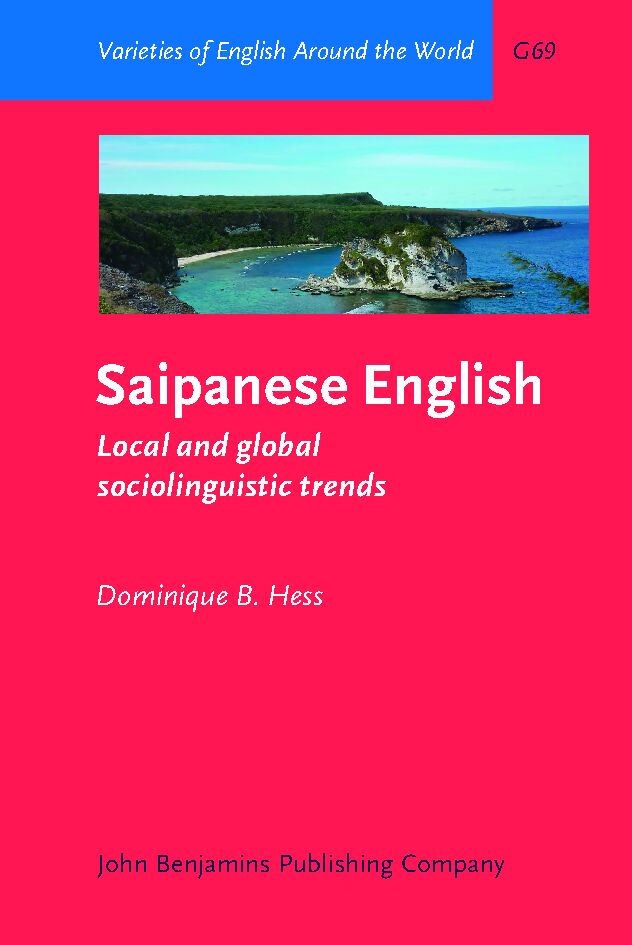
Saipanese English : local and global sociolinguistic trends
In this volume, the emergence of English in Saipan is being examined in the complex context of its colonial past. The focus lies on the influence of the American era on the linguistic outcomes in Saipan. Sociolinguistic interviews with indigenous Chamorros and Saipan Carolinians were analyzed using qualitative and quantitative methods.
eBook

Yellow Beach 2 after 75 Years
On June 15, 1944, Afetna Point was called 'Yellow Beach 2' by the U.S. Marines and Army infantry braving Japanese resistance to establish a beachhead before capturing As Lito airfield in the following days. After 75 years, this book presents archaeological evidence, archival records, and respected elders' accounts from WWII.
eBook

Substantive Evidence of Initial Habitation in the Remote Pacific
At the Unai Bapot Site of the Mariana Islands, new excavation has clarified the oldest known instance of a residential habitation prior to 1500 B.C. in the Remote Pacific, previously difficult to document in deeply buried layers that originally had comprised near-tidal to shallow subtidal zones.
eBook

Global, regional, and national burden of esophageal cancer: a systematic analysis of the Global Burden of Disease Study 2021
Background and objective
Esophageal cancer (EC) is the seventh most prevalent cancer globally and the sixth leading cause of cancer-related mortality. This study aimed to provide an updated stratified assessment of rates in EC incidence, mortality, and disability-adjusted life-years (DALYs) from 1990 to 2021 by sex, age, and Socio-demographic Index (SDI) at global, regional, and national levels, as well as to project the future trends of EC both globally and regionally.
Methods
Data about age-standardized rates (ASRs) of incidence (ASIR), mortality (ASDR), probability of death (ASPoD) and DALYs (ASDALYRs) of EC were obtained from the 2021 Global Burden of Disease (GBD) study. Estimated annual percentage changes (EAPCs) and average annual percentage changes (AAPC) were calculated over certain periods to describe the temporal trends of EC burdens. The analyses were disaggregated by sexes, GBD super-regions and regions, nations/territories, age-groups, and SDI quintiles. A Bayesian age-period-cohort (BAPC) model was constructed to project the global and regional EC ASRs in 2022–2035.
Results
Despite global reductions in EC ASRs, with ASIR, ASDR, and ASDALYR in 2021 of 6.65 [5.88, 7.45] (95% uncertainty interval), 6.25 [5.53, 7.00], and 148.56 [131.71, 166.82], decreasing by 24.9%, 30.7%, and 36.9% in 1990–2021, respectively, the absolute burden numbers were increased from 1990 to 2021, probably because of population growth and aging. Global newly diagnosed cases, deaths, and DALYs of EC increased to 576,529 [509,492, 645,648], 356,263 [319,363, 390,154], and 12,999,265 [11,522,861, 14,605,268] in 2021, by 62.53%, 51.18%, and 33.28% compared to records in 1990. The geographical pattern of EC was consistent: locations with the highest EC incidence and mortality rates were predominantly located in the Asian Esophageal Cancer Belt and African Esophageal Cancer Corridor, with East Asia, Southern Sub-Saharan Africa, and Eastern Sub-Saharan Africa as the GBD regions with the heaviest EC burdens, and Malawi, Eswatini, Mongolia, Zambia, and Zimbabwe with the most EC ASRs in 2021. However, owing to the population size, China, India, the United States, Japan, and Brazil had the heaviest absolute EC burdens. More pronounced alleviations of ASRs were observed in locations with high SDI levels, indicated by their lower AAPC values compared to those of low-SDI locations, while Sub-Saharan Africa regions had increasing EC ASRs, especially in Chad (114.76% in ASDR, for example), Sao Tome and Principe (97.93%), Togo (92.53%), Northern Mariana Islands (84.32%), Liberia (82.33%), etc. Smoking remained the leading contributor to EC ASDALYR globally and across most GBD super-regions in 2021. The EC burden is significantly heavier for males, with incidence and mortality in males in 2021 being 2.89 and 2.88 times higher, respectively, than in females. Across all age groups, EC posed an increasingly significant threat to men aged > 75 years. From 2022 to 2035, the ASR projections show only modest decrease in both global and regional EC burdens, and the absolute burden numbers are expected to increase globally and in nearly all GBD super-regions.
Conclusion
EC burden remains significant, with disparities across sexes, age groups, and regions. Region-specific and age-targeted measures are crucial to addressing these inequalities, especially in light of increasing EC burdens in older men and in African regions. Efforts should be taken in finding more solid attributions to risk factors for EC burdens and to better identify high-risk populations to inform targeted prevention and screening, and ultimately reduce the EC burden in an efficient and cost-effective way.
Graphical Abstract
Journal Article

Population Size and Habitat Occupancy by the Endangered Mariana Crow
I present data on the Mariana Crow for an extensive but previously unavailable set of population and habitat surveys from 1992 to 1993. From these, I (1) compute a series of population estimates from that period during which Mariana Crow numbers were first entering a precipitous decline, (2) quantitatively assess the habitats occupied by individual birds and thereby provide a view of the range of habitats occupied during a time when the species was still widespread, and (3) provide the first direct wet-dry season comparisons of populations and habitat occupancy. Surveys yielded significantly different wet (943) and dry season (459) population estimates, which suggested wet season courtship activity preceding dry season nesting when birds became more secretive. Moreover, they indicated that the critical turning point in population decline was after 1995. Forest was the principal habitat type occupied during both wet and dry seasons, with savanna present less than half as often as forest, although birds occupied a range of additional habitats. The species was more versatile in habitat use than is often assumed, as rates of habitat occupancy and availability were similar. Versatility is an advantage for populations confined to small islands that periodically suffer catastrophic habitat damage due to typhoons.
Journal Article

Revealing unmapped tectonic settings through geochemical fingerprinting of Th-Nb-Yb
The widely used tectonic discrimination diagram, \"Th/Yb-Nb/Yb,\" has long served as a global standard. However, it is limited in scope, as it primarily distinguishes igneous rock samples within well-established tectonic settings, such as nonsubduction environments (e.g. midoceanic ridge and oceanic island basalts) and subduction-related volcanic arcs (e.g. continental and island arcs). This study presents a novel approach to geochemical modeling for Th-Nb-Yb systematics, aimed at enhancing our understanding of various magmatic and tectonic settings. We developed a new geochemical discrimination diagram based on Nb/Yb versus Th/Nb ratios, which successfully identifies and differentiates a wider range of tectonic environments than previous models. Our findings demonstrate that this diagram can distinguish between intracontinental rifting, mixed oceanic-continental rifts producing low-alkaline-enriched tholeiitic magmatism, within-plate continental extensional settings (early lithospheric rifts), and alkaline arcs. Additionally, the model identifies magmatic interactions associated with active continental margin that occur due to oceanic slab break-off. Furthermore, our research refines the use of Th/Yb, Nb/Yb, and La/Yb ratios for improved and more accurate magmatic alkalinity discrimination, enabling clearer differentiation among tholeiitic, calc-alkaline, enriched tholeiitic, and alkaline rock types. These advancements provide a more comprehensive framework for interpreting magmatic processes and their tectonic implications, offering valuable insights to the fields of geochemistry and tectonics.
Journal Article

Validation of Reef-Scale Thermal Stress Satellite Products for Coral Bleaching Monitoring
Satellite monitoring of thermal stress on coral reefs has become an essential component of reef management practice around the world. A recent development by the U.S. National Oceanic and Atmospheric Administration’s Coral Reef Watch (NOAA CRW) program provides daily global monitoring at 5 km resolution—at or near the scale of most coral reefs. In this paper, we introduce two new monitoring products in the CRW Decision Support System for coral reef management: Regional Virtual Stations, a regional synthesis of thermal stress conditions, and Seven-day Sea Surface Temperature (SST) Trend, describing recent changes in temperature at each location. We describe how these products provided information in support of management activities prior to, during and after the 2014 thermal stress event in the Commonwealth of the Northern Mariana Islands (CNMI). Using in situ survey data from this event, we undertake the first quantitative comparison between 5 km satellite monitoring products and coral bleaching observations. Analysis of coral community characteristics, historical temperature conditions and thermal stress revealed a strong influence of coral biodiversity in the patterns of observed bleaching. This resulted in a model based on thermal stress and generic richness that explained 97% of the variance in observed bleaching. These findings illustrate the importance of using local benthic characteristics to interpret the level of impact from thermal stress exposure. In an era of continuing climate change, accurate monitoring of thermal stress and prediction of coral bleaching are essential for stakeholders to direct resources to the most effective management actions to conserve coral reefs.
Journal Article

Afetna Point, Saipan
Archaeological investigations at the Chamorro village at Afetna Point on the southwest coast of Saipan yielded Latte Period burials, ceramics, stone and shell tools, microfossils from food remains, and charcoal from cooking features dating between A.D. 1450 and 1700.
eBook
Shallow Water Bathymetry Based on Inherent Optical Properties Using High Spatial Resolution Multispectral Imagery
Bathymetric surveys are of great importance for submarine topography mapping and coastal construction projects. They are also of great significance for terrain surveys of islands and coastal zones, maritime navigation and marine management planning. Traditional ship-borne water depth measurement methods are costly and time-consuming, therefore, in recent years, passive optical remote sensing technology has become an important means for shallow water depth measurements. In addition, multispectral water depth optical remote sensing has wide application values. Considering the relationship between water depth and the inherent optical characteristics of water column, an inherent optical parameters linear model (IOPLM) is developed to estimate shallow water bathymetry from high spatial resolution multispectral images. Experiments were carried out in the shallow waters (≤20 m) around Dongdao Island in China’s Paracel Islands and Saipan Island in the Northern Mariana Islands. Different accuracy evaluation indexes were used to verify the model. The comparisons with the traditional log-linear model and the Stumpf model show that in terms of overall accuracy and accuracy in different water depths, the IOPLM has slightly better results and stronger retrieval capabilities than the other models. The mean absolute error (MAE) of Dongdao Island and Saipan Island reached 1.17 m and 1.92 m, and the root mean square error (RMSE) was 1.49 m and 2.4 m, respectively.
Journal Article