
Catalogue Search | MBRL


Are you sure you want to remove the book from the shelf?

{{itemTitle}}
15
result(s) for
"Northwest, Old -- History -- 1775-1865"
Sort by:

Tecumseh : Speech at Vincennes
\"A Shawnee warrior and chief, Tecumseh was widely admired as a skilled orator who wanted to unite Indigenous groups in the United States and Canada to prevent the loss of their territory and way of life. This thought-provoking book features his memorable speech in 1810 at Vincennes, to Indiana Governor Harrison to revoke a treaty that took Indigenous lands, and to Indigenous peoples to resist the takeover of their territories. Readers are introduced to the social and political circumstances of the time and an anlysis of text highlights Tecumseh's skill in persuasive writing\"-- Provided by publisher.
Book

Seeing Red
Against long odds, the Anishinaabeg resisted removal, retaining
thousands of acres of their homeland in what is now Michigan,
Wisconsin, and Minnesota. Their success rested partly on their
roles as sellers of natural resources and buyers of trade goods,
which made them key players in the political economy of plunder
that drove white settlement and U.S. development in the Old
Northwest. But, as Michael Witgen demonstrates, the credit for
Native persistence rested with the Anishinaabeg themselves.
Outnumbering white settlers well into the nineteenth century, they
leveraged their political savvy to advance a dual citizenship that
enabled mixed-race tribal members to lay claim to a place in U.S.
civil society. Telling the stories of mixed-race traders and
missionaries, tribal leaders and territorial governors, Witgen
challenges our assumptions about the inevitability of U.S.
expansion. Deeply researched and passionately written, Seeing
Red will command attention from readers who are invested in
the enduring issues of equality, equity, and national belonging at
its core.
eBook

General Thomas Posey
Revolutionary War general Thomas Posey (1750-1818) lived his life against the backdrop of one of the most dramatic periods in American history. Posey, who played a minor role in the actual War for Independence, went on to participate in the development and foundation of several states in the transappalachian West. His experiences on the late 18th- and early 19th-century American frontier were varied and in a certain sense extraordinary; he served as Indian agent in Illinois Territory; as Lieutenant Governor of Kentucky, as U.S. Senator from Louisiana, and as Governor of Indiana during its transition from territorial status to statehood.
His biographer speculates on the contrasting influences of Thomas's ne'er-do-well father, Captain John Posey, and the family's close friend, General George Washington. Posey's progress is then followed as he raises his own family in the newly formed nation. Of particular interest is an appendix containing a detailed analysis of evidence available to support popular 29th-century speculation that Thomas Posey was, in fact, George Washington's illicit son.
eBook

Race and Rights
In the Old Northwest from 1830 to 1870, a bold set of activists battled slavery and racial prejudice. This book is about their expansive efforts to eradicate southern slavery and its local influence in the contentious milieu of four new states carved out of the Northwest Territory: Illinois, Indiana, Michigan, and Ohio. While the Northwest Ordinance outlawed slavery in the region in 1787, in reality both it and racism continued to exert strong influence in the Old Northwest, as seen in the race-based limitations of civil liberties there. Indeed, these states comprised the central battleground over race and rights in antebellum America, in a time when race's social meaning was deeply infused into all aspects of Americans' lives, and when people struggled to establish political consensus.
Antislavery and anti-prejudice activists from a range of institutional bases crossed racial lines as they battled to expand African American rights in this region. Whether they were antislavery lecturers, journalists, or African American leaders of the Black Convention Movement, women or men, they formed associations, wrote publicly to denounce their local racial climate, and gave controversial lectures. In the process, they discovered that they had to fight for their own right to advocate for others. This bracing new history by Dana Elizabeth Weiner is thus not only a history of activism, but also a history of how Old Northwest reformers understood the law and shaped new conceptions of justice and civil liberties. The newest addition to the Mellon-sponsored Early American Places Series, Race and Rights will be a much-welcomed contribution to the study of race and social activism in nineteenth-century America.
eBook

James Madison, the South, and the trans-Appalachian West, 1783–1803
The strong relationship that historians have described between the South and the trans-Appalachian West in the early nineteenth century had its origins in the twenty-year period after the American Revolution when a group of far-sighted southerners, with James Madison in the forefront, worked to form a political bond between the two regions. While many historians have taken this close relationship for granted or have dismissed it as a natural product of cultural similarities, strong family bonds and slavery being just two, it was built deliberately by a handful of forward-looking southerners with hard work and dedication. Jeffrey A. Zemler carefully analyzes the development of this bond and the history of these two regions during this twenty-year period, which is far more complicated than historians have imagined or described.
eBook

The Northwest Ordinance
Adoption of the Northwest Ordinance in 1787 ended a long and sometimes acrimonious debate over the question of how to organize and govern the western territories of the United States. Many eastern leaders viewed the Northwest Territory as a colonial possession, while freedom-loving settlers demanded local self- government. These essays address the ambiguities of the Ordinance, balance of power politics in North America, missionary activity in the territory, slavery, and higher education in the Old Northwest.
eBook

Trans-Appalachian Frontier, Third Edition
The first American frontier lay just beyond the Appalachian Mountains and along the Gulf Coast. Here, successive groups of pioneers built new societies and developed new institutions to cope with life in the wilderness. In this thorough revision of his classic account, Malcolm J. Rohrbough tells the dramatic story of these men and women from the first Kentucky settlements to the closing of the frontier. Rohrbough divides his narrative into major time periods designed to establish categories of description and analysis, presenting case studies that focus on the county, the town, the community, and the family, as well as politics and urbanization. He also addresses Spanish, French, and Native American traditions and the anomalous presence of African slaves in the making of this story.
eBook

General Thomas Posey
Revolutionary War general Thomas Posey (1750-1818) lived his life against the backdrop of one of the most dramatic periods in American history. Posey, who played a minor role in the actual War for Independence, went on to participate in the development and foundation of several states in the transappalachian West. His experiences on the late 18th- and early 19th-century American frontier were varied and in a certain sense extraordinary; he served as Indian agent in Illinois Territory; as Lieutenant Governor of Kentucky, as U.S. Senator from Louisiana, and as Governor of Indiana during its transition from territorial status to statehood.His biographer speculates on the contrasting influences of Thomas's ne'er-do-well father, Captain John Posey, and the family's close friend, General George Washington. Posey's progress is then followed as he raises his own family in the newly formed nation. Of particular interest is an appendix containing a detailed analysis of evidence available to support popular 29th-century speculation that Thomas Posey was, in fact, George Washington's illicit son.
eBook
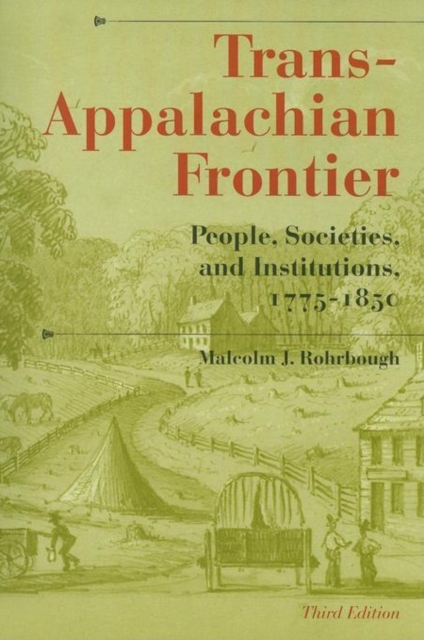
Trans-Appalachian frontier: people, societies, and institutions, 1775-1850
The first American frontier lay just beyond the Appalachian Mountains and along the Gulf Coast. Here, successive groups of pioneers built new societies and developed new institutions to cope with life in the wilderness. In this thorough revision of his classic account, Malcolm J. Rohrbough tells the dramatic story of these men and women from the first Kentucky settlements to the closing of the frontier. Rohrbough divides his narrative into major time periods designed to establish categories of description and analysis, presenting case studies that focus on the county, the town, the community, and the family, as well as politics and urbanization. He also addresses Spanish, French, and Native American traditions and the anomalous presence of African slaves in the making of this story.
eBook

The Northwest Ordinance
Adoption of the Northwest Ordinance in 1787 ended a long and sometimes acrimonious debate over the question of how to organize and govern the western territories of the United States. Many eastern leaders viewed the Northwest Territory as a colonial possession, while freedom-loving settlers demanded local self- government. These essays address the ambiguities of the Ordinance, balance of power politics in North America, missionary activity in the territory, slavery, and higher education in the Old Northwest.
eBook