
Catalogue Search | MBRL


Are you sure you want to remove the book from the shelf?

{{itemTitle}}
13,413
result(s) for
"Nuclear Strategy"
Sort by:


Nuclear strategy in the modern era
The world is in a second nuclear age in which regional powers play an increasingly prominent role. These states have small nuclear arsenals, often face multiple active conflicts, and sometimes have weak institutions. How do these nuclear states-and potential future ones-manage their nuclear forces and influence international conflict? Examining the reasoning and deterrence consequences of regional power nuclear strategies, this book demonstrates that these strategies matter greatly to international stability and it provides new insights into conflict dynamics across important areas of the world such as the Middle East, East Asia, and South Asia.
Vipin Narang identifies the diversity of regional power nuclear strategies and describes in detail the posture each regional power has adopted over time. Developing a theory for the sources of regional power nuclear strategies, he offers the first systematic explanation of why states choose the postures they do and under what conditions they might shift strategies. Narang then analyzes the effects of these choices on a state's ability to deter conflict. Using both quantitative and qualitative analysis, he shows that, contrary to a bedrock article of faith in the canon of nuclear deterrence, the acquisition of nuclear weapons does not produce a uniform deterrent effect against opponents. Rather, some postures deter conflict more successfully than others.
Nuclear Strategy in the Modern Eraconsiders the range of nuclear choices made by regional powers and the critical challenges they pose to modern international security.
eBook

India and nuclear Asia : forces, doctrine, and dangers
India's nuclear profile, doctrine, and practices have evolved rapidly since the country's nuclear breakout in 1998. However, the outside world's understanding of India's doctrinal debates, forward-looking strategy, and technical developments are still two decades behind the present. This book will fill that gap in our knowledge by focusing on the post-1998 evolution of Indian nuclear thought, its arsenal, the triangular rivalry with Pakistan and China, and New Delhi's nonproliferation policy approaches. Joshi and O'Donnell show how India's nuclear trajectory has evolved in response to domestic, regional, and global drivers. The book argues that doctrinal and posturing developments in India, China, and Pakistan are elevating inadvertent and accidental escalation risks. As nuclear South Asia continues to attract global concern, this book provides an indispensable and timely guide to its challenges and offers potential solutions to them. Based on primary-source research and interviews, this book will be important reading for scholars and students of India's international relations and security as well as for military, defense contractor, and policy audiences outside of India.
Book

The End of Victory
The End of Victory recounts
the costs of failure in nuclear war through the work of the most
secret deliberative body of the National Security Council, the Net
Evaluation Subcommittee (NESC). From 1953 onward, US
leaders wanted to know as precisely as possible what would happen
if they failed in a nuclear war-how many Americans would die and
how much of the country would remain. The NESC told Presidents
Dwight Eisenhower and John F. Kennedy what would be the result of
the worst failure of American strategy-a maximum-effort surprise
Soviet nuclear assault on the United States.
Edward Kaplan details how NESC studies provided key information
for presidential decisions on the objectives of a war with the USSR
and on the size and shape of the US military. The subcommittee
delivered its annual reports in a decade marked by crises in
Berlin, Quemoy and Matsu, Laos, and Cuba, among others. During
these critical moments and day-to-day containment of the USSR, the
NESC's reports offered the best estimates of the butcher's bill of
conflict and of how to reduce the cost in American lives.
Taken with the intelligence community's assessment of the
probability of a surprise attack, the NESC's work framed the risks
of US strategy in the chilliest years of the Cold War. The End
of Victory reveals how all policy decisions run risks-and ones
involving military force run grave ones-though they can rarely be
known with precision.
eBook


To Kill Nations
\"Edward Kaplan's To Kill Nations is a
fascinating work that packs a thermonuclear punch of ideas and
arguments... The work is suitable for anyone from advanced
undergraduates to experts in the field.\" ― Strategy
Bridge
In To Kill Nations , Edward Kaplan
traces the evolution of American strategic airpower and preparation
for nuclear war from this early air-atomic era to a later period
(1950-1965) in which the Soviet Union's atomic capability,
accelerated by thermonuclear weapons and ballistic missiles, made
American strategic assets vulnerable and gradually undermined
air-atomic strategy.
Kaplan throws into question both the inevitability and
preferability of the strategic doctrine of MAD. He looks at the
process by which cultural, institutional, and strategic ideas about
MAD took shape and makes insightful use of the comparison between
generals who thought they could win a nuclear war and the cold
institutional logic of the suicide pact that was MAD. Kaplan also
offers a reappraisal of Eisenhower's nuclear strategy and diplomacy
to make a case for the marginal viability of air-atomic military
power even in an era of ballistic missiles.
eBook

The Russian Way of Deterrence
Selected among Foreign Affairs's \"Best of Books 2024\"
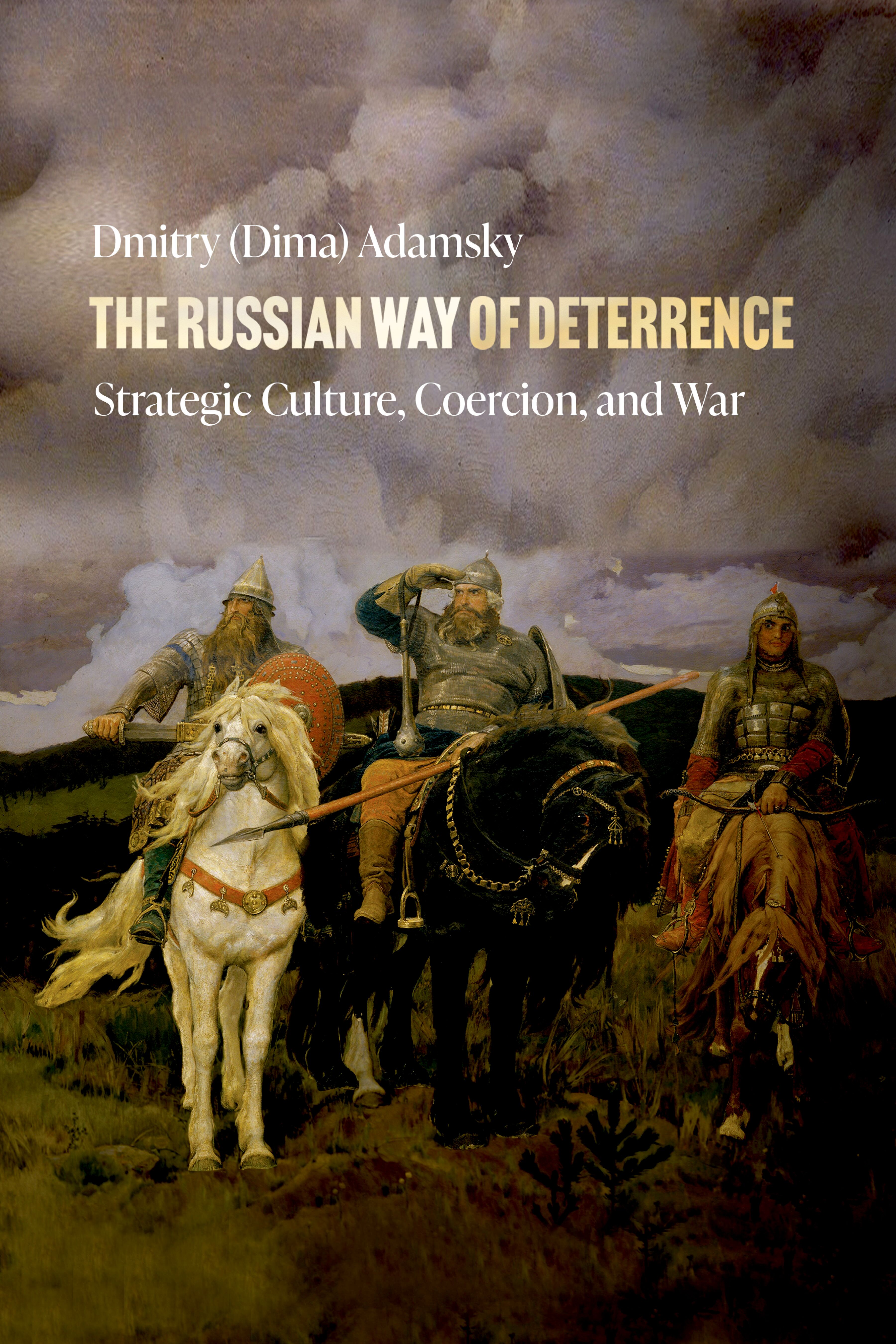
From a globally renowned expert on Russian military strategy and national security, The Russian Way of Deterrence investigates Russia's approach to coercion (both deterrence and compellence), comparing and contrasting it with the Western conceptualization of this strategy. Strategic deterrence, or what Dmitry (Dima) Adamsky calls deterrence à la Russe, is one of the main tools of Russian statecraft. Adamsky deftly describes the genealogy of the Russian approach to coercion and highlights the cultural, ideational, and historical factors that have shaped it in the nuclear, conventional, and informational domains. Drawing on extensive research on Russian strategic culture, Adamsky highlights several empirical and theoretical peculiarities of the Russian coercion strategy, including how this strategy relates to the war in Ukraine. Exploring the evolution of strategic deterrence, along with its sources and prospective avenues of development, Adamsky provides a comprehensive intellectual history that makes it possible to understand the deep mechanics of this Russian stratagem, the current and prospective patterns of the Kremlin's coercive conduct, and the implications for policymakers on both sides of the Atlantic.
eBook

Behavioral economics and nuclear weapons
\"Recent discoveries in psychology and neuroscience have improved our understanding of why our decision making processes fail to match standard social science assumptions about rationality. As researchers such as Daniel Kahneman, Amos Tversky, and Richard Thaler have shown, people often depart in systematic ways from the predictions of the rational actor model of classic economic thought because of the influence of emotions, cognitive biases, an aversion to loss, and other strong motivations and values. These findings about the limits of rationality have formed the basis of behavioral economics, an approach that has attracted enormous attention in recent years. This collection of essays applies the insights of behavioral economics to the study of nuclear weapons policy. Behavioral economics gives us a more accurate picture of how people think and, as a consequence, of how they make decisions about whether to acquire or use nuclear arms. Such decisions are made in real-world circumstances in which rational calculations about cost and benefit are intertwined with complicated emotions and subject to human limitations. Strategies for pursuing nuclear deterrence and nonproliferation should therefore, argue the contributors, account for these dynamics in a systematic way. The contributors to this collection examine how a behavioral approach might inform our understanding of topics such as deterrence, economic sanctions, the nuclear nonproliferation regime, and U.S. domestic debates about ballistic missile defense. The essays also take note of the limitations of a behavioral approach for dealing with situations in which even a single deviation from the predictions of any model can have dire consequences\"-- Provided by publisher.
Book

Cryptic concrete : a subterranean journey into Cold War Germany
Cryptic Concrete explores bunkered sites in Cold War Germany in order to understand the inner workings of the Cold War state.
* A scholarly work that suggests a reassessment of the history of geo- and bio-politics
* Attempts to understand the material architecture that was designed to protect and take life in nuclear war
* Zooms in on two types of structures - the nuclear bunker and the atomic missile silo
* Analyzes a broad range of sources through the lens of critical theory and argues for an appreciation of the two subterranean structures' complementary nature
eBook