
Catalogue Search | MBRL


Are you sure you want to remove the book from the shelf?

{{itemTitle}}
22,365
result(s) for
"Nuclear testing"
Sort by:

Bombing the Marshall Islands : a Cold War tragedy
\"During the Cold War, the United States conducted atmospheric tests of nuclear weapons in the Marshall Islands of the Pacific. The total explosive yield of these tests was 108 megatons, equivalent to the detonation of one Hiroshima bomb per day over nineteen years. These tests, particularly Castle Bravo, the largest one, had tragic consequences, including the irradiation of innocent people and the permanent displacement of many native Marshallese. Keith M. Parsons and Robert Zaballa tell the story of the development and testing of thermonuclear weapons and the effects of these tests on their victims and on the popular and intellectual culture. These events are also situated in their Cold War context and explained in terms of the prevailing hopes, fears, and beliefs of that age. In particular, the narrative highlights the obsessions and priorities of top American officials, such as Lewis L. Strauss, Chairman of the Atomic Energy Commission.\"--Page i.
Book

Downwind
Downwindis an unflinching tale of the atomic West that reveals the intentional disregard for human and animal life through nuclear testing by the federal government and uranium extraction by mining corporations during and after the Cold War.
Sarah Alisabeth Fox highlights the personal cost of nuclear testing and uranium extraction in the American West through extensive interviews with \"downwinders,\" the Native American and non-Native residents of the Great Basin region affected by nuclear environmental contamination and nuclear-testing fallout. These downwinders tell tales of communities ravaged by cancer epidemics, farmers and ranchers economically ruined by massive crop and animal deaths, and Native miners working in dangerous conditions without proper safety equipment so that the government could surreptitiously study the effects of radiation on humans.
In chilling detailDownwindbrings to light the stories and concerns of these groups whose voices have been silenced and marginalized for decades in the name of \"patriotism\" and \"national security.\"
With the renewed boom in mining in the American West, Fox's look at this hidden history, unearthed from years of field interviews, archival research, and epidemiological studies, is a must-read for every American concerned about the fate of our western lands and communities.
eBook
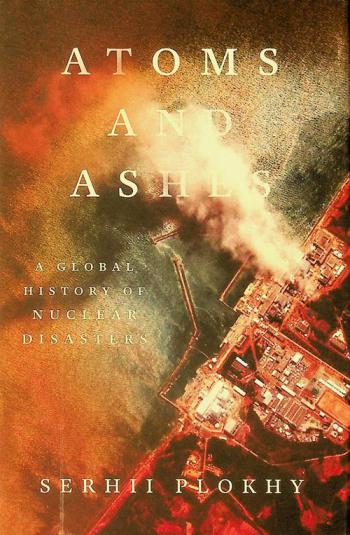
Atoms and ashes : a global history of nuclear disasters
\"A chilling account of seventy years of nuclear catastrophes, by the author of the \"definitive\" (Economist) Cold War history, Nuclear Folly. Nuclear energy was embraced across the globe at the height of the nuclear industry in the 1960s and 1970s; today, there are 440 nuclear reactors operating throughout the world, with nuclear power providing 10 percent of world electricity. Yet as the world seeks to reduce carbon emissions to combat climate change, the question arises: Just how safe is nuclear energy? Atoms and Ashes recounts the dramatic history of nuclear accidents that have dogged the industry in its military and civil incarnations since the 1950s. Through the stories of six terrifying major incidents-Bikini Atoll, Kyshtym, Windscale, Three Mile Island, Chernobyl, and Fukushima-Cold War expert Serhii Plokhy explores the risks of nuclear power, both for military and peaceful purposes, while offering a vivid account of how individuals and governments make decisions under extraordinary circumstances. Atoms and Ashes provides a crucial perspective on the most dangerous nuclear disasters of the past, in order to safeguard our future\"-- Provided by publisher.

Savage dreams
\"A beautiful, absorbing, tragic book.\"—Larry McMurtry In 1851, a war began in what would become Yosemite National Park, a war against the indigenous inhabitants. A century later–in 1951–and a hundred and fifty miles away, another war began when the U.S. government started setting off nuclear bombs at the Nevada Test Site. It was called a nuclear testing program, but functioned as a war against the land and people of the Great Basin. In this foundational book of landscape theory and environmental thinking, Rebecca Solnit explores our national Eden and Armageddon and offers a pathbreaking history of the west, focusing on the relationship between culture and its implementation as politics. In a new preface, she considers the continuities and changes of these invisible wars in the context of our current climate change crisis, and reveals how the long arm of these histories continue to inspire her writing and hope.
eBook

Eyes of fire : the last voyage of the Rainbow Warrior
On 10 July 1985, French secret agents bombed the Greenpeace campaign flagship Rainbow Warrior in Auckland Harbour, New Zealand. Portuguese-born photographer Fernando Pereira died in the sabotage outrage that shook the world. The bombed ship was scuttled off a New Zealand bay in 1987 to form a living reef and Rainbow Warrior II was commissioned. Eyes Of Fire tells this story, but it also tells the story of nuclear testing in the Pacific. In 1954 the United States government tested a nuclear weapon in the Marshall Islands that poisoned Rongelap Atoll. Thirty years later the people of Rongelap, who were still suffering from radiation poisoning, asked the crew of the Rainbow Warrior to move them to Mejato, 180 kilometres away. This was the Warrior's last and most dramatic mission, before it sailed to Auckland to meet its fate. The 30th anniversary edition has a Little Island microsite with plenty of Rainbow Warrior resources. We have created this site in the lead-up to the 30th anniversary of the bombing to provide context and capture interviews with the Warrior's crew members. We think that it's a fantastic resource, made with the help of AUT University and Greenpeace.
Book
Grappling with the Bomb
Grappling with the Bomb is a history of Britain’s 1950s program to test the hydrogen bomb, code name Operation Grapple. In 1957–58, nine atmospheric nuclear tests were held at Malden Island and Christmas Island—today, part of the Pacific nation of Kiribati. Nearly 14,000 troops travelled to the central Pacific for the UK nuclear testing program—many are still living with the health and environmental consequences. Based on archival research and interviews with nuclear survivors, Grappling with the Bomb presents i-Kiribati woman Sui Kiritome, British pacifist Harold Steele, businessman James Burns, Fijian sailor Paul Ah Poy, English volunteers Mary and Billie Burgess and many other witnesses to Britain’s nuclear folly.
eBook


Healing the Collective Grief: A Story of a Marshallese Pastor from Okinawa
World War II and the Cold War never ended in the Marshall Islands. A seamless continuum of colonialism, wars and nuclear testing destroyed their ancestral islands, traditions, as well as the physical and spiritual wellbeing of the people; it caused them profound personal and collective grief. This article considers the grieving of the Marshallese people, through the lens of a life story of a migrant to the Marshall Islands from Okinawa, Chutaro Gushi (1911–1977). The examination uses the concepts provided by grief studies, such as personal grief and collective grief, and applies the theoretical and conceptual framework presented by the social constructionists, such as meaning making, social validation, and moral injury, to frame the understanding of their grieving, coping and healing processes. The life story of pastor Chutaro revealed an intricate reflexive interface between his personal grief and collective grief in the Marshall Islands. His personal grieving and healing process was also closely linked with the healing of the collective grief that was also an element of his personal grief. In this process, Christian churches played crucial roles to bridge the two levels of grief. They facilitated the transformation of Chutaro’s profound personal grief and moral injury into a powerful public mission to give voices to the victims of the nuclear tests in the Marshall Islands.
Journal Article


The Comprehensive Nuclear Test Ban Treaty
This report reviews and updates the 2002 National Research Council report, Technical Issues Related to the Comprehensive Nuclear Test Ban Treaty (CTBT) . This report also assesses various topics, including:
the plans to maintain the safety and reliability of the U.S. nuclear stockpile without nuclear-explosion testing;
the U.S. capability to detect, locate, and identify nuclear explosions;
commitments necessary to sustain the stockpile and the U.S. and international monitoring systems; and
potential technical advances countries could achieve through evasive testing and unconstrained testing.
Sustaining these technical capabilities will require action by the National Nuclear Security Administration, with the support of others, on a strong scientific and engineering base maintained through a continuing dynamic of experiments linked with analysis, a vigorous surveillance program, adequate ratio of performance margins to uncertainties. This report also emphasizes the use of modernized production facilities and a competent and capable workforce with a broad base of nuclear security expertise.
eBook