
Catalogue Search | MBRL


Are you sure you want to remove the book from the shelf?

{{itemTitle}}
6,542
result(s) for
"Nuclear weapons -- Government policy"
Sort by:


Nuclear Apartheid
After World War II, an atomic hierarchy emerged in the noncommunist world.Washington was at the top, followed over time by its NATO allies and then Israel, with the postcolonial world completely shut out.An Indian diplomat called the system nuclear apartheid.Drawing on recently declassified sources from U.S.
eBook

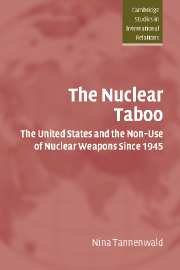
The nuclear taboo : the United States and the non-use of nuclear weapons since 1945
There has been no use of nuclear weapons since Hiroshima and Nagasaki. Nina Tannenwald argues that this was not inevitable, but that a tradition of non-use of nuclear weapons has grown up, based on the feeling that nuclear weapons are not a legitimate weapon of war.
eBook


Essence of Indecision
Tracing Diefenbaker's deliberations over nuclear policy, McMahon shows that Diefenbaker was politically cautious, not indecisive - he wanted to acquire nuclear weapons and understood from public opinion polls that most Canadians supported this position. However, Diefenbaker worried that the growing anti-nuclear movement might sway public opinion sufficiently to undermine his political support. He also feared that Liberal leader Lester Pearson could use the issue for political advantage. As long as Pearson opposed Canada's membership in the nuclear club, he could portray Diefenbaker's government as an irresponsible proponent of nuclear proliferation. Despite these reservations, Diefenbaker was involved in nuclear negotiations with the Americans throughout his tenure as prime minister, and an agreement was within reach on a number of occasions. When, in January 1963, Pearson reversed his position, Diefenbaker felt trapped - in making a clear public statement in favour of nuclear weapons it would appear as though he was merely following his opponent's lead. When Canada acquired nuclear weapons in 1963, it was under the leadership of Pearson, not Diefenbaker.
eBook


Cryptic Concrete
Cryptic Concrete explores bunkered sites in Cold War Germany in order to understand the inner workings of the Cold War state. * A scholarly work that suggests a reassessment of the history of geo- and bio-politics * Attempts to understand the material architecture that was designed to protect and take life in nuclear war * Zooms in on two types of structures - the nuclear bunker and the atomic missile silo * Analyzes a broad range of sources through the lens of critical theory and argues for an appreciation of the two subterranean structures' complementary nature
eBook


Nuclear Statecraft
\"Gavin not only succeeds in disentangling postwar
nuclear history from the US-Soviet rivalry of the Cold War, but
provides a deeper and more complex understanding of the long-term
effects of nuclear weapons on Great Power relations.\" -
Matthew Jones ― International Affairs
We are at a critical juncture in world politics. Nuclear
strategy and policy have risen to the top of the global policy
agenda, and issues ranging from a nuclear Iran to the global zero
movement are generating sharp debate. The historical origins of our
contemporary nuclear world are deeply consequential for
contemporary policy, but it is crucial that decisions are made on
the basis of fact rather than myth and misapprehension. In
Nuclear Statecraft , Francis J. Gavin
challenges key elements of the widely accepted narrative about the
history of the atomic age and the consequences of the nuclear
revolution.
On the basis of recently declassified documents, Gavin
reassesses the strategy of flexible response, the influence of
nuclear weapons during the Berlin Crisis, the origins of and
motivations for U.S. nuclear nonproliferation policy, and how to
assess the nuclear dangers we face today.
In case after case, he finds that we know far less than we think
we do about our nuclear history. Archival evidence makes it clear
that decision makers were more concerned about underlying
geopolitical questions than about the strategic dynamic between two
nuclear superpowers.Gavin's rigorous historical work not only tells
us what happened in the past but also offers a powerful tool to
explain how nuclear weapons influence international relations.
Nuclear Statecraft provides a solid
foundation for future policymaking.
We are at a critical juncture in world politics. Nuclear
strategy and policy have risen to the top of the global policy
agenda, and issues ranging from a nuclear Iran to the global zero
movement are generating sharp debate. The historical origins of our
contemporary nuclear world are deeply consequential for
contemporary policy, but it is crucial that decisions are made on
the basis of fact rather than myth and misapprehension. In
Nuclear Statecraft , Francis J. Gavin challenges key
elements of the widely accepted narrative about the history of the
atomic age and the consequences of the nuclear revolution.On the
basis of recently declassified documents, Gavin reassesses the
strategy of flexible response, the influence of nuclear weapons
during the Berlin Crisis, the origins of and motivations for U.S.
nuclear nonproliferation policy, and how to assess the nuclear
dangers we face today. In case after case, he finds that we know
far less than we think we do about our nuclear history. Archival
evidence makes it clear that decision makers were more concerned
about underlying geopolitical questions than about the strategic
dynamic between two nuclear superpowers.Gavin's rigorous historical
work not only tells us what happened in the past but also offers a
powerful tool to explain how nuclear weapons influence
international relations. Nuclear Statecraft provides a
solid foundation for future policymaking.
eBook