
Catalogue Search | MBRL


Are you sure you want to remove the book from the shelf?

{{itemTitle}}
345
result(s) for
"Nuns Fiction."
Sort by:

Bloodmoon
\"Ireland. AD 671. Sister Fidelma has a mission, and she is sworn by oath to reveal her purpose to no other. The secret investigation leads Fidelma and her companions to the abbey of Finnbarr to question the abbot. But before they have a chance to speak to him, the abbot is found murdered - and the young girl suspected of the crime has fled the scene\"--Publisher's website.
Book


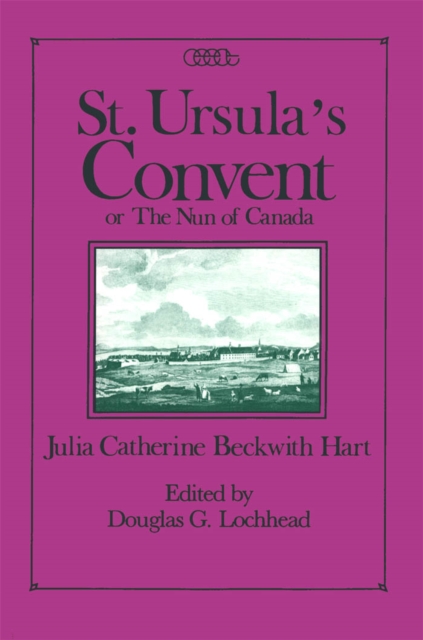
St. Ursula's Convent or the Nun of Canada
In 1824, when the novel was issued in Kingston, Upper Canada, it became not only the first work of fiction written by a native-born Canadian and published in what is now Canada, but also a significant early attempt by a Canadian of English and French heritage to articulate a vision of a North American nation that linked through family, social and religious ties, the best of Great Britain and France.
eBook

The patron saint of liars
Rose, married for three years, decides she has made a mistake and leaves her husband, traveling from California to Kentucky to take up residence in a home for unwed mothers. She plans to have her baby and give it up for adoption, but she soon discovers life still holds some surprises.
Book

Love and the incredibly old man
“It was the best of times, it was the worst of times” begins one chapter of critically acclaimed Lee Siegel’s new novel, Love and the Incredibly Old Man. “In the beginning” starts another. What else can a novelist do when hired as a ghostwriter by an elderly, irascible, conquistador-costumed man claiming to be the 540-year-old Juan Ponce de León? The fantastic life of that legendary explorer—inventor of rum, cigars, Coca-Cola, and popcorn—is the frame for Siegel’s fourth chronicle of love, lies, luck, loss, and labia. Summoned with cold hard cash and a pinch of flattery, a professor and novelist named Lee Siegel finds himself in Eagle Springs, Florida, attempting to give form to the life of the man who, contrary to popular and historical opinion, did indeed find the Fountain of Youth. Spending humid days listening to the romantic ramblings of the old man and sleepless nights doubting yet trying to craft these reminiscences into a narrative that will satisfy the literary aspirations of his subject, Siegel the ghostwriter spins an improbable tale filled with Native Americans, insatiable monarchs, philandering cantors, deliriously passionate nuns, delicate actresses, androgynous artists, and deceptions small and large. For de León, and for Siegel too, centuries of conquest and colonialism, fortune and identity, are all refracted through the memories of the conquistador’s lovers, each and every one of them adored “more than any other woman ever.” Comic, melancholic, lusty, and fully engaged with the act of invention, whether in love or on the page, Love and the Incredibly Old Man continues the real Lee Siegel’s exuberant exploration of that sentiment which Ponce de León confesses has “transported me to the most joyous heights, plunged me to the most dismal depths, and dropped me willy-nilly and dumbfounded at all places in between.”
eBook

The great chicken escape
A wordless picture book in which chickens flee their coop at an Alaskan monastery and four, eluding the nuns, enjoy a day in the forest before returning home to roost. Features cut-paper artwork and a die-cut cover.
Book

The Untold Love Story of Aphra Behn's The History of the Nun
Aphra Behn’s The History of the Nun (1688) is a complex narrative that challenges gender norms and moral conventions, while providing multifaceted illustrations of how restrictions of freedom engender rebellion. Erstwhile a critically neglected piece, this short novel has recently attracted renovated attention on account of its sophisticated narrative perspective, ambivalent moral, and general exploration of unconventional themes, including sexual nonconformity. Taking its cue from this critical landscape, this article explores the text’s queer dimensions, focusing on a crucial yet often overlooked scene depicting sapphic eroticism. Unpacking the internal dynamics and external implications of this passage, the essay argues for the pivotal role of the untold romance between Isabella and Katteriena within the narrative. It suggests that this peripheral storyline offers valuable insights into Behn's larger thematic concerns, particularly, the root causes of personal dissatisfaction and the transgression of social norms. It proposes that the suggestive yet not fully realized depiction of sapphic love presents a potential solution for the dichotomy between heterosexual marriage and celibacy, both depicted as unsatisfactory. Further, it posits that the scene in question sheds light on and is illuminated by its connection to the novel’s dedicatee: Hortense Mancini, who was not only a notorious vow-breaker but also a famous pursuer of sapphic pleasures, creating an effect akin to that of a roman á clef . Finally, the article contends that, in offering a captivating subplot left unresolved, the sapphic episode both tantalizes and frustrates readers, increasing the demands for their involvement in the creation of meaning. This emphasis on the power of imagination and the endless possibilities of fiction can be seen as metafictional gestures revealing a degree of literary sophistication not always associated with amatory fiction.
Journal Article

When in Rome : a novel
Desperate for a new start in life at age fifty-two, Claire takes a chance on a trip to Rome to assist the funny, fearless nuns at a struggling convent, and confronts her own missed connection with convent life in the past as well as an old flame who reappears in her life just as she's about to make a momentous decision.
Book

Recrafting the Model of the Portuguese Nun in England
The first English translation of Lettres portugaises was published in 1678 as Five Love-Letters from a Nun to a Cavalier. Capitalising on its literary success, the nun’s letters were extended and revised in two sequels. Their influence on women’s autochthonous fiction was strong in the years that followed. I will first focus on the history of the English reception of these French works to concentrate afterwards on two texts: Aphra Behn’s Love-Letters between a Nobleman and His Sister (1684-85) and Delarivier Manley’s Letters (1696). Whereas the former questions the veracity of the love letter by exploring the artificiality of love discourses and their dangerous effects on women’s lives, the latter recrafts the tradition of the female complaint by choosing a protagonist who voices her lament on the run. The reproducibility of the nun’s model makes us read Portuguese Letters not merely as the expression of unbidden emotion, but as a letter manual that could be revised and adapted.
Journal Article