
Catalogue Search | MBRL


Are you sure you want to remove the book from the shelf?

{{itemTitle}}
13
result(s) for
"OVERVIEWS AND LECTURES"
Sort by:
MEGAGAUSS FIELDS FROM FORTY YEARS AGO INTO THE NEXT CENTURY
The development of the megagauss conferences is traced from their origin. The development of techniques for generating megagauss fields is reviewed, and an outlook to future developments is given.
Book Chapter
THEORIES OF HIGH TEMPERATURE SUPERCONDUCTIVITY
While the theory of low temperature superconductors has been well established for more than two decades, the theory of the high temperature cuprates has yet to be agreed upon. Several of the leading proposals will be discussed, including spin fluctuations, interlayer tunneling, phase fluctuations of the order parameter, and excitations in short coherence length materials. The essential physical ideas will be stressed. These materials will depend upon high and ultra high magnetic fields to judge which theory is correct.
Book Chapter
EXPLOSIVE FLUX COMPRESSION: 50 YEARS OF LOS ALAMOS ACTIVITIES
Los Alamos flux compression activities are surveyed, mainly through references in view of space limitations. However, two plasma physics programs done with Sandia National Laboratory are discussed in more detail.
Book Chapter
ADVANCED HIGH EXPLOSIVE PULSED POWER TECHNOLOGY AT VNIIEF
The primary purpose of this presentation is to present the possibilities of super high power explosive magnetic energy sources and to demonstrate some of their applications where their use would be most impressive and beneficial.
Book Chapter
ELECTROMAGNETIC LAUNCH - STATE OF THE ART AND OPPORTUNITIES
One of the most interesting applications of high magnetic fields is related to projectile acceleration to high velocities. This problem is traditionally considered at conferences on megagauss magnetic field generation and related topics. The applied significance of this problem has stimulated worldwide large-scale laboratory research and has led to the organization of regular, international conferences on electromagnetic launch problems. Here, the present state of the art of this research area is analyzed, the most significant (in the author’s opinion) advances are outlined, and problems and prospects of electromagnetic launching of solids are discussed.
Book Chapter
THE DIRAC EXPERIMENTS - RESULTS AND CHALLENGES
The 1997 international Dirac II Series held at Los Alamos National Laboratory involved low temperature electrical transport and optical experiments in magnetic fields exceeding 800 T, produced by explosive flux compression using Russian MC-1 generators. An overview of the scientific and technical advances achieved in this Series is given, together with a strategy for future work in this challenging experimental environment. A significant outcome was achieved in transport studies of microfabricated thin-film YBCO structures with the magnetic field in the CuO plane. Using a GHz transmission line technique at an ambient temperature of 1.6 K, an onset of dissipation was observed at 150 T (a new upper bound for superconductivity in any material), with a saturation of resistivity at 240 T. Comparison with the Pauli limit expected at B – 155 T in this material suggests that the critical field in this geometry is limited by spin paramagnetism. In preparation for a Dirac III series, a systematic temperature-dependent transport study of YBCO using in-plane magnetic fields of 150 T generated by single-turn coils, at temperatures over the range 10-100 K, has been undertaken in collaboration with the Japanese Megagauss Laboratory. The objective is to map out the phase diagram for this geometry, which is expected to be significantly different than the Werthamer-Helfand-Hohenberg model due to the presence of paramagnetic limiting. Nanofabricated magnetometers have also been developed in a UNSW-LANL collaboration for use in Dirac III for Fermi surface measurements of YBCO in megagauss fields, which are described.
Book Chapter
A REVIEW OF U. S. HIGH EXPLOSIVE PULSED POWER SYSTEMS
This paper summarizes current high explosive pulsed power (HEPP) work in the U.S. Three categories are listed in the following text: computational, experimental, and university programs. The focus is on the type of work being done rather than the goals of each program. Most of the work mentioned is also represented elsewhere in the conference, and specific program goals are described in those papers. The programs are treated individually within each category. In reviewing the work, many papers are referenced in this conference (ITC) by principle author, but will not be compiled in a reference list due to space. The reader can find the author, hence the paper, in the index.
Book Chapter
INVESTIGATIONS OF FLUX COMPRESSION ENERGY SOURCES AND ULTRA-HIGH MAGNETIC FIELD GENERATORS IN VNIIEF
Results of VNIIEF investigations in the creation of flux compression energy generators (FCG) with different geometry are considered. Calculations and experimental data are analyzed on application of these devices for pulsed formation of high voltages, generation of high-power electron beams and of ultra-high magnetic fields. Perspectives on the development of explosive generators are connected with the creation of the “Sprut” energy system and complex EMIR, intended for investigations in high-energy density physics. Experiments using ultra-high magnetic field generators created, for the first time in the world, a magnetic field of 28 MG.
Book Chapter

Turning the Page: Pre-Class AI-Generated Podcasts Improve Student Outcomes in Ecology and Environmental Biology
In the aftermath of the COVID-19 pandemic, instructors in higher education have reported a decline in foundational reading habits, particularly in STEM courses where dense, technical texts are common. This study examines a low-barrier instructional intervention that used generative AI (GenAI) to support pre-class preparation in two upper-division biology courses. Weekly AI-generated audio overviews—“podcasts”—were paired with timed, textbook-based online quizzes. These tools were not intended to replace reading, but to scaffold engagement, reduce preparation anxiety, and promote early familiarity with course content. We analyzed student engagement, perceptions, and performance using pre/post surveys, quiz scores, and exam outcomes. Students reported that the podcasts helped manage time constraints, improved their readiness for lecture, and increased their motivation to read. Those who consistently completed the quizzes performed significantly better on closed-book, in-class exams and earned higher final course grades. Our findings suggest that GenAI tools, when integrated intentionally, can reintroduce structured learning behaviors in post-pandemic classrooms. By meeting students where they are—without compromising cognitive rigor—audio-based scaffolds may offer inclusive, scalable strategies for improving academic performance and reengaging students with scientific content in an increasingly attention-fragmented educational landscape.
Journal Article
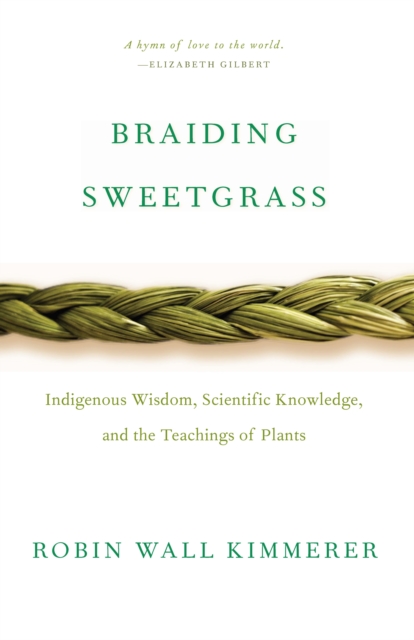
Braiding Sweetgrass
A New York Times BestsellerA Washington Post BestsellerNamed a \"Best Essay Collection of the Decade\" by Literary HubAs a botanist, Robin Wall Kimmerer has been trained to ask questions of nature with the tools of science. As a member of the Citizen Potawatomi Nation, she embraces the notion that plants and animals are our oldest teachers. In Braiding Sweetgrass, Kimmerer brings these two lenses of knowledge together to take us on \"a journey that is every bit as mythic as it is scientific, as sacred as it is historical, as clever as it is wise\" (Elizabeth Gilbert).Drawing on her life as an indigenous scientist, and as a woman, Kimmerer shows how other living beings-asters and goldenrod, strawberries and squash, salamanders, algae, and sweetgrass-offer us gifts and lessons, even if we've forgotten how to hear their voices. In reflections that range from the creation of Turtle Island to the forces that threaten its flourishing today, she circles toward a central argument: that the awakening of ecological consciousness requires the acknowledgment and celebration of our reciprocal relationship with the rest of the living world. For only when we can hear the languages of other beings will we be capable of understanding the generosity of the earth, and learn to give our own gifts in return.
eBook