
Catalogue Search | MBRL


Are you sure you want to remove the book from the shelf?

{{itemTitle}}
1,155
result(s) for
"Occultism"
Sort by:


La Guerra Contra el Ocultismo, la Brujería y la Falsa Religión
Este libro es un trabajo sobre lo que yo llamo la trinidad del mal-el ocultismo, la brujería y la falsa religión.Estas son las agencias a través de las cuales Satanás lleva a cabo sus planes malvados contra el avance del reino de Dios y contra la humanidad.
eBook


Investigating the Supernatural
An enlightening and entertaining narrative that includes colorful people like \"Allan Kardec\"--a pseudonymous former mathematics teacher from Lyon who wrote successful works on the science of the séance and what happened after death--Investigating the Supernatural reveals the rich and vibrant diversity of unorthodox beliefs and practices that existed at the borders of the French scientific culture in the late nineteenth and early twentieth centuries.
eBook


Of flying saucers and social scientists : a re-reading of When prophecy fails and of cognitive dissonance
Do prophecies in fact fail? A small group led by spirit mediums, infiltrated by social scientists, and reported on at intervals by the press: Together, these different parties create a sequence of mutual misunderstandings that leads both to a series of missed appointments with flying saucers from distant planets and to success in averting a global catastrophe. This volume proposes a re-reading of Leon Festinger's classic work on cognitive dissonance, offering a different account of the motivations and meanings of a group expecting the arrival of spacemen from another planet and anticipating the End of the World, and incorporating the social scientists who studied them into the picture. The author explores the relations between anthropology and psychology and between social scientific and natural scientific accounts of human behaviour, contributing to ideas about the role of science in contemporary society and to the sociology of secrecy.--Publisher's description.
Book
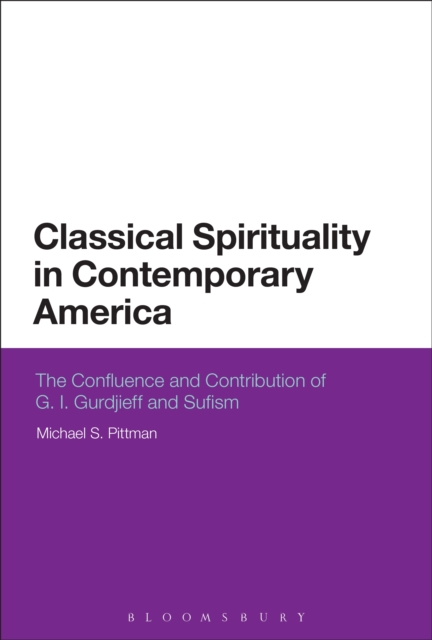
Classical Spirituality in Contemporary America
G.I. Gurdjieff (d. 1949) remains an important, if controversial, figure in early 20th-century Western Esoteric thought. Born in the culturally diverse region of the Caucasus, Gurdjieff traveled in Asia, Africa, and elsewhere in search of practical spiritual knowledge. Though oftentimes allusive, references to Sufi teachings and characters take a prominent position in Gurdjieff's work and writings. Since his death, a discourse on Gurdjieff and Sufism has developed through the contributions as well as critiques of his students and interlocutors. J.G. Bennett began an experimental 'Fourth Way' school in England in the 1970s which included the introduction of Sufi practices and teachings. In America this discourse has further expanded through the collaboration and engagement of contemporary Sufi teachers. This work does not simply demonstrate the influence of Gurdjieff and his ideas, but approaches the specific discourse on and about Gurdjieff and Sufism in the context of contemporary religious and spiritual teachings, particularly in the United States, and highlights some of the adaptive, boundary-crossing, and hybrid features that have led to the continuing influence of Sufism.
eBook