
Catalogue Search | MBRL


Are you sure you want to remove the book from the shelf?

{{itemTitle}}
412
result(s) for
"Occupational aptitude tests."
Sort by:

Ultimate aptitude tests : over 1000 practice questions for abstract visual, numerical, verbal, physical, spatial and systems tests
\"Do you need to prepare for an aptitude test for an interview or selection process? Do you want to practise and improve your scores? Ultimate Aptitude Tests, now in its fourth edition and part of the best-selling Ultimate series, is the largest and most comprehensive book of its kind, boasting over 1000 varied practice aptitude questions with accompanying answers and explanations. In such a competitive job market, it's the perfect book to ensure you're entirely prepared to get those high scores and impress potential employers.\"--Publisher description.
Book
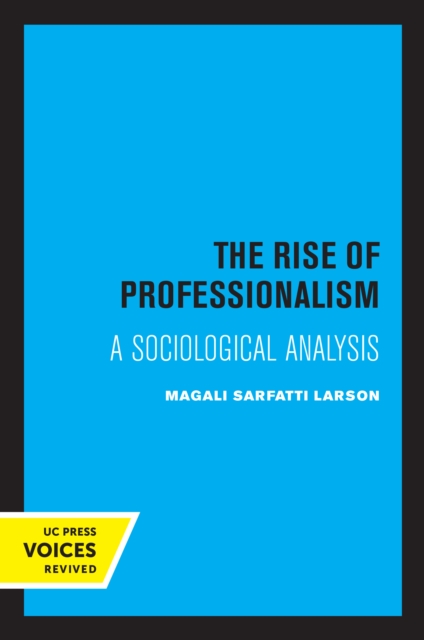
The Rise of Professionalism
The Rise of Professionalism offers a penetrating reconstruction of how \"the professions\" emerged as distinctive power formations in modern capitalist societies. Magali Sarfatti Larson dismantles functionalist and ideal-typical accounts that naturalize professional prestige by invoking disinterested service and esoteric knowledge. Drawing on Freidson's practice-centered sociology and Gramsci's theory of intellectuals, Larson reframes professionalization as a historical project: the collective construction of market shelter and social closure that translates scarce expertise into monopoly rents, jurisdictional control, and middle-class status. Through a comparative analysis centered on England and the United States--the \"purer\" laboratories of laissez-faire--she traces how associations, credentialing systems, and claims to autonomy were negotiated with state and elite patrons, how educational institutions became engines of stratification, and why self-regulation insulates professions while binding them to political authority. By distinguishing market control from collective mobility--and showing how they converge in the organization of knowledge and the regulation of entry--Larson provides a general model that travels across law and medicine to aspiring occupations while excluding nonmarket corps (military, clergy). Equally important is the book's long view of structural change. Larson shows how the liberal-capitalist figure of the free practitioner gives way to the salaried specialist in corporate and bureaucratic settings, even as the professional ideal persists--and hardens--into an ideology that legitimates inequality and occupational closure. Case materials, historical synthesis, and theoretical argument cohere into a powerful explanation of why professionals resist union identities, how client status reciprocally stratifies practitioners, and
what happens to professional authority under \"revolutionary\" social change. Essential for scholars of stratification, labor and occupations, sociology of knowledge, STS, policy and higher education, and historians of medicine, law, and engineering, The Rise of Professionalism remains the canonical sociological analysis of how expertise becomes property--and why that settlement continues to organize the contemporary social order. This title is part of UC Press's Voices Revived program, which commemorates University of California Press's mission to seek out and cultivate the brightest minds and give them voice, reach, and impact. Drawing on a backlist dating to 1893, Voices Revived makes high-quality, peer-reviewed scholarship accessible once again using print-on-demand technology. This title was originally published in 1977. Many titles in the Voices Revived program are also newly available as ebooks, offered at a discounted price to support wider access to scholarly work.
eBook


Participation in Occupation and Diabetes Self-Management in Emerging Adulthood
I present the findings of a study aimed at developing an in-depth understanding of how engagement in occupation influences young adults’ ability to effectively manage diabetes and, conversely, how their diabetes self-management strategies shape their occupational participation. The qualitative interview-based study of 8 people ages 19–25 with Type 1 diabetes revealed that study participants often experienced tension between diabetes self-management and participation in valued occupations, which required them to make calculated decisions about how to balance these competing priorities in their everyday lives. Seven themes are discussed in detail that characterized the relationship between participating in valued occupations and attending to the complex factors that dictate successful diabetes self-management. This research offers a preliminary framework for occupational therapists to assist young adults with diabetes and other chronic illnesses in reconciling these competing demands.
Journal Article


GENDER-NORMED PHYSICAL-ABILITY TESTS UNDER TITLE VII
Employers seeking to test job applicants for strength or speed while adhering to the mandates of Title VII often use gender-normed physicalability tests. Gender-normed tests set different raw cutoffs for male and female applicants such that each class would be expected to have roughly equal pass rates. This practice has helped employers—especially law enforcement agencies—retain physical hiring standards while mitigating their disparate impact on women.
In Bauer v. Lynch, the Fourth Circuit became the first court of appeals to directly consider the permissibility of gender-norming physical-ability tests under Title VII. Though the court concluded that the gender-norming did not itself constitute a form of discrimination, to do so, it applied the so-called unequal-burdens test, a much-maligned doctrine that had previously been applied in only one area of Title VII jurisprudence: appearance and grooming standards.
This Note reexamines the practice of gender-norming physicalability tests in light of the Bauer decision. It argues that contrary to the Bauer court’s decision, gender-norming physical-ability tests is a form of discrimination under Title VII that must be justified by a bona fide occupational qualification and that neither the unequal burdens doctrine nor any other Title VII carveout can excuse employers from carrying that burden. It then provides a normative defense of that doctrinal conclusion. While unitary hiring standards that impose a disparate impact on women perpetuate the gender hierarchy by exclusion, job-unrelated, gender-normed physical-ability tests perpetuate the gender hierarchy by arbitrarily privileging masculinity while evading judicial review. Thus, applying a demanding business justification for physicalability tests—the bona fide occupational qualification for gendernormed tests and the job-relatedness–business-necessity standard for tests with a disparate impact—best serves Title VII’s antisubordination principle.
Journal Article

The unofficial Divergent aptitude test : discover your true faction!
Ever wonder what faction you'd be placed in if you were a part of the bestselling Divergent series? Filled with hundreds of personality questions, this book guides you through different scenarios to help you demonstrate your virtues, uncover your strengths, and discover your true faction.
BOOK

Artificial Intelligence, Automation and the Future of Competence at Work
Artificial intelligence and the autonomous robots of the Fourth Industrial Revolution will render certain jobs and competences obsolete but will also create new roles, which in turn will require new sets of skills. They will also transform how we produce, distribute and consume, as well as how we think. Rather than a linear understanding of evolutionary processes, we will develop a more interactive and circular interpretation.
This book offers a unique and holistic perspective on the future of work in the context of industry 4.0. It discusses the globalization of capital markets, how artificial intelligence can help organizations to be more competitive and the new role of leadership in this technological landscape.
The author argues that there are four categories of competences, which will be required to maintain the relevance of human skills and expertise in the innovation economy. The new jobs that come into being will lend themselves to a particular set of skills. General competences will be necessary for roles involving the 4Cs of communication, creativity, collaboration and change. Specific or STEM competences will be called for across the science, technology, engineering and mathematics sectors. Human competences will lend themselves to positions comprising the SELC framework of social, emotional, leadership and cultural skills. Critical or REVE competences will be in demand for roles embracing reflection, ethics, values and the environment.
This book provides a human-centric view of the current technological advancements of artificial intelligence and robotics and offers a positive outlook for human actors seeking continued relevance. It will appeal to scholars and students of the innovation economy, the knowledge society and the coming Fourth Industrial Revolution.
eBook

Ultimate aptitude tests : assess and develop your potential with numerical, verbal and abstract tests
\"With over a thousand realistic practice questions and detailed answer explanations, Ultimate Aptitude Tests provides essential practice for test takers. The book offers practical skills and understanding of psychological tests, abstract visual tests, verbal and numerical reasoning aptitudes, recruitment tests, aptitude assessment, and different types of mechanical and spatial tests. This updated third edition contains a new section to cover the variety of online testing formats, a new test in the Core Intelligence section, and a free extended version of the test online\"-- Provided by publisher.
Book